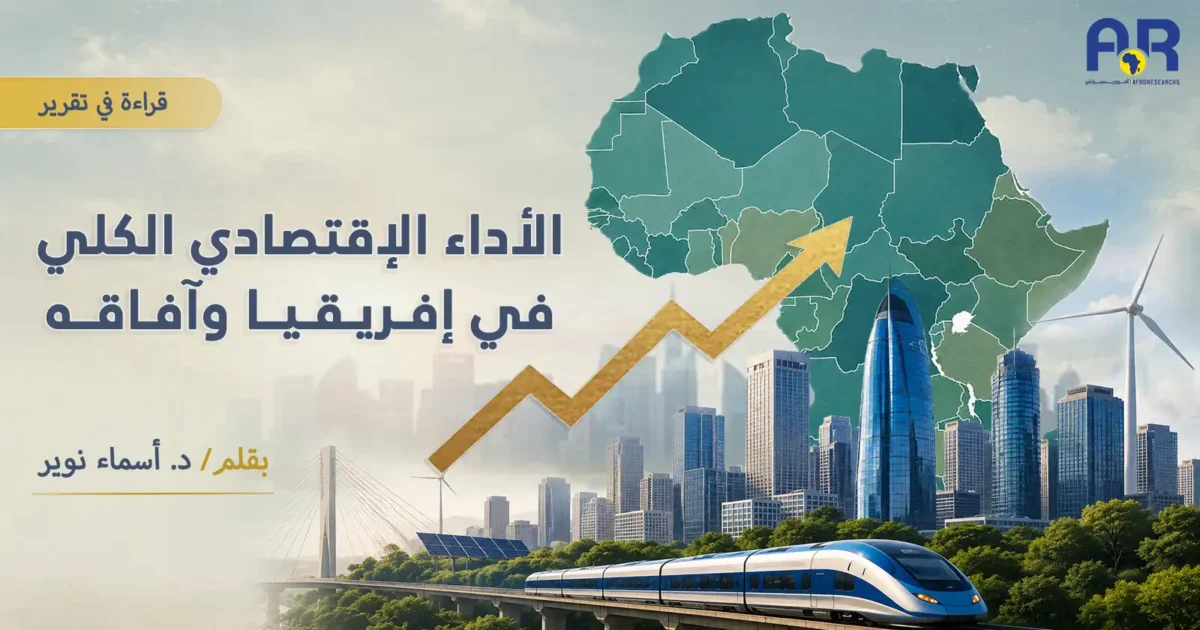
Macroeconomic Performance and Prospects in Africa – January 2026

Executive Summary
The Africa Macroeconomic Performance and Outlook (MPO) – January 2026 report provides a complex reading of an economic condition oscillating between elements of structural strength and chronic sources of vulnerability. Despite pressures resulting from the fragmentation of the global economic system, market volatility, and accumulating debt burdens, the continent continues to record notable growth rates. This momentum is driven by improved economic governance, easing inflationary pressures, and the expanding role of the services sector and infrastructure investment. However, this performance cannot be interpreted as sufficient evidence of an established, sustainable development path; it remains below the threshold required to achieve a qualitative leap in living standards or to radically reduce poverty.
The fundamental paradox lies in the fact that growth—though geographically and sectorally broad-based—remains constrained by deep structural limitations. Chief among these are low productivity, minimal value addition, an over-reliance on extractive sectors, and fragile fiscal foundations. Furthermore, the improvement in macroeconomic indicators—such as inflation and fiscal deficits—cannot be separated from the context of austerity policies that may weigh heavily on vulnerable populations, placing the question of social justice at the very heart of the economic equation.
In this context, the report implicitly posits that macroeconomic stability is not an end in itself, but a prerequisite to be surpassed toward deeper structural reforms aimed at reshaping the productive base, strengthening regional integration, and mobilizing domestic resources. Thus, the real challenge is not merely sustaining growth momentum, but redefining it—transforming it from quantitative, limited-impact growth into qualitative growth capable of producing a more inclusive and resilient form of development.
Below is an overview of the chapters and the key topics addressed within the report:
Chapter One: Macroeconomic Performance and Outlook
This chapter examines the structure of economic growth across the continent as a complex phenomenon that cannot be reduced to aggregate numbers. Instead, it must be interpreted within its structural, sectoral, and regional contexts. Although recorded growth appears positive on the surface, it remains tied to a network of determinants that reveal deep disparities across countries and sectors, as well as persistent imbalances within the nature of this growth itself. Consequently, analyzing economic performance requires going beyond tracking quantitative trends to scrutinize the quality of this growth and its capacity to drive genuine productive transformations.
Within this framework, the improvement in growth rates during 2025 emerges as the result of an interplay among several factors. These include relatively lower inflationary pressures, improved economic policy management, and favorable agricultural conditions in a number of nations. However, this uptick does not necessarily imply that the continent’s economies have overcome their structural challenges. In many instances, growth remains driven by situational or external factors—such as commodity price fluctuations or capital flows—leaving it vulnerable to volatility and instability.
The chapter dives deeper into the components of growth by breaking them down into sectoral dimensions. It becomes clear that the services sector remains the primary engine of economic activity, outperforming agriculture and industry in its contribution to Gross Domestic Product (GDP). This dynamic reflects a structural imbalance within the economy: over-reliance on services amid a weak industrial base limits the prospects for achieving sustainable development anchored in production and manufacturing. Meanwhile, despite its critical role in absorbing a large share of the labor force, the agricultural sector remains exposed to climate shocks and low productivity, constraining its actual contribution to growth.
From another angle, the chapter highlights the demand side as a key determinant of growth, with private consumption remaining the primary driver of output, contrasted with a relatively limited role for investment and exports. This pattern reveals an economy dependent on consumer spending rather than capital accumulation or productive expansion. This raises questions regarding the sustainability of such growth, particularly under pressures that may erode individual purchasing power due to inflation or declining incomes.
Regionally, a heterogeneous growth landscape emerges. East Africa leads as the fastest-growing region, propelled by increased investment and an expanding services sector. Conditions across other regions vary according to their specific economic and political dynamics:
North Africa: Growth is supported by improvements in the tourism and energy sectors.
Southern Africa: Structural constraints related to infrastructure and weak external demand continue to pose headwinds.
Central Africa: Growth remains tied to natural resources—particularly oil and minerals—leaving it exposed to global market volatility.
Despite these regional variations, the chapter uncovers a overarching pattern: the vulnerability of growth to external shocks, whether stemming from commodity price swings, geopolitical tensions, or supply chain disruptions. Internal crises, such as political conflicts and weak institutions, add another layer of complexity that makes long-term economic stability difficult to achieve. Hence, the challenge lies not only in attaining high growth rates, but in building an economy capable of absorbing and adapting to shocks.
Figure (1) Illustrates: Average Real GDP Growth in Africa
Data from the report indicates that real GDP growth in Africa averaged approximately 4.2% in 2025, up from 3.5% in 2024, with projections reaching 4.3% in 2026 and 4.5% in 2027. Furthermore, more than half of African nations recorded improved growth rates, with a significant number achieving rates above 5%. This reflects a broadening economic recovery, though it remains below the level required to drive comprehensive developmental transformation.
Regarding the sectoral distribution of growth, the analysis shows that:
The services sector contributed approximately 2.4 percentage points to total growth in 2025.
Industry contributed approximately 1.0 percentage point.
Agriculture contributed approximately 0.7 percentage points.
On the demand side, private consumption remained the largest growth driver, while the contributions of investment and exports remained relatively constrained, reflecting an imbalance in the sources generating growth.
In light of these data, the chapter concludes that Africa’s economic performance embodies a fundamental paradox: it combines positive indicators reflecting resilience and recovery with structural constraints that limit deep transformation. Consequently, the true challenge is not merely maintaining current growth rates, but redirecting this growth toward more productive sectors, enhancing the role of investment, and improving the efficiency of economic policies to translate current momentum into a more balanced and sustainable development path.
Chapter Two: Other Macroeconomic Developments and Their Implications
Chapter Two addresses a complex web of macroeconomic variables that extend beyond measuring growth to examine the underlying structures that simultaneously produce and constrain it. While Chapter One focused on describing growth trends, this chapter deconstructs the tools and policies that shape the economic environment—ranging from exchange rates, inflation, and monetary policy to fiscal conditions, external balances, and financial flows. Here, the analytical approach interrogates the true capacity of African economies to achieve stability—not as an ultimate goal, but as a prerequisite for building a firmer development trajectory.
In this context, exchange rates occupy a central position in the analysis of economic imbalances. The report reveals clear disparities among countries in their ability to manage national currencies against external pressures. While some economies absorbed shocks through more flexible policies, others experienced sharp currency depreciations that directly impacted price levels and financial stability. The exchange rate is viewed here not merely as a technical indicator, but as a mirror reflecting the fragility of productive structures, import dependency, and the limited foreign exchange reserves in several states.
Accordingly, the analysis of inflation is closely linked to exchange rate movements, with inflation standing out as one of the most pressing challenges across African economies. Although inflation rates declined noticeably compared to previous years, this decline is not without caveats: it remains driven by external factors such as the stabilization of global food and energy prices, alongside monetary policy tightening. Nevertheless, persistent high inflation in a number of countries exposes deep-seated domestic imbalances in supply chains and market structures, making inflation control a matter that transcends traditional monetary tools.
At the core of this equation, monetary policy takes center stage as a primary tool for economic stabilization. Many African countries adopted monetary tightening to curb inflationary pressures by raising interest rates and absorbing liquidity. However, while necessary to restrain inflation, these policies present a dual dilemma due to their adverse effects on investment and growth. Higher borrowing costs restrict private sector expansion and constrain the financing of productive projects, placing policymakers before a difficult tradeoff between price stability and supporting economic activity.
On the fiscal front, the chapter reveals a relative improvement in fiscal deficits, driven by government efforts to enhance revenue mobilization and rationalize expenditure. Yet, this improvement remains fragile, as it is inextricably tied to mounting pressures from rising debt-service costs and declining revenue sources—particularly in primary commodity-exporting nations. Furthermore, fiscal consolidation policies, while contributing to deficit reduction, may impose social burdens on vulnerable groups, raising questions about the balance between fiscal stability and social justice.
Regarding external balances, the current account balance serves as an indicator of how African economies interact with the global economy. The report points to a slight improvement in current account positions, driven by lower import bills and improved export revenues in select countries. However, this improvement does not necessarily reflect sustainable competitive strength so much as temporary conditions, such as exchange rate fluctuations or global demand shifts. Therefore, the real challenge lies in building export capacity and diversifying the productive base to reduce reliance on a narrow set of commodities.
An analysis of external balances remains incomplete without addressing financial flows, which represent a critical element in financing African economies. The report shows that these flows—whether foreign direct investment (FDI), official development assistance (ODA), or remittances—remain subject to volatility influenced by global economic conditions and investor confidence in African markets. Moreover, an over-reliance on these external flows introduces sustainability challenges, leaving domestic economies vulnerable to shifts in global investment sentiment.
In light of this reading, the African economy emerges as a system of interconnected variables that cannot be addressed in isolation. Exchange rate stability is tied to monetary policy effectiveness, which in turn is influenced by fiscal conditions—all of which intersect with external balances and financial flows. Hence, any effort to achieve economic stability remains contingent on the ability of policies to achieve coordination and harmony, rather than relying on piecemeal measures that treat symptoms rather than root causes.
Figure (2) Illustrates: Average Inflation Rate in Africa
The report estimates that average inflation in Africa fell to approximately 13.6% in 2025, down from 21.8% in 2024, with projections anticipating a further decline to 9.5% in 2026 and 8.6% in 2027. Additionally, nearly two-thirds of African economies are expected to maintain inflation rates below 5%, whereas elevated inflation will persist in countries facing deep fiscal and monetary imbalances.
Figure (3) Illustrates: Average Fiscal Deficit in Africa
Data indicates that Africa’s average fiscal deficit stood at approximately 5.1% of GDP in 2025, compared to 4.8% in 2024, with projections expecting a decline to 4.8% in 2026 and 4.4% in 2027. More than half of the continent’s nations are projected to record deficits below 3% of GDP, while select economies continue to face deficits exceeding 5% due to high subsidy burdens and debt-servicing costs.
Building on these indicators, African economies stand at a critical crossroads where stabilization efforts intersect with the imperatives of growth and development. The progress achieved in lowering inflation and improving fiscal positions cannot be detached from the cost of these policies, nor from their sustainability within an unstable global environment. Thus, the challenge is not merely balancing these objectives, but reformulating the economic model itself to make it more shock-absorbent, less reliant on external factors, and more anchored in domestic capabilities.
In this sense, Chapter Two offers more than a description of economic reality; it implicitly poses a critical question regarding the limits of conventional policies in addressing complex crises that transcend monetary and fiscal tools. At its core, the issue is structural: how to build a balanced economy capable of achieving stability without sacrificing growth opportunities, and engaging with the global economy without becoming captive to it.
Chapter Three: Debt Dynamics in Africa and Development Financing
Chapter Three examines public debt as one of the most complex structural issues within the African economic architecture. Public debt is treated not merely as a financing mechanism, but as a structural phenomenon where economic sovereignty, developmental capacity, and integration into the global financial system intersect. Accordingly, the chapter presents a reading that moves beyond conventional frameworks that evaluate debt solely by its volume or debt-to-GDP ratio, focusing instead on its dynamics, composition, financing terms, and long-term implications.
Public debt in Africa emerges as a historical outcome of cumulative factors: limited domestic resource mobilization, the imperative to finance infrastructure and essential public services, and external shocks that forced governments to expand borrowing. However, the core dilemma lies not only in rising debt levels, but in the evolving nature of the debt itself. The composition of debt has shifted markedly from concessional financing toward increased reliance on international capital markets and commercial borrowing. This shift has elevated financing costs and heightened exposure to interest rate volatility and exchange rate risks.
The chapter reveals that debt-service pressures represent a growing burden on public finances, consuming a substantial share of government revenues and constraining the capacity to direct resources toward productive investment or social spending. In this framework, debt ceases to be merely a financial obligation; it becomes a structural constraint that narrows fiscal space and dictates policy options, forcing governments to balance fiscal stability against development imperatives.
Furthermore, the chapter highlights the complex relationship between debt and development. Theoretically, borrowing ought to finance productive projects that enhance growth and debt-servicing capacity; however, reality uncovers a gap between theory and execution. In many instances, debt has failed to translate into tangible productivity gains or value addition due to inefficient public investment, resource misallocation, or governance deficits. Thus, the issue rests not only on the volume of debt, but on how it is deployed.
The analysis delves deeper into debt composition, emphasizing the growing reliance on domestic debt alongside external debt. While this reflects attempts by states to diversify financing sources, it simultaneously creates interdependencies between the financial and government sectors, elevating crisis transmission risks. A high share of domestic debt can crowd out private sector credit, constraining investment, while public finance distress can directly compromise banking sector stability.
The chapter also addresses debt vulnerability within the global economic environment, where African nations face multiple risks, including global interest rate volatility, shifting investor sentiment, and elevated borrowing costs. This vulnerability is compounded by a high proportion of foreign-currency-denominated debt, leaving countries exposed to exchange rate risks where local currency depreciations directly amplify the debt burden.
In this context, the chapter introduces the concept of “debt vulnerability” as a more meaningful indicator than aggregate debt volume, pointing to a state’s capacity to manage obligations under various shocks. Data reveals that numerous African countries face high vulnerability levels, leaving them susceptible to potential debt distress, particularly given limited foreign exchange reserves and weak productive bases.
Key Debt Figures
Total Public Debt Volume: Rose from approximately $1.6 trillion in 2020 to $1.9 trillion in 2024, representing an average annual growth rate of roughly 4.4%. While this increase aligns relatively with GDP growth, it underscores a continued reliance on borrowing as a primary financing source amid weak domestic resource mobilization.
Debt-to-GDP Ratios: Averaged approximately 63.9% during 2023–2024, with projections anticipating a decline to 62.0% in 2025 and 61.4% in 2026, driven by improved economic growth and fiscal consolidation efforts.
Domestic Debt Share: The share of domestic debt relative to total public debt grew from 29% in 2010 to 38% in 2023, signaling a structural shift in financing frameworks.
In light of these data, the chapter frames development financing as the converse side of the debt issue: African nations face a real dilemma stemming from massive investment needs required for development juxtaposed against limited resources and high borrowing costs. Consequently, relying on debt alone cannot offer a sustainable solution and risks deepening existing imbalances.
The chapter underscores the necessity of rethinking financing models by:
Strengthening domestic resource mobilization.
Enhancing expenditure efficiency.
Developing domestic capital markets.
Expanding public-private partnerships (PPPs) and multilateral engagements.
It also highlights the importance of reforming debt governance frameworks to enhance transparency, improve monitoring systems, and ensure that loans are channeled toward projects with clear economic and social returns.
In a broader systemic context, the chapter connects the debt issue to the global financial architecture, noting that African nations operate within an unequal environment marked by stricter borrowing conditions and higher capital costs compared to developed economies. Addressing the debt crisis cannot be confined to national policy alone; it necessitates international reforms, including debt restructuring mechanisms, improved financing terms, and an enhanced role for multilateral institutions.
Ultimately, Chapter Three posits that debt in Africa should not be viewed merely as a burden to be reduced, but as a mechanism to be redirected within a more efficient and equitable developmental framework. The real challenge is transforming debt from a tool of consumption into an instrument of production—from a policy constraint into a leverage point for development. Without this transformation, debt will remain a persistent pressure point, reproducing vulnerability rather than overcoming it.
Chapter Four: Policy Recommendations
Chapter Four adopts an actionable, policy-oriented approach, transitioning from diagnosis to guidance and the formulation of alternatives. Rather than presenting off-the-shelf technical fixes, these recommendations attempt to realign policy priorities within an economic context defined by intersecting crises. The core value of this chapter lies in its governing logic: transitioning from crisis management to establishing conditions for sustainability, and moving from short-term responses to structural foundations.
Macroeconomic stability policies serve as the starting point, framed not as self-sufficient ends, but as tools to stabilize the broader operating environment. The report emphasizes the need to maintain anti-inflation efforts, achieve fiscal balance, and manage exchange rates efficiently, while explicitly linking these goals to avoiding adverse social impacts. Mechanical fiscal austerity risks deepening social fragility, threatening the very stability it seeks to secure. Hence, the report advocates for “smart fiscal consolidation”—a framework combining discipline with flexibility that redirects spending toward sectors that simultaneously drive growth and equity.
Connected to this is the report’s emphasis on fiscal reform, achieved not merely through deficit reduction, but by improving spending quality and resource allocation efficiency. The challenge often lies in expenditure structures, where recurrent spending consumes the largest share at the expense of capital investments in infrastructure and social services. Restructuring public budgets is thus a prerequisite for unlocking sustainable developmental dynamics. The report further stresses expanding the tax base, improving tax administration, and curbing revenue leakages to enhance domestic resource mobilization over external financing dependencies.
Additionally, the chapter places special emphasis on public debt management as a central challenge facing African economies. Recommendations extend beyond lowering debt levels to improving debt governance, enhancing transparency, and aligning borrowing with strategic development priorities. When necessary, debt restructuring should be pursued within a clear, communicative framework that preserves market confidence and minimizes financial disruption. The report also calls for developing innovative financing instruments and regional financial stability mechanisms to reduce reliance on global financial systems that may fail to accommodate African economic realities.
However, the primary imperative emphasized in this chapter is driving structural reforms to reshape the productive base. “Structural transformation” serves as the overarching framework for these reforms, calling for:
Economic diversification and expanding productive sectors.
Developing manufacturing capabilities and advancing up value chains.
Investing in core infrastructure—particularly energy, transportation, and digital connectivity—as a prerequisite for catalyst growth.
The report moves beyond traditional views on investment to emphasize improving the business climate, streamlining regulatory procedures, and enhancing transparency to enable private sector participation. It highlights the need for public-private partnerships and blended finance models that pool public and private resources to expand investment scale without overburdening public balance sheets. Furthermore, it stresses attracting foreign direct investment (FDI) structured to target productive, value-adding sectors rather than remaining confined to extractive activities.
Domestic resource mobilization stands as a top priority, based on the premise that external financing cannot serve as a permanent foundation for development. The report calls for modernizing tax systems, leveraging digital technologies for collection, and reducing tax evasion. It also advocates for advancing financial inclusion to integrate broader segments of the population into the formal financial system, unlocking domestic savings for productive investment.
On the regional dimension, the report highlights economic integration across African nations as a primary engine for growth. Boosting intra-African trade, harmonizing economic policies, and developing cross-border infrastructure can expand market scale, reduce external dependencies, and enhance the continent’s collective bargaining power within the global economy. Continental initiatives, such as removing trade barriers and standardizing regulations, play a key role in achieving this objective.
At the heart of this vision, the chapter places increasing emphasis on human capital as the ultimate determinant of economic transformation. Recommendations extend to investing in education, skills development, and innovation to raise labor productivity and enhance adaptability to technological shifts. The report also stresses transitioning toward a green economy by investing in renewable energy and sustainable infrastructure, balancing economic growth with environmental preservation.
A careful reading of this chapter uncovers an implicit tension between reform ambitions and operational constraints. While theoretically coherent, recommendations face institutional capacity limits, resource constraints, and a complex international environment. The success of these policies depends on the capacity of states to translate them into actionable programs and foster coordination across national and regional governance levels.
In this sense, Chapter Four presents a framework for rebuilding African economies on more balanced foundations. It serves as a call to transition from a reactive economy to an assertive one—from managing crises to generating opportunities, and from fragile growth to sustained development. Achieving this shift requires political will, institutional capacity, and a critical understanding of existing challenges, making these recommendations a starting point for an ongoing reform process.
Conclusion
The analysis of the Africa Macroeconomic Performance and Outlook – January 2026 report leads to the conclusion that the continent stands at a delicate equilibrium between promising potential and entrenched structural constraints. Macroeconomic indicators—while carrying positive signals regarding improved growth rates and easing inflationary pressures—are insufficient on their own to confirm a firm development path. They simultaneously expose the limits of this improvement when evaluated by its capacity to drive qualitative changes in economic structures and living standards. Thus, the central question concerns not merely the occurrence of growth, but its nature, direction, and ultimate outcomes.
The analysis demonstrates that African economies remain constrained by structural imbalances, chief among them low productivity, limited economic diversification, and an over-reliance on primary sectors and external flows. Stabilization policies, while necessary, remain limited in impact unless complemented by deep reforms that reshape the productive base and enhance the economy’s ability to generate value addition. In this context, the true challenge lies not in managing macroeconomic indicators in isolation, but in orienting them to serve a broader, more inclusive, and sustainable development model.
Ultimately, the future of the African economy hinges on its ability to move beyond reactive crisis management toward strategic action. Investing in human capital, upgrading infrastructure, and deepening regional integration are central elements in building an economy capable of absorbing shocks and navigating global shifts without undue dependency. The core imperative is not merely sustaining growth for its own sake, but converting it into a driving force that transforms economic and social realities—achieving balance between efficiency and equity, and between stability and long-term transformation.