Attempted Coup in Mali: Two Generals and Over 45 Officers Arrested Amidst Political Crisis and Escalating Jihadist Attacks
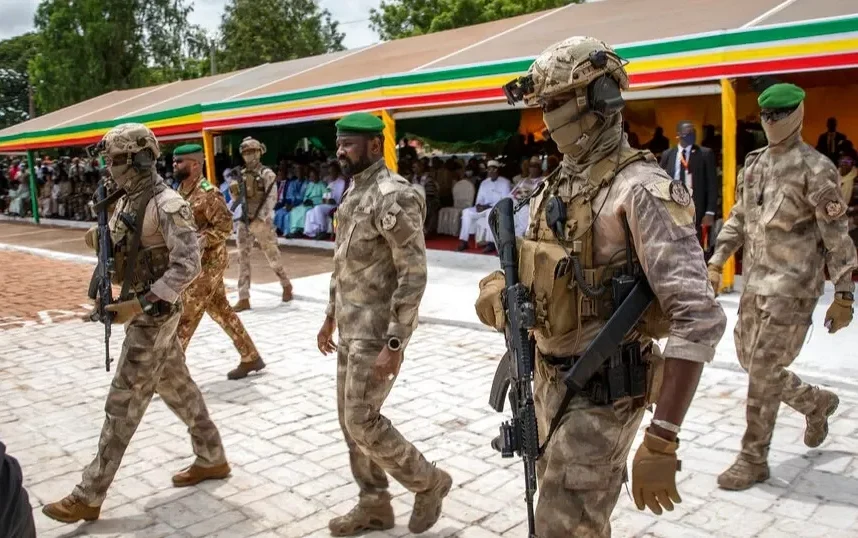
Since Sunday, August 10, 2025, Mali has witnessed a striking development marked by an attempted coup d’état. This occurred after the authorities announced the arrest of more than 45 military personnel, including Major General Abass Dembélé—the former governor of the Mopti region and one of the army’s most prominent figures—and Major General Néma Sagara, one of the rare female commanders in the Malian Air Force.
The arrests took place on the outskirts of the capital, Bamako, early Sunday morning amid an absence of official explanations. However, parliamentary sources indicated that the objective was to overthrow the ruling military junta.
These developments come within a highly complex political and security context. The military junta, led by Colonel Assimi Goïta, has ruled the country since two consecutive coups in 2020 and 2021. The presidential elections were postponed to 2027, and all political parties were dissolved last May, sparking protests and criticism regarding the shrinking political space and restrictions on pluralism.
These decisions, alongside the prolonged transition period, have deepened internal divisions and heightened the overall fragility of the landscape. On the security front, this attempted coup in Mali coincides with an escalation in attacks by jihadist groups, chief among them JNIM (Jama’at Nusrat al-Islam wal-Muslimin), which launched an attack on the Boulkessi base in the central region on June 1, 2025, resulting in the deaths of over 30 soldiers.
Data from the Armed Conflict Location & Event Data Project (ACLED) indicates that the first half of 2024 witnessed 7,620 fatalities in the Sahel region due to armed violence, reflecting the widening scope of threats and their intersection with political dynamics.
Accordingly, this article provides a concise and focused reading of the event within its broader context across three main pillars: the political context and background in Mali; the dynamics of the military establishment and internal divisions; and the security equation along with its implications for state stability and the near future.
First: Background and Context
Following the attempted coup in Mali on August 11, 2025, the country reverts to a trajectory defined by sharp shifts since 2020. Military officers ousted President Ibrahim Boubacar Keïta in August 2020, before Colonel Assimi Goïta removed the transitional leadership in May 2021 to assume the presidency. These sequential coups produced an open-ended transition and a realignment of power in Bamako.
Throughout 2023–2025, signs of consolidating military rule accumulated: the postponement of elections originally scheduled earlier, followed by the recommendations of the “National Dialogue” in April 2025 to appoint Goïta president for a five-year term—a recommendation subsequently translated into a legislative track granting him a renewable mandate. Consequently, the country shifted from the promise of a brief transition to an extended political horizon stretching to 2027 and beyond.
This coincided with a closing of the political space: on May 7, 2025, authorities suspended the activities of political parties “until further notice,” followed by the complete dissolution of all parties on May 13. This prompted rare protests in Bamako and brought the question of legitimacy back to the forefront. This closure of the public sphere formed the immediate backdrop to current events.
Externally, the domestic path was accompanied by a realignment of regional and international alliances, while a volatile security environment persisted due to jihadist group activities in the north and center. This interplay between an open-ended political transition and mounting security fragility constitutes the broader context in which the recent attempted coup in Mali emerged.
Second: Military Dynamics and Internal Rifts
The core of the current event lies in the detention of over 45 military personnel, including Major General Abass Dembélé (former governor of Mopti) and Major General Néma Sagara of the Air Force, under allegations of attempting to “destabilize institutions” and overthrow the military junta. The sensitivity of these two names within the armed forces—particularly Dembélé’s popularity in certain circles—signals quiet tensions within the establishment.
The timing of the arrests—dawn on Sunday on the outskirts of Bamako—and the lack of detailed official information suggest that the leadership sought to rapidly contain any potential blocs. In the literature on coups within fragile militaries, preemptive detentions serve as a tool to deter the “contagion of adventure” within units, especially when coinciding with discontent over a prolonged transition. Within this framework, the coup attempt stands as a test of the command structure’s cohesion.
The impact of this development on the trajectory of governance depends on whether the arrests eliminate the instigators or expose a wider rift. If the circle of suspicion expands to include senior ranks, the leadership may be forced to realign loyalties within the security apparatus, which could affect the state’s capacity to manage other pressing files concurrently.
Third: The Security Equation and Legitimacy
Operations by JNIM (Al-Qaeda’s branch in the Sahel) are escalating, striking military positions and units with increasing frequency. On June 1, 2025, a deadly attack was recorded on the Boulkessi base, followed by a series of targeted strikes in the east, reinforcing the image of an adversary expanding geographically and pressing tactically. Against this backdrop, an attempted coup in Mali undermines the perception of central control and drains operational focus.
Independent reports show that JNIM raised the human toll of regional violence in recent months, recording hundreds of deaths in May alone across Mali, Burkina Faso, and Niger. Detailed analyses monitor the group’s expansion and its exploitation of governance vacuums. This trend places severe pressure on the legitimacy of an authority that anchors its survival on promises of security.
On the political front, restrictions on the public sphere—from suspending activities to dissolving parties—undermine peaceful channels of expression and increase the likelihood of unconstitutional paths, raising susceptibility to recurring coup attempts in Mali. The concurrence of political repression with escalating jihadist attacks creates a cycle that exhausts legitimacy and dissipates deterrence capabilities.
Conclusion
In light of these developments, the attempted coup in Mali serves as an additional indicator of the country’s fragile political and security architecture. Factors of political closure and military divisions converge with escalating jihadist threats to create a complex mix of risks. If these dynamics continue to interact without a balanced resolution, the landscape may remain vulnerable to recurring disruptions that jeopardize medium-term stability.
Looking ahead, three potential scenarios can be envisioned:
Control Consolidation: The current leadership successfully tightens its grip by reinforcing loyalties within the army and containing waves of discontent, allowing it to continue managing the transition until 2027, albeit under persistent security pressures.
Escalating Division: Internal rifts widen or renewed coup attempts occur if the authorities fail to address the root causes of friction within the military or respond to political demands.
Strategic Realignment: Exacerbating security challenges—particularly from jihadist groups—force a reprioritization of governance, potentially driving a calculated political opening to secure broader internal and external support.
In all cases, the trajectory of the Malian landscape remains contingent on the state’s ability to formulate an equation that maintains a minimum baseline of institutional cohesion, responds to societal aspirations, and simultaneously confronts security threats that transcend its national borders.