Tribe and National Reconciliation in Africa From Social Legitimacy to Peaceful Governance
How can we establish the tribe's role in peace without making it a basis for governance or a substitute for the state of citizenship?

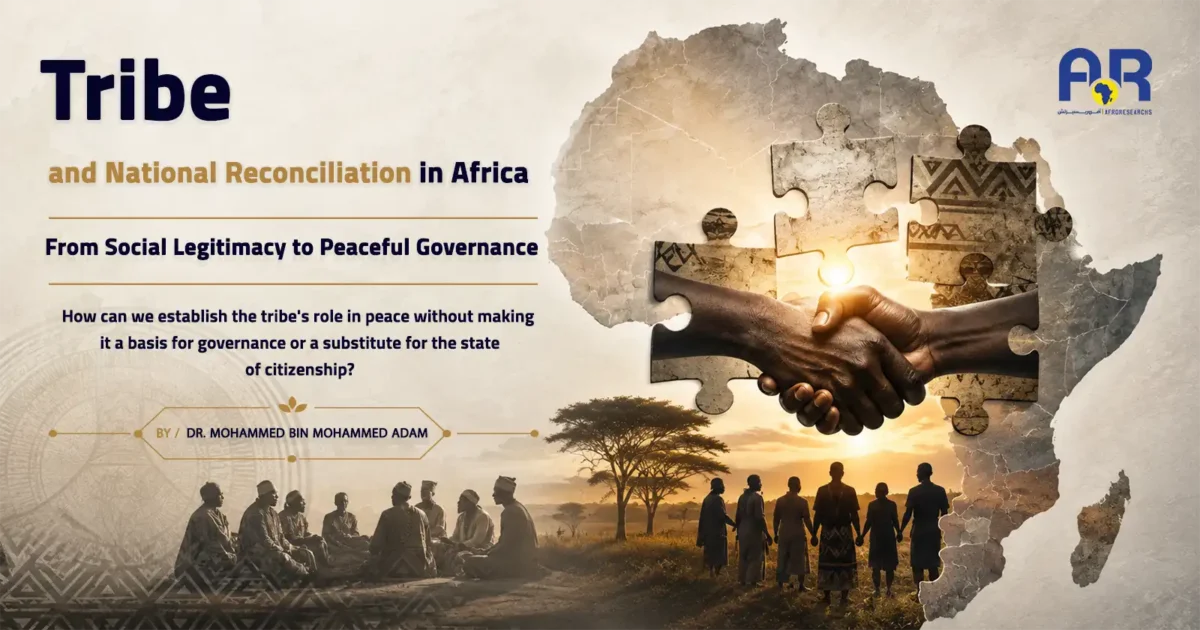
The state is not built against society, and society is not protected by establishing a state within the state; the tribe is a bridge to reconciliation when disciplined by the constitution, and a danger to it when it turns into a weapon or a political quota.
The tribe in Africa is not a static remnant of the past, nor is it a single bloc that moves at the will of one sheikh or leader. In its various forms, it is a network of kinship, memory, mutual solidarity, customary authority, and local interests; it may also be a language elites use to mobilize supporters, distribute benefits, or justify taking up arms. And from here the ambiguity begins: when a conflict is said to be “tribal,” behind it may lie competition over land, the state, trade, or security, and the parties then clothe it in the garb of lineage to give it a greater capacity for mobilization and endurance.
This paper proceeds from a clear premise: the problem is not the existence of the tribe as a social affiliation, but its transformation into a closed political identity, a military unit, or a mandatory pathway to reach the state. On the other hand, ignoring it does not produce modern citizenship; rather, it leaves a vacuum that militias and political brokers exploit, because an absent state cannot be compensated for by a legal discourse that people do not see in their daily lives.
The right question, then, is not: do we keep the tribe or abolish it? Rather: what legitimate function can it perform in reconciliation, and what constitutional limits prevent it from turning into a parallel authority? The answer this paper proposes is the institutionalization of its role in mediation, early warning, reparation, and reintegration, while subjecting this role to law, human rights, balanced representation, and public accountability.
The Central Thesis
States emerging from war need to combine two types of legitimacy: legal legitimacy issuing from the constitution and elected institutions, and social legitimacy stemming from local trust and the capacity to influence the community. Neither is sufficient alone; but combining them must occur under the rule of law, such that the tribe is a partner in building peace, not an independent source of sovereignty, weapons, or political rights.
In condensed terms: what is required is to constitutionalize the tribe’s social function, not to constitutionalize tribal partisanship — that is, to recognize what it can contribute in reform and mediation, without fixing people into proportional quotas or turning the tribal sheikh into a mandatory political representative.
I. Defining Concepts before Building Policies
Tribe and political tribalism
The tribe is a social bond that may be based on real or imagined lineage, but it is also formed through intermarriage, neighborliness, interest, and shared history. Political tribalism, meanwhile, is the deployment of this bond in the struggle over power, wealth, and security. The difference between the two is the difference between knowing one’s roots and making one’s roots a criterion for one’s own rights and those of others. The first is a space for identity and solidarity; the second is a mechanism of exclusion and quota-sharing once left unregulated.
Social identity and political identity
Mahmood Mamdani — particularly in Citizen and Subject and Define and Rule — argues that colonialism did not merely engage with existing social differences but re-fixed them into legal and administrative categories, tying land and authority to what he called “native” identities. He described the resulting system as “decentralized despotism”: governing the countryside through customary authorities that held coercive power without full citizenship. The value of this idea today is that it warns against reproducing indirect rule in a new guise; if a constitution or a quota system turns the tribe into a fixed unit of representation, flexible identity becomes a political cage, and the citizen is represented by lineage rather than by choice.
Social legitimacy and legal legitimacy
A sheikh or customary council may hold people’s trust and the ability to calm a dispute without holding legislative or judicial authorization. A court may hold legal authority, but access to it can be slow, costly, or effectively impossible on the periphery. This gap is what Christian Lund, in his study of “twilight institutions,” described as the space where the boundaries between the formal and informal blur, and authority is built in practice through mutual recognition between society and institution. The conclusion is not to legitimize this ambiguity, but to turn actual authority into a defined and monitored public function.
Negative peace and positive peace
Johan Galtung distinguished between a peace that merely stops direct violence and a deeper peace that addresses the structures that reproduce it. Tribal reconciliation can achieve negative peace by halting gunfire or vendetta, but positive peace requires justice, services, professional security, equal opportunity, and fair management of land and water. The success of reconciliation should therefore not be measured by the number of signed documents alone, but by its capacity to change the conditions that make a return to arms profitable or necessary.
Horizontal and vertical reconciliation
Horizontal reconciliation repairs relations between groups and communities that fought or harmed one another; vertical reconciliation rebuilds trust between the citizen and the state. The tribe can play an important role in the first, but it cannot alone accomplish the second. If neighbors reconcile while state institutions remain biased, corrupt, or absent, the social truce will remain fragile, because the contract binding everyone to institutions has not yet been repaired.
II. What Do Researchers Add to Our Understanding?
Serious literature offers no single prescription, but it opens four doors of understanding. The first is Mamdani’s history of the making of political identity: violence attributed to the “nature” of groups may in fact result from governance rules that fixed differences and distributed rights on their basis. The second is the analysis by Lund and Volker Boege of hybrid political orders, where the state does not operate alone but intersects with custom, religion, local councils, and civic networks. This intersection is neither a virtue nor a flaw in itself; its value depends on who is held accountable and who receives protection.
Kate Baldwin offers a more precise conclusion than simply asking whether traditional leaders are for or against democracy. Her comparative study found that some help provide public goods and connect rural areas to elected officials, because they possess coordination capacity and local trust. But the same function can turn into clientelist electoral mediation once the leader begins trading the group’s votes for benefits. An Afrobarometer survey covering 22 countries supports this functional distinction: 71% of respondents saw traditional leaders as having some or a great deal of influence in resolving local disputes, while 69% said they should stay out of partisan politics. The implication is that integration is possible, but conditional on transparency, the citizen’s freedom of choice, and the mediator’s electoral neutrality.
Jeffrey Herbst explains that the difficulty of extending state authority in Africa is historically linked to the vastness of geographic space and the cost of reaching the periphery, not merely to weak political will. From this angle, the tribe sometimes becomes an institution of access in places the administration cannot reach. But turning it into a permanent substitute entrenches the state’s absence rather than remedying it. What is required is that it serve as a transitional bridge toward the reach of the judiciary, services, and security — not as a guardian of closed social boundaries.
Joel Migdal completes this picture with the idea of the “state in society”: the state does not operate in a vacuum but negotiates and competes with notables, religious groups, merchants, and local networks over who sets the rules and who implements them. This explains why issuing a law from the capital is not enough; its success depends on the network of authority that translates it on the ground. Recognizing this network, however, does not mean submitting to it, but incorporating it into a reviewable institutional arrangement.
Ashutosh Varshney’s work, though drawn from non-African cases, showed that civic networks crossing group lines are more capable of protecting peace than bonds that operate within a single group alone. The first can be called “bridging social capital,” the second “bonding social capital.” Cohesion within the tribe protects its members but may also raise its capacity to mobilize against others; organized bridges between groups, by contrast, curb rumor and create shared interests in de-escalation. A council bringing together each tribe separately may organize a truce, but sustainable peace also needs markets, unions, women’s and youth associations, and resource committees that bring different people together around shared daily interests.
| Research Summary Traditional authority can complement the state when it performs a defined public function, but it competes with the state when it monopolizes representation, coercion, or taxation. The institutional question must therefore always be: what service does it provide? Under what mandate? To whom is it accountable? And what right does an individual who rejects its decision retain? |
III. Why Does the Tribe Remain an Important Actor in Reconciliation?
Precise knowledge of the conflict
In many rural and border areas, conflict is not merely a security incident; it may be tied to a closed grazing route, a well whose ownership changed, land that returnees find occupied by new beneficiaries, or a vendetta whose cycle never closed. Local leaders know the individuals, the memory, the customs, and the balances of trust. This “contextual knowledge” is a resource a short-term central mission cannot quickly produce.
Capacity for early warning and guarantee
Kinship, trade, and pastoral networks pick up early on the language of vendetta, arms movement, rumors, and mobilization. If neutral, they can also guarantee the opening of a road or market, the exchange of detainees, the protection of a funeral, and the return of prisoners. A political agreement needs someone to translate it into daily behavior; here social authority acts as a guarantor of implementation, not as an owner of national decision-making.
Reparation and reintegration
Custom carries experience in apology, compensation, restoration of standing, and the anchoring of pledges. A demobilized fighter returns to a family and community, not merely to an abstract administrative program. The tribe can therefore support disarmament, demobilization, and reintegration, and help in accepting returnees and monitoring their non-return to violence. This role, however, does not eliminate criminal responsibility, nor does it turn compensation into a price for buying victims’ silence.
Cross-border extension
In Libya, Chad, Niger, Mali, and Sudan, kinship and pastoral and trade routes cross state borders. This allows local mediators to reach parties that official channels may fail to reach. But it also creates the possibility of weapons, fighters, and illicit economies moving across borders. The network itself can thus be a channel for calming or for escalation; its direction is determined not by affiliation but by incentives, rules, and oversight.
IV. When Does the Tribe Turn from a Peace Resource into a Conflict Structure?
1. Elite capture
The tribe is not one voice: it contains women, youth, displaced persons, herders, farmers, and merchants, and political, class, and religious differences. When only the strongest gather, reconciliation may produce calm among elites while grievances persist within the groups. A study by Daron Acemoglu, Tristan Reed, and James Robinson on local leadership in Sierra Leone confirms that high popular respect for a chief, or dense social ties, does not by itself guarantee development or accountability; a limited number of families may capture land, local institutions, and civil society. The lesson is that historical legitimacy needs, like electoral legitimacy, competition, transparency, and a right of objection.
2. Militarization of identity
When an armed group carries a tribe’s name, weapons appear as a natural defense of everyone, and holding the commander accountable looks like an insult to the group. This is a deliberate conflation of organization and society. The necessary rule is: not every armed group represents a tribe, and not every tribe is responsible for its fighters. The armed organization must be broken down into leadership, financing, recruits, crimes, and interests, rather than attaching its acts to millions of people.
3. Securitization
That is, turning an entire social identity into a security matter. If Fulani, Tuareg, Arab, or other affiliation becomes grounds for suspicion, security work shifts from pursuing criminal behavior to surveilling the group. The result is not only injustice but a loss of information and trust, creating an environment that extremist groups exploit for recruitment.
4. Unregulated legal pluralism
The presence of custom alongside law can ease settlement, but it can harm women and the vulnerable if settlements are imposed against their will, or if serious crimes are handled solely through the logic of blood money. Human rights, the right to litigation, and free consent must therefore be boundaries no local reconciliation may cross.
5. Freezing of quotas
The transitional phase may need representation guarantees that prevent exclusion, but turning tribes into permanent quotas makes the state a union of lineages rather than a community of citizens. The temporary guarantee must open a path toward institutions based on individual citizenship, not become an eternal constitution for dividing power.
V. A Comparative Reading of Conflict Hotspots
Libya — Locality of Weapons Does Not Mean Tribalism of All Weapons
Wolfram Lacher’s work reveals a high degree of fragmentation and localism in the Libyan armed landscape after 2011: many formations were tied to cities, neighborhoods, and social networks, and some invoked the tribe, but this does not make the whole scene a tribal war. An armed actor may be socially rooted while simultaneously running an independent economic or security project, sometimes using the community’s name to protect its position within state institutions.
Virginie Collombier’s studies of local dialogue show that mediation by cities and notables helped reduce violence and open channels of communication, especially when national settlement stalled. But local success does not unify the military establishment, dismantle financing networks, or resolve the political divide. Local reconciliations should therefore be linked to a national track for security sector reform and transitional justice, so the truce does not turn into a new distribution of zones of influence.
The needed Libyan equation is distinguishing between “social rootedness” and “social mandate.” A faction may be a child of its environment without automatically holding the right to represent it; a sheikh may be influential without holding the right to grant legitimacy to weapons outside the law. Recognition of the local role must be accompanied by independent verification of representation, disclosure of interests, and a ban on combining mediation with command of armed force.
The Zintan–Mashashiya reconciliation offers a case worth studying: it linked the return of the displaced, the opening of roads, and the removal of armed manifestations to handing the perpetrator over to a neutral party and lifting social cover from him. The value here lies not in copying the agreement but in its principle: the group uses its solidarity to deny protection to the perpetrator, not to turn the crime into collective guilt or an open vendetta.
Chad — Reconciling Notables Is Not Enough While Bearing Arms Remains a Political Path
In Chad, traditional authorities hold practical importance in land, water, and grazing disputes, and in areas where courts and administration are distant. But Marielle Debos points to a deeper layer: armed violence was not merely a wartime exception; for some men it became a “practical profession” and a path of social mobility and negotiation between insurgency, the state, and the border. This means reconciliation between groups fails if the war economy remains capable of generating status, income, and immunity.
One must also reject the binary picture that makes the north Muslim and the south Christian, or makes every group hold a single political stance. Southern Chad, including Sara, Ngambaye, and other communities, is religiously and socially diverse; the Fulani or Fulbe spread across Chad and the Sahel are not a single command bloc. Precision here is not an academic luxury but a condition for reconciliation, because misclassification creates false representatives and burdens an entire group with the stance of some of its individuals.
Chad needs to insulate customary mediation from partisan appointment and electoral instrumentalization, and to link local reconciliation to professional management of land and grazing routes and to an accessible judiciary. It also needs programs that turn the “armed profession” into genuine civilian paths; moral commitment cannot compete with the income and power weapons provide unless the structure of incentives changes.
Field studies in the south and Dar Sila indicate that committees formed from the community itself — including herders, farmers, and religious and traditional authorities — are better at prevention than committees imposed from above, especially when they hold information on the timing of herd movements and damage assessment. Their effectiveness, however, remains conditional on state support for implementation, without the state seizing the selection of mediators or steering their outcomes.
Sudan — The Tribe on the Face of War, the Political Economy of Power at Its Core
In Sudan, tribal identity appears in mobilization, recruitment, and revenge, particularly in Darfur and areas where grazing, farming, and displacement intersect. But reducing the war to “tribes that have fought since ancient times” obscures the role of the state, arming, marginalization, resources, and patronage networks. Mamdani warned, in his analysis of Darfur, against turning shifting political categories into fixed ethnicities, because a narrative that criminalizes an entire identity reproduces the logic of war even as it claims to explain it.
Alex de Waal adds the concept of the “political marketplace,” where loyalties are bought and sold through money, positions, protection, and weapons. This concept helps explain that tribal mobilization may be a facade for political bargaining and a war economy; affiliation supplies the recruitment network, but the decision to use violence is also driven by leadership interests, financing, and impunity. Calling on tribes to show tolerance is therefore not enough as long as the structure that rewards the armed commander remains in place.
Sudanese reconciliation needs three simultaneous levels: halting revenge and returning the displaced at the local level; a national civilian track that redefines the state and citizenship; and justice that holds those responsible for crimes accountable as individuals and commanders, not as lineages. Native administrations can help with truth-telling, return, and compensation, but they hold no mandate to pardon war crimes or negotiate victims’ rights without them.
In Darfur, the experience of the Judiya offers a lesson: a native mediator succeeds when coming from outside the dispute and holding the trust of the parties, and its settlement needs a state that provides security and guarantees implementation; but state intervention in appointing mediators or rewarding loyalists corrupts neutrality. The best formula is to support implementation without confiscating mediation, and to review the agreement legally without turning it into an administrative order.
Mali, Niger, and Burkina Faso — From Conflict over Protection to the Stigmatization of Groups
Studies by Tor Benjaminsen and Boubacar Ba in central Mali show that some herders’ joining of jihadist groups is not understood through religion alone, but through a context of marginalization, resource conflict, corruption, mistreatment, and the search for protection. This does not justify the crime, but it shifts the analysis from an alleged ethnic essence to political and economic causes that can be addressed. The cycle begins with the “ethnicization of grievances” — reinterpreting disputes over land, protection, and taxation in ethnic language — and reaches the “securitization of identity,” when affiliation itself becomes grounds for security suspicion.
Research by Yvan Guichaoua and Ferdaous Bouhlel also shows that civilians’ relationship with armed groups is not a fixed loyalty; it ranges between resistance, negotiation, submission, and forced coexistence, depending on the balance of risk. Describing a village or clan as a “harboring ground” can thus reflect ignorance of survival strategies under coercion. And the more the state arms a narrow local self-defense group, the greater the risk that security turns into ethnic competition and mutual revenge.
The Fulani are a clear example of the danger of collective stigma. They are highly diverse communities spanning many countries, not reducible to pastoralism or to a single political or religious movement. When identity is equated with terrorism, security loses its local partners and extremists gain a grievance narrative. The more effective policy is individual investigation, protecting civilians without discrimination, organizing land and water, opening safe pathways for defection from armed groups, and building joint committees of herders and farmers.
In the Tillabéri region of Niger, the state, local leaderships, armed groups, and informal economic networks compete over protection, justice, and the imposition of fees. Residents may deal with an armed actor seeking survival rather than out of conviction in its project. It is therefore essential to distinguish coerced cooperation from political affiliation, and to link local agreements — such as initiatives bringing together Fulani, Zarma, Arab, and Tuareg communities — to freedom of movement, resource-sharing, and legal monitoring.
Western Sahara — Custom as a Social Resource, Not a Tool for Settling Sovereignty
Alice Wilson’s study of the Saharan camps shows that tribal relations are not fixed; they have been critiqued and reshaped, then re-emerged in new functions related to governance, dispute resolution, and managing inequality. This finding is useful in rejecting two opposing ideas: that the tribe has disappeared entirely, or that it still functions as it did before the state, displacement, and political organization.
Family and tribal bonds can open humanitarian channels, support family reunification, ease hate speech, and produce necessary knowledge about the community. But the Western Sahara conflict is political, legal, and regional, tied to self-determination, sovereignty, and an acceptable settlement. It is therefore not permissible to use notables to lend ready-made social legitimacy to a political stance, nor to reduce the population’s rights to selective tribal representation. Custom’s function here is to prepare society for peace, not to determine the territory’s final status.
This limit is confirmed by the International Court of Justice’s 1975 advisory opinion: the Court found legal ties of allegiance between the Sultan of Morocco and some tribes of the territory, and certain legal ties with the Mauritanian entity, but found no tie of territorial sovereignty that would negate the application of the principle of self-determination. The methodological lesson is that historical allegiance or kinship for some groups is a given of history, but it is not by itself a legal tool for settling contemporary political status.
VI. Six Deductive Conclusions from the Comparison
- What appears to be a tribal conflict may be a conflict over the state. When groups compete over a position, a contract, a rank, or land, lineage becomes the language of mobilization. Conflict should therefore be broken down into its resources, institutions, and leaders, rather than settling for ethnic maps.
- Local legitimacy is a resource that can be converted in two directions. Trust can turn into a guarantee of truce, or into a closed mandate for an armed commander. The difference is made by rules of transparency, accountability, and the individual’s freedom within the group.
- Local reconciliation is necessary but insufficient. It stops the bloodshed and restores daily life, but it does not by itself address the monopoly on weapons, state corruption, and national representation. It must be a layer within a broader settlement, not a substitute for it.
- Individual responsibility is the group’s best protection. When the perpetrator is punished by name and by evidence, the crime is prevented from turning into a hereditary stigma, and the group can disown the act without feeling its entire existence is under threat.
- Justice is part of prevention, not an enemy of reconciliation. Impunity teaches people that weapons are the fastest path to influence. Custom can support truth, apology, and compensation, but serious crimes require an independent judiciary.
- A nearby state reduces the need for political tribalism. When the citizen obtains security, justice, and education without a kinship intermediary, the tribe remains a home of identity and solidarity, and does not become a forced gateway to public rights.
VII. A Model of “Institutionalized Community Mediation”
This paper proposes a middle model between exclusion and monopolization: traditional authorities are neither abolished nor granted general jurisdiction. Community peace councils are established at the municipal or regional level, by law defining their mandate, term of membership, funding, and relationship to the judiciary. They include traditional leaders alongside legal professionals and representatives of women, youth, the displaced, herders, farmers, and civil actors.
- Functional, not sovereign, mandate — The council’s role is limited to early warning, mediation, facilitating return, monitoring agreements, and settling reconcilable civil disputes. It does not legislate, does not impose taxes, does not command a force, and has no veto over elected administration.
- Declared mandate and verifiable representation — It is not enough for a person to declare they represent a group. The method of their selection must be documented, objection allowed, and plurality of voices within the community ensured. Combining mediation membership with leading an armed faction or managing an election campaign is prohibited.
- Integration of custom and judiciary — Reconciliation agreements are registered with a judicial or administrative body, and their compliance with law and fundamental rights is examined. Parties retain the right to recourse to the judiciary, and a settlement may not be imposed on a victim or a case involving a serious crime dropped.
- Protection of victims and individual responsibility — Victims are heard before leaders; damages, missing persons, and property are documented; and compensation and return programs are built on reviewable data. Accusation and punishment are directed at the perpetrator, the commander, and the financier, based on evidence — not at a tribe or ethnicity.
- Representation of women and youth as a condition of legitimacy — The presence of women and youth is not treated as decoration. An effective quota is set for them, and they are allowed to propose issues and reject settlements that affect their rights. War redistributes roles within society, and post-war reconciliation must not forcibly return everyone to the old power hierarchy.
- Linking reconciliation to security sector reform — Every local agreement includes a clear clause on weapons: their containment, their handover or integration according to national standards, and a ban on taxation, checkpoints, and recruitment in the name of the group. Reconciliation that coexists with a deferred tribal army is a truce between two forces, not civil peace.
- Joint governance of resources and borders — Technical and community committees are established for grazing routes, water points, land, and the return of the displaced, with maps, registries, and compensation mechanisms. In border areas, committees are linked to their counterparts in neighboring states, because mobile conflict requires prevention across borders.
- Public follow-up with measurable indicators — A summary of each agreement is published, with dates, responsibilities, and a complaint mechanism defined. Success is measured by the decline in violence, the return of residents, the opening of markets and schools, and the resolution of property issues — not by the number of conferences or handshake photos.
| Governing Constitutional Rule The tribe is consulted and participates in peace, but it neither grants citizenship nor withdraws it; it does not monopolize public land, employment, or weapons; and it does not represent the individual against their will. The source of political rights is citizenship, the source of public authority is the constitution, and the source of judgment in crime is evidence and law. |
VIII. What Should the State, Society, and Research Centers Do?
The state must move from managing tribes to managing rights. This begins with a census of local disputes and agreements, defining the legal status of traditional authorities, expanding access to the judiciary, reforming the police and local administration, and preventing armed formations from using group names. Land, grazing, and decentralization systems should also be reviewed, because ambiguity in these areas turns every dispute into a question of identity.
Tribal leaderships should redefine their standing as a social service, not a political privilege: rejecting collective recruitment and incitement, declaring conflicts of interest, making room for women and youth, handing perpetrators over to the judiciary, and shifting from defending “group prestige” to protecting the rights of their own members and of their neighbors.
Political parties must stop treating tribes as vote reservoirs. What is needed are programs that compete on education, security, and development, not deals that trade loyalty for positions. Well-designed electoral and decentralization systems can widen incentives for building cross-identity coalitions, instead of making victory hostage to mobilizing one group against another.
Research centers have a role in building a knowledge base that does not start from the ready-made image. Maps should be drawn of actual authority, not just lineages; successful and failed mediations should be documented; the real constituency represented by native councils should be measured; the economy of arms and resources should be studied; and training guides for mediators should be produced, combining custom, law, and transitional justice.
Conclusion — We Keep the Roots and Prevent Them from Becoming Borders
Africa does not need a citizen without a tribe, just as it does not need a state ruled by tribes. It needs a citizen who can take pride in their origin without deriving an extra right from it, and a state that understands society without handing it the keys to sovereignty. This is not a linguistic balancing act, but a precise institutional engineering between the legitimacy of society and the universality of law.
Two opposing approaches have failed: one that describes the tribe as backward and imagines that a central decision will make it disappear, and one that glorifies it until it becomes a natural and eternal representative of the people. The first leaves room for invisible power; the second entrenches an unelected inequality. The alternative is disciplined recognition: a clear function, diverse representation, non-negotiable rights, a single armed force belonging to the state, and a judiciary the individual can actually reach.
Thus, the value of the tribe in reconciliation is not that it is a faster alternative to the state, but that it can help the state and society restore the severed connection between them. If it steps out of the barracks, moves away from quota-sharing, and enters mediation institutions as a party subject to the law, it turns from a memory summoned for war into a shared memory that prevents its repetition. Then the tribe becomes a foundation for social belonging, not a foundation for political rule; and citizenship becomes the name that unites everyone.
Key Concepts for the Reader
Political tribalism — The deployment of tribal affiliation in the distribution of power and wealth, or in mobilization and exclusion.
Politicization of identity — Turning a flexible social difference into a fixed political category that determines rights and loyalties.
Hybrid public authority — The overlap of state institutions with custom, local leaderships, and civic actors in producing order and services.
Elite capture — A small number monopolizing representation and resources in the name of a broader group that cannot hold them accountable.
Ethnicization of grievances — Reinterpreting a political, economic, or environmental conflict as a fixed ethnic rivalry.
Securitization — Treating a group or social issue as a comprehensive security threat, rather than pursuing criminalized behavior on the basis of evidence.
Bonding and bridging social capital — The first strengthens solidarity within a group; the second builds regular bonds and interests between different groups.
Negative peace — The cessation of direct violence without addressing its structural causes.
Positive peace — Building justice, institutions, and relationships that reduce the likelihood of violence returning.
Horizontal reconciliation — Repairing relations between groups and communities.
Vertical reconciliation — Rebuilding trust and the political contract between the citizen and the state.
Institutionalized community mediation — Integrating local mediators into a legally defined framework of mandate and accountability.