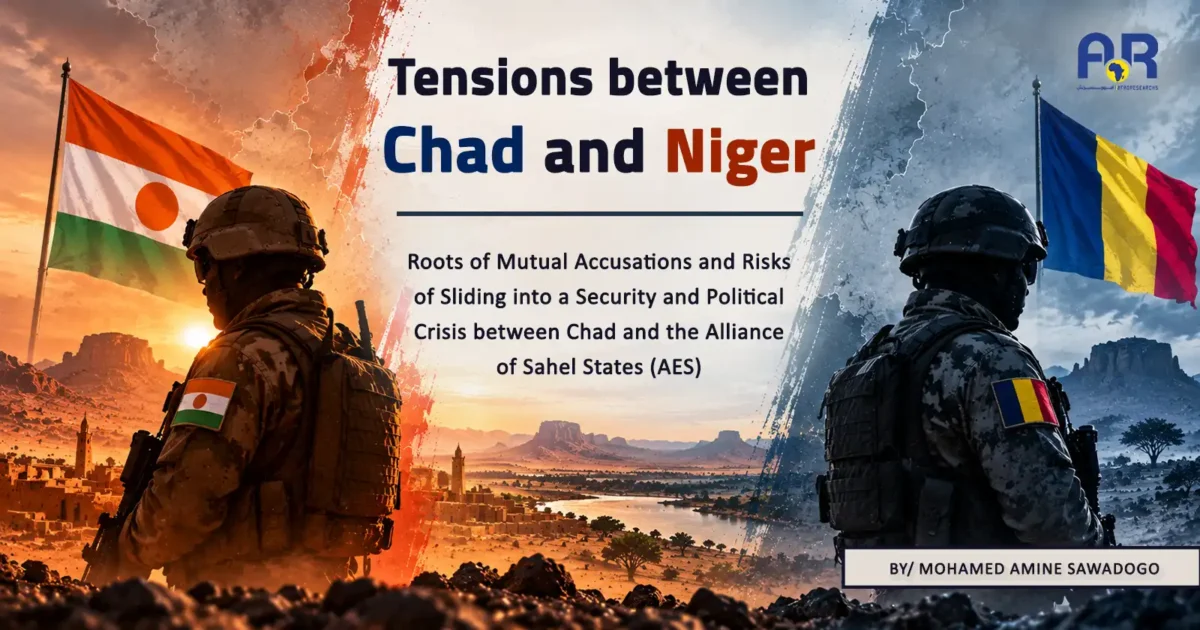
Tensions between Chad and Niger: Roots of Mutual Accusations and Risks of Sliding into a Security and Political Crisis between Chad and the Alliance of Sahel States (AES)

First: The Beginning of Escalation and Mutual Accusations between the Two Countries
- Accusations against Chad of Standing Behind the Military Mutiny in the Capital, Niamey: On August 28 and 29, 2026, the Nigerien capital, Niamey, witnessed a military mutiny targeting an airbase and sensitive sites. After containing the mutiny, Nigerien authorities issued accusations alleging external support for the military mutineers, with Chad named among the accused entities. Captain Roger Gabriel, one of the leaders of the Nigerien military mutineers, spoke about receiving communications regarding the military mutiny in Niamey during a testimony broadcast on Nigerien state television on the evening of Tuesday, September 1, 2026, and published by media outlets on September 2 and 3. He explained that the communications came following the outbreak of clashes at Air Base 101 on the night of August 28 and 29, 2026. He noted that a Chadian officer contacted him twice and informed him, according to his account, of an intervention being prepared from Chad, with the participation of Chadian authorities and French special forces, aimed at supporting the mutinous elements. Chadian parties denied these accusations, while no independent, public evidence has been presented to prove the narrative in full.
- Accusing Chad of Standing Behind the Drone Attack in Northern Niger: The Nigerien government announced, on the evening of Monday, October 26, 2026, its accusation that Chad was behind a drone attack targeting the Imi-Loulou area in the Agadez Region of northern Niger on October 24, 2026. It also accused France of providing support for the operation. The Nigerien government announced the summoning of the Chadian ambassador to protest, as well as heading to the United Nations Security Council and the Peace and Security Council of the African Union, while demanding an independent international investigation. It also reaffirmed its right to take the necessary measures to defend its territory and vital interests.
- Transfer of French Forces to Chad After Their Expulsion from Niger: The military coup that ousted Nigerien President Mohamed Bazoum in July 2023, and the subsequent expulsion of French forces from Niger, deepened the trust crisis between Paris and the new authorities in Niamey. French forces withdrew from Niger at the end of December 2023, and some of their personnel relocated to Chad in the context of the military council’s rejection of the continued French military presence in Niger—a matter that contributed to increasing the Nigerien authorities’ suspicions toward the Chadian leadership. Chad, in turn, experienced a military rupture with France in late 2024, and French forces withdrew from its territory in January 2025. However, subsequent developments showed that the rupture was not final; during 2026, Paris and N’Djamena began restoring military cooperation on a limited basis. According to a report published by Le Monde on October 14, 2026, France had indeed begun rebuilding its military cooperation with Chad following the withdrawal of around 1,000 French soldiers in January 2025. The new cooperation includes training and intelligence sharing, alongside exploring the possibility of regaining limited access to a military base in N’Djamena.
Second: What Are the Most Prominent Causes of Tension between the Two Countries?
- The Trust Crisis between the Two Countries: The disagreement is no longer confined to a border security incident. Nigerien authorities linked the events witnessed in Niamey in August to the drone attack, alongside other accusations. This reflects a high level of tension and lack of trust between the two countries. Conversely, the Chadian leadership does not seem entirely comfortable with the new authority in Niger, given the failure of the mediation undertaken by the Chadian president in the wake of the military coup. Chadian President Mahamat Idriss Déby visited Niamey on July 30 and 31, 2023, following the military coup that ousted elected President Mohamed Bazoum on July 26, 2023, in an attempt to contain the crisis and reach a peaceful settlement restoring constitutional order. Déby met with the coup leaders, led by General Abdourahamane Tiani, as well as detained President Mohamed Bazoum and former President Mahamadou Issoufou. However, the mediation did not achieve its primary goal, as the coup leaders held onto power and refused to reinstate Bazoum despite diplomatic moves and regional pressure. Thus, the Chadian initiative ended without reaching an agreement restoring constitutional legitimacy. The most prominent political significance of this mediation is that, despite its importance in opening channels of communication, it was unable to alter the calculations of the new military leadership. As a result, the crisis turned into an extended confrontation between the military council and ECOWAS on one side, while the Sahel region entered a new phase of tension and realigned alliances on the other.
- The Struggle over the Security Sphere in the Sahara: The northern regions of Niger—particularly the Agadez Region and the desert corridors connecting to Libya, Algeria, and Chad—represent a highly complex domain from a security perspective due to vast areas, difficulty in border monitoring, and the activity of smuggling networks and armed groups. The importance of these areas is heightened by their connection to the movement of people, gold, fuel, and supplies, as well as their proximity to strategic routes and zones where armed groups operate. Therefore, any tension between Niamey and N’Djamena may weaken border coordination and open the door for non-state actors to exploit security gaps.
- Divergence in Relations with External Powers: Nigerien authorities seek to reshape their security partnerships, sever military ties with France, and expand relations with Russia, Iran, and others. Conversely, Chad tends toward expanding its relations with France, with indicators emerging of a resumption of military cooperation between the two sides. Hence, the disagreement transcends the limits of bilateral relations to raise a broader question regarding the ability of the region’s countries to manage their security disputes independently and prevent competition among external partners from becoming an additional factor complicating regional relations.
Third: Did Niger Object to Chad’s Request to Join the Alliance of Sahel States (AES)?
There is no reliable information confirming that Chad submitted an official request to join the Alliance of Sahel States (AES) and that its request was subsequently rejected due to Niger’s objection. However, there are indicators of Chadian interest in joining, contrasted by the absence of an official decision on membership. In May 2025, Gassim Cherif, Minister of Communication and Spokesperson for the Chadian Government, voiced personal support for Chad joining the alliance, but clarified that his position did not represent the official stance of the government. In January 2026, reports indicated that Chad had not received an official invitation to join, amid speculation regarding reservations held by some members of the Confederation, with reference to Niger’s stance in this context. This subject may have been discussed during meetings between the Burkinabè and Chadian presidents, as Chadian President Marshal Mahamat Idriss Déby Itno visited Burkina Faso on February 21 and 22, 2025, at the invitation of Burkinabè President Ibrahim Traoré, to participate in the opening of the 29th edition of the Pan-African Film and Television Festival of Ouagadougou (FESPACO), where Chad was the guest of honor. Presidents Traoré and Déby agreed on the necessity of convening the Joint Commission for Cooperation, strengthening national sovereignty, reducing external dependency, and discussing shared security challenges and ways to enhance bilateral cooperation. The Chadian President also extended an invitation to Ibrahim Traoré to visit Chad. The visit came after Chad announced the termination of its defense agreements with France in November 2024, and before the completion of the withdrawal of French forces from its territory in January 2025. It reflected N’Djamena’s desire to expand relations with Burkina Faso, Mali, and Niger, without officially declaring a desire to join the Alliance of Sahel States. Accordingly, it can be said that Chad demonstrated political interest in the Confederation, but its membership was not realized. There is no reliable evidence of an official request being submitted and then rejected. Therefore, linking its non-adherence to a trust crisis or to its relations with France remains a hypothesis requiring additional evidence, rather than an established fact.
Fourth: The Relationship between Chad and Mali in the Security File and Military Cooperation
Historically, the relationship between Chad and Mali in the security file was characterized by military cooperation, but it also witnessed political disagreements regarding the management of the crisis in the Sahel region. Chad’s importance lies in its military expertise in desert environments and its past participation with forces in operations against armed groups inside Mali. Chadian forces were among the most prominent African troops participating in the United Nations Multidimensional Integrated Stabilization Mission in Mali (MINUSMA), deploying notably in the northern areas of Kidal, Aguelhok, and Tessalit. Their role included protecting civilians, conducting security patrols, and safeguarding mission sites and convoys in a highly hazardous environment. At the end of 2022, Mali agreed to reinforce Chadian participation with approximately 1,000 additional troops within the mission, in the context of reordering the international military presence following the withdrawal of French forces from their main bases in northern Mali. In May 2022, Mali announced its withdrawal from the G5 Sahel and its Joint Force, protesting what it considered an imbalance in the organization’s functioning and insufficient progress in combating terrorism. In response, Chadian President Mahamat Idriss Déby at the time called on Malian authorities to reconsider their decision, emphasizing the importance of continued regional cooperation. This position reveals Chad’s inclination to maintain existing security cooperation mechanisms, whereas Mali moved toward reshaping its alliances. The UN mission (MINUSMA) withdrew from Mali on December 31, 2023, after Malian authorities demanded the termination of its mandate. This brought an end to the framework through which Chadian forces participated in security operations in northern Mali. After the expulsion of French forces and the end of the UN presence in Mali, Bamako moved to strengthen its military cooperation with Russia, while Chad ended the presence of French forces on its territory in January 2025. Indicators then emerged of a resumption of French-Chadian military cooperation in October 2026. This reflects the diverging paths of the two countries in managing their foreign relations, despite the existence of shared security interests. Chad was an important military partner for Mali within the framework of international operations against armed groups; however, Mali’s withdrawal from the G5 Sahel and the subsequent termination of the UN mission altered the nature of security cooperation between the two sides and contributed to destabilizing trust between them. This occurs amidst the ongoing strength of Chadian-French relations, which contrasts with the new orientation of Mali and the Alliance of Sahel States (AES).
Fifth: Repercussions of the Crisis between Niger and Chad on the Alliance of Sahel States (AES)
The tension between Niger and Chad, in light of recent Nigerien accusations regarding a drone attack, is not limited in impact to bilateral relations. Rather, it poses a broader challenge to the Alliance of Sahel States, which includes Burkina Faso, Mali, and Niger. On October 26, 2026, Niamey accused Chad and France of involvement in an attack that left two civilians dead in the Imi-Loulou area of northern Niger, and announced its intention to approach international bodies to demand an investigation. These accusations remain subject to independent verification. The crisis is increasingly sensitive because Chad is a neighboring country of strategic importance to the security of the Sahel region, while the Confederation countries seek to reinforce the independence of their security decision-making and coordinate efforts to confront armed groups.
Most Prominent Potential Repercussions:
- A Test of Solidarity within the Confederation: Burkina Faso and Mali will find themselves facing a political test regarding how to support Niger while simultaneously maintaining manageable relations with Chad. The Confederation has already reaffirmed its support for Niger’s institutions following the military mutiny events in August 2026, calling for the protection of the unity and cohesion of its states.
- Complicating Regional Security Cooperation: Niger and Chad share cross-border security challenges related to the desert, the Lake Chad basin, and networks of armed groups and smuggling. If trust between them declines, information sharing and field coordination could be harmed, which armed groups might exploit.
- Increasing Pressure on AES Relations with France: If Nigerien accusations regarding French participation in the attack are proven, the French file will become increasingly sensitive for the Confederation countries. Prior to independent verification, however, the possibility of French-Chadian coordination against Niger should be treated as an unproven hypothesis rather than an established fact.
- Complicating the Possibility of Chad’s Rapprochement with the Confederation: The current tension could make any Chadian rapprochement with the Alliance of Sahel States more difficult, especially if Niamey perceives its security to be threatened from Chadian territory. However, the crisis does not necessarily mean future rapprochement is impossible; it can be contained through investigation, mediation, and the provision of necessary security guarantees.
- Risk of Diverting Efforts Away from Confronting Armed Groups: The more countries are preoccupied with political and border disputes, the harder it becomes to coordinate resources and operations directed against armed groups. This represents a practical danger to the entire region, not only to the countries of the Alliance of Sahel States.
The most dangerous potential outcome of this crisis lies in the transformation of the disagreement between Niger and Chad from a bilateral trust crisis into a rift in the regional security structure. Results will depend on whether Niamey and N’Djamena move toward investigation and containment, or continue mutual escalation. For the Alliance of Sahel States, the most crucial stance lies in supporting Niger’s security while demanding independent evidence, and working to prevent any confrontation between the two neighbors. The Confederation’s cohesion is tested not only by the extent of solidarity among its members, but also by their ability to prevent regional crises from undermining the security the Confederation was established to reinforce.
Sixth: Is the Crisis Heading toward an Open Military Confrontation?
Three potential paths can be envisioned for the evolution of the crisis, without current data permitting the identification of any single path as the definitive outcome:
- First Path: Diplomatic Containment: This path relies on conducting an independent investigation, exchanging evidence, and opening direct channels of communication, thereby preventing accusations from translating into retaliatory acts.
- Second Path: Continuation of Cold Escalation: This consists of mutual protests and accusations, tightening border control, and raising security readiness without entering into a direct military confrontation.
- Third Path: On-the-Ground Escalation: If attacks recur or retaliatory military measures are taken based on accusations, the scope of conflict could widen, increasing its repercussions on regional security alongside heightened risks of harm to civilians.
The tension between Chad and Niger in October 2026 reveals the fragility of security trust in the Sahel and Sahara region, where internal crises overlap with border disputes and rivalry over external influence. The gravity of the current phase lies in the fact that accusations of interference in the military mutiny in Niamey, followed by the allegation concerning the drone attack in northern Niger, could move the dispute from the level of political suspicion to the level of security confrontation if not addressed through clear evidence and effective diplomatic channels.