Algerian–Nigerien Relations under General Tchiani Between the Imperatives of Military Cooperation and the Future of Strategic Security of the Confederation of Sahel States (AES)

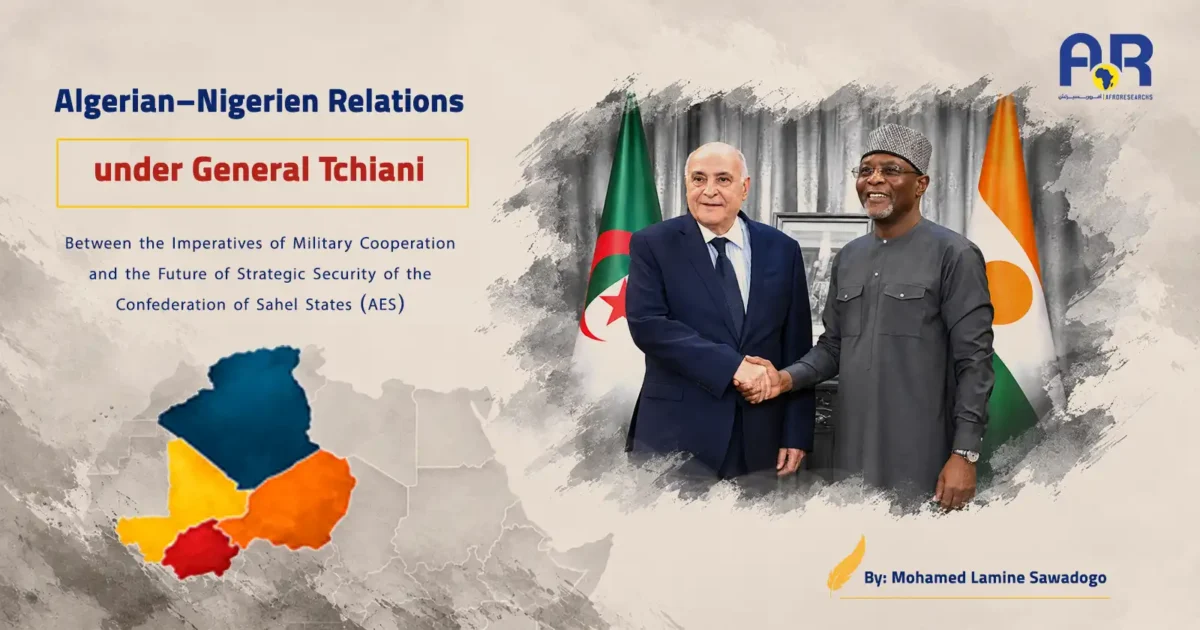
The decision to deploy units of the Algerian army to Nigerien territory has sparked extensive debate within political and security circles in the Sahel and beyond, given that its implications extend beyond the bilateral framework between Algeria and Niger and reach into the overall security and geopolitical balances that have been taking shape within the space of the Confederation of Sahel States (AES) in recent years.
At the outset, I consider it necessary to stress that this argument does not stem from a rejection of Algerian–Nigerien relations, nor from an objection to the right of the two states to develop their political, security and military partnership, nor from any attempt to diminish the value of Algerian military expertise or Algeria’s regional standing. Rather, the discussion focuses essentially on a more specific question: the soundness of deploying foreign military forces on Nigerien territory, and the strategic consequences that may follow for Niger’s security and for the future of the emerging defence system within the Confederation of Sahel States.
The article is built around six calm, focused and objective windows:
The First Window: Algerian–Nigerien Agreements under General Abdourahamane Tiani and President Abdelmadjid Tebboune:
Relations between Algeria and Niger developed markedly during 2026, as cooperation between the two countries moved from the level of traditional diplomatic relations to a broader phase of political, security and military coordination, in addition to an expansion of the economic partnership and of energy and infrastructure projects.
To understand the background to the decision to send Algerian army units to Niger, it is necessary to revisit the main milestones and agreements concluded by the two countries during this period.
- General Abdourahamane Tiani’s visit to Algeria on 15 and 16 February 2026:
The President of Niger, General Abdourahamane Tiani, paid an official visit to Algeria on 15 and 16 February 2026, at the invitation of President Abdelmadjid Tebboune, at the head of a high-level delegation. The visit culminated in a joint communiqué in which the two parties affirmed their desire to preserve bilateral relations and to strengthen cooperation in order to address regional challenges.
The announced understandings covered a range of areas, most notably:
– Security cooperation and border control: strengthening surveillance of the common border, and coordinating strategies for combating terrorism and transnational organised crime.
– Political coordination: maintaining diplomatic relations at the highest level, reactivating bilateral cooperation mechanisms, and holding regular political and sectoral consultations.
– Economic and trade cooperation: accelerating the finalisation and adoption of agreements that were under consideration, and encouraging investment and trade exchanges.
– Energy and hydrocarbons: developing the partnership in oil, gas and renewable energy.
– The Trans-Saharan Gas Pipeline project: accelerating the steps related to the project linking Nigeria to Algeria through Nigerien territory, thereby opening prospects for exporting gas to international markets.
– Infrastructure and telecommunications: accelerating completion of the Trans-Saharan Highway project and the Trans-Saharan Optical Fibre project.
– Education and training: expanding cooperation in higher education, vocational training and capacity-building.
– Health and culture: developing cooperation in health services, culture, youth and sport.
These understandings reveal the desire of the two leaderships to broaden the bilateral partnership so that it is not limited to the diplomatic dimension but also encompasses economic and strategic sectors important to the future of both countries.
- Agreements of the second session of the High Joint Commission in Niamey on 23 and 24 March 2026:
On 23 and 24 March 2026, the second session of the Algerian–Nigerien High Joint Commission was held in the capital, Niamey, co-chaired by Algerian Prime Minister Sifi Ghrieb and his Nigerien counterpart Ali Mahaman Lamine Zeine.
The meetings resulted in the signing of a series of agreements, memoranda of understanding and cooperation programmes covering multiple sectors, most notably:
– Energy, hydrocarbons and renewable energy.
– Health and medical services.
– Public works and infrastructure.
– Religious affairs, sport, higher education and scientific research.
These agreements reveal the widening scope of the partnership between the two countries and its extension into vital sectors related to the economy, development and public services.
It is important to distinguish between these sectoral agreements of an economic and developmental nature and the subsequent military understandings, since each has a different nature and its own strategic implications.
- Strengthening cooperation in hydrocarbons and strategic interests:
The energy sector occupies an important place in Algerian–Nigerien relations, given the shared interests in oil exploration and in developing gas transport infrastructure.
The Algerian company Sonatrach participates in projects related to oil exploration and production in Niger, and the Trans-Saharan Gas Pipeline project represents one of the most prominent strategic projects linking the interests of Algeria, Niger and Nigeria.
In this context, 2026 witnessed joint moves to develop cooperation in the hydrocarbons sector, including the Kafra well project, the launch of whose drilling operations was announced on 13 August 2026.
On 19 October 2026, General Abdourahamane Tiani also received the Algerian Ambassador to Niger, Saïd Ahmed, accompanied by a delegation of Algerian experts, in the presence of a number of Nigerien ministers and officials, including the Minister of Petroleum. The talks focused particularly on the hydrocarbons sector, the transfer of Algerian expertise to the Nigerien side, and the development of cooperation in oil exploration and production.
This aspect is important for understanding Algeria’s interests in Niger: Algeria does not view its relations with Niamey solely from the angle of geographical proximity; these relations are also tied to energy and infrastructure projects and to strategic corridors that can strengthen its economic and regional position.
- Signing of the military cooperation protocol on 21 October 2026:
21 October 2026 marked a new milestone in relations between the two countries, namely the signing of a protocol agreement on military cooperation at the headquarters of the General Staff of the Algerian People’s National Army.
This followed the visit to Algeria of Niger’s Minister of State and Minister of National Defence, General Salifou Mody, and his meeting with General Saïd Chanegriha, Minister Delegate to the Minister of National Defence and Chief of Staff of the People’s National Army.
President Abdelmadjid Tebboune also received General Salifou Mody on 13 October 2026, and the two sides discussed strengthening security and military cooperation between the two countries. The signing of this protocol moves bilateral relations to a more sensitive level, as it concerns the military institution and areas of defence and security cooperation.
It is important to note, however, that the full text of the protocol has not been published; detailed provisions should therefore not be attributed to it without an official document confirming them.
- Approval of the deployment of Algerian army units to Niger on 25 October 2026:
On 25 October 2026, both chambers of the Algerian Parliament approved the dispatch of units of the People’s National Army abroad, specifically to the Republic of Niger, in accordance with Algerian constitutional procedures, which require the approval of two-thirds of the members of each chamber for the deployment of military units abroad.
The decision came after the signing of the military cooperation protocol between the two countries, and within the framework of understandings relating to the protection of common interests.
The declared Algerian justifications for sending the forces can be summarised in several points:
– Protecting Algerian economic interests: in particular investments and projects linked to Sonatrach in the oil exploration and production sector.
– Securing strategic facilities: protecting economic and energy facilities and projects from armed attacks and from the security threats the region is experiencing.
– Responding to the request of the Nigerien authorities: providing support within the framework of bilateral cooperation and the protection of common interests.
– Strengthening the Algerian presence in the Sahel: protecting Algerian interests in its southern neighbourhood, and linking Niger’s stability to Algeria’s security and economic interests.
Reports indicate that the expected deployment is linked to the Madama area in northern Niger, near the Libyan border, with the aim of protecting strategic interests and facilities.
- What do these agreements mean for the security of the Confederation of Sahel States?
When these milestones are taken together, it becomes clear that Algerian–Nigerien relations under Tiani and Tebboune have expanded simultaneously along five tracks: political cooperation, security coordination, economic partnership, energy and infrastructure projects, and finally military cooperation.
Here a number of questions arise that deserve discussion:
Were the leaderships of Burkina Faso and Mali consulted on the implications of the new military agreement? Will the mission of the Algerian forces be limited to protecting economic facilities, or could it expand in the future to other security tasks? What is the nature of the guarantees regarding the duration of the military presence, the powers of the forces and their areas of deployment? Is there a coordination mechanism between the Algerian forces and the joint defence system of the Confederation of Sahel States? Did these agreements take into account the history of past disputes between Algeria and Mali, and their potential repercussions on relations among the Confederation’s member states?
Economic and trade agreements do not raise the same problem as a foreign military presence; each has a different nature and different strategic effects.
The Second Window: Divergent Orientations and Geopolitical Calculations between Algeria and Niger
Among the most important issues to be taken into account are the differing political and strategic approaches of Algeria and Niger, particularly since the transformations the Sahel has undergone after 2023.
Since the coup of July 2023, the overthrow of President Mohamed Bazoum and the coming to power of General Abdourahamane Tiani, Niger has set about reorganising its foreign relations, ending the French and American military presence on its territory, and strengthening its cooperation with new partners, foremost among them Russia and Turkey, alongside its move towards closer political and military coordination with Burkina Faso and Mali.
Algeria, for its part, despite its long history of struggle against French colonialism, still maintains diplomatic, economic and security relations with France, even though these relations experience periodic disputes and political tensions.
During 2026, Franco-Algerian relations witnessed a series of high-level official visits aimed at reopening channels of dialogue after a severe diplomatic crisis.
On 16 and 17 February 2026, Laurent Nuñez, the French Minister of the Interior, visited Algeria and met his Algerian counterpart, Saïd Sayoud; he was also received by President Abdelmadjid Tebboune. The talks focused on the resumption of security cooperation and other files.
Alice Rufo, Minister Delegate to the Minister of the Armed Forces and Veterans, also visited Algeria and the city of Sétif from 8 to 9 May 2026 to take part in the commemoration of the events of 8 May 1945, when French colonial forces suppressed Algerian demonstrations. The visit coincided with the return to Algiers of French Ambassador Stéphane Romatet after he had been recalled to Paris.
Gérald Darmanin, the French Minister of Justice, visited Algeria on 18 May 2026 and met Algerian President Abdelmadjid Tebboune and Algerian officials, in a visit aimed at reactivating judicial and security cooperation and discussing extradition cases and the fight against drug trafficking, as well as the case of French journalist Christophe Gleizes.
Economic relations also saw significant moves, as the French Ministry of Foreign Affairs confirmed the visit of Patrick Martin, President of the Movement of the Enterprises of France (MEDEF), on 24 and 25 April 2026, to reactivate economic dialogue between the two countries.
These visits reveal the continuity of political, economic and security relations between the two countries despite historical and political disputes. This differs from the orientation of Niger, which chose to end the Western military presence on its territory and to reorganise its international security relations. Hence, I believe that the divergence in geopolitical calculations between the two countries deserves careful study before decisions are taken concerning an Algerian military presence inside Niger.
This issue becomes all the more important in view of the attacks that targeted strategic facilities in the Nigerien capital, Niamey, during 2026.
On the night of 28 to 29 January 2026, an armed attack targeted Air Base 101 within the Niamey airport complex. The Nigerien authorities announced that 20 attackers had been killed and four soldiers wounded, stating that the terrorist Islamic State in the Sahel organisation was behind the attack.
On 18 June 2026, the airport and the adjacent air base were subjected to another armed attack which, according to the information announced, left 11 soldiers and two civilians dead, in addition to 22 attackers killed; the attack was attributed to Jama’at Nusrat al-Islam wal-Muslimin (JNIM), led by Iyad Ag Ghaly. There were also reports of gunfire and explosions near the airport and the air base on 29 August 2026, without sufficient independent information being available to confirm the details of the incident and the party responsible for it.
Accordingly, one can speak of two major attacks on the airport complex during 2026, in addition to a subsequent security incident in its vicinity whose circumstances have not been fully clarified.
The repeated attacks on military and strategic facilities in Niamey illustrate the scale of the security challenges facing Niger, particularly with regard to protecting sensitive facilities even within the capital.
Moreover, the coincidence of these events with the resumption of French official contacts and visits to Algeria invites reflection on the nature of regional transformations, without this implying any proven link between the French visits and the attacks that took place in Niger.
Any political observer has the right to raise questions about the security balances in the region, and we likewise have the right to call for caution regarding any decision that permits a foreign military presence, especially given the divergent regional orientations and alliances.
The Third Window: Algeria Is No Better Off than Niger in Security and Economic Terms
Niger is a country rich in natural resources, foremost among them oil, uranium and gold. Its population is approximately 28 to 29 million according to commonly cited demographic estimates, and young people make up the largest share of society.
Niger is known in Africa and the world for its important natural resources, particularly uranium and oil, and it possesses economic and human potential that can be invested in developing its defence and security capabilities.
In my view, a state with such natural wealth and human potential can, if it manages its resources well, develop its army, train its young people in specialised military academies, purchase modern defence equipment, and develop its capabilities in drones, surveillance and reconnaissance.
Some may ask: why does Niger cooperate with Russia and Turkey without objection, while we object to sending the Algerian army?
The answer is that the objection is not to military cooperation with Algeria as such, nor to benefiting from its expertise, but rather concerns the nature of the proposed military presence, its justifications and its objectives.
Russia possesses extensive military and industrial capabilities and expertise in arms, training and military support, while Turkey has developed its defence industry, particularly in drones and modern military technologies.
Algeria, too, is a significant military power on the African continent, with a large army and considerable armament capabilities; but it is not an indispensable military power in the region, and cooperation with it should not turn into permanent security dependence. Algeria itself faces economic and regional security challenges and has its own interests, which must govern its foreign policy decisions.
Consequently, I believe it would be better for Niger to benefit from Algerian expertise in training, armament and intelligence cooperation, and for its national forces to take charge of protecting the economic facilities located on its territory, rather than establishing a foreign military presence whose missions might expand in the future.
The Fourth Window: Building a Joint Military Force for the Confederation of Sahel States Can Strengthen the Protection of the Three Countries
The Confederation of Sahel States, comprising Burkina Faso, Niger and Mali, could develop a high-quality joint military force whose strength could gradually reach 60,000 personnel or more, according to the security needs and the financial and human capacities of the three states.
The combined population of the three countries is approximately 77.2 million, according to World Bank data for 2025, with a geographical area exceeding 2.7 million square kilometres.
These human, geographical and economic capacities oblige the three states to develop a joint defence system capable of protecting borders and strategic facilities and of confronting armed groups.
By this figure, I do not simply mean forming a huge army of untrained soldiers, but rather building a professional force distributed across specialised units, including:
– Rapid intervention units and units for combating armed groups.
– Air and ground reconnaissance and surveillance units.
– Drone operation and counter-drone units.
– Units for protecting oil, mining and strategic facilities.
– Border and desert area surveillance units.
– Logistics support, military intelligence and communications units.
– Training and qualification units and units for developing local defence industries.
This force could benefit from the expertise of friendly countries in training, armament and technology transfer, while military command and decision-making remain in the hands of the Confederation’s institutions. If the Confederation of Sahel States is unable to form and finance a joint force to protect its territory and interests, reliance on foreign forces, whatever their nationality, will not provide it with a sustainable strategic solution.
We still do not know why the joint defence system has not reached the required level of military integration, despite the natural resources the three countries possess, from oil to uranium and gold, and their vast human potential. The three states should also review their military spending priorities, seek joint financing mechanisms, and invest their natural resources in building their defence capabilities. The principle that should govern this approach is: “Nothing scratches your skin like your own fingernail, so take charge of all your affairs yourself.”
The Fifth Window: Political Reconciliation between Algeria and Mali Still Needs Confidence-Building
The Algerian military presence in Niger cannot be addressed in isolation from the history of Algerian–Malian relations, especially since Mali and Niger belong to the same Confederation, and any tension between Algeria and one of the Confederation’s member states could affect political and security coordination within it.
During 2025 and 2026, Algerian–Malian relations went through a severe diplomatic crisis, during which the two governments exchanged serious accusations. In January 2025, the Malian government accused Algeria of rapprochement and collusion with armed groups active in northern Mali, stating that the Algerian authorities had provided some of them with shelter and logistical support. Bamako also objected to the Algerian position calling for dialogue with the groups that had signed the 2015 Algiers Peace Agreement.
In April 2025, Mali accused Algeria of shooting down a Malian military drone near the common border, describing the incident as a deliberate hostile act intended to protect separatist terrorist leaders. Algeria, for its part, asserted that the drone had violated its airspace and carried out manoeuvres it regarded as a security threat. The escalation led to the withdrawal of ambassadors and the closure of airspace to the aircraft of both countries.
The disputes were not limited to bilateral statements but reached international forums: the speech of the Malian Prime Minister, General Abdoulaye Maïga, before the 80th session of the United Nations General Assembly in New York on 26 September 2025, followed by the Malian delegation’s right-of-reply statement on 29 September 2025, were both clear in their stance against Algeria.
The Malian accusations moved from the dispute over the downing of the military drone to accusing Algeria of interfering in Mali’s internal affairs and supporting armed and separatist groups. Algeria, in turn, rejected these accusations, affirmed its commitment to Mali’s territorial integrity and stability, and called for an end to what it described as accusations that Algeria was providing political and logistical support to armed groups active in the Sahel.
Relations between the two countries then showed signs of rapprochement and reconciliation during 2026, after a period of intense tension; this is a positive development that should be supported and preserved. However, political reconciliation does not necessarily mean that all contentious files have been definitively resolved, nor that security trust has returned to its former level.
Here I raise a number of legitimate questions:
Have all the security and political disputes between Algeria and Mali been definitively resolved? Have clear understandings been reached regarding the mutual accusations relating to armed and separatist groups? Have the files that led to the recall of ambassadors and the diplomatic escalation been addressed? Are there sufficient guarantees to prevent the return of past disputes? And did the institutions of the Confederation of Sahel States take these files into account when assessing the nature of the new military cooperation between Algeria and Niger?
I do not raise these questions with the aim of reviving disputes or obstructing reconciliation, but because political reconciliation requires building trust and addressing the causes of disagreement, not merely exchanging visits and positive statements.
Algeria is a neighbouring and important state in the region, and it is in the interest of the Sahel states that their relations with it be stable and positive. But genuine stability is not built on ignoring contentious files; it rests on addressing them clearly in a way that safeguards everyone’s interests. More importantly, Niger should not take a decision concerning its military security in isolation from its partners in the Confederation, because the effects of such a decision may extend beyond its geographical borders and reach Mali and Burkina Faso.
The Sixth Window: The Need to Define the Missions of the Algerian Forces and Guarantees for the Military Presence
It is important to recognise that the Sahel is going through a phase of reshaping alliances and regional balances, and that any foreign military presence there may have repercussions that go beyond the mission announced at its establishment.
If the purpose of sending Algerian forces is to protect oil facilities, then the mission must be precisely defined in terms of the number of personnel, their place of deployment, the duration of their presence, the nature of their powers, the authority responsible for commanding them, and the mechanisms guaranteeing that they do not interfere in Niger’s internal security and political affairs.
It should also be clarified whether the military presence will be limited to protecting Algerian facilities, or will include other tasks relating to border surveillance and combating armed groups, and the extent to which it is linked to the joint defence system of the Confederation of Sahel States.
These are not conditions directed against Algeria, but natural guarantees that should be present in any agreement allowing foreign forces to operate within a sovereign state.
I believe it would be better for Niger to take charge of protecting the economic facilities located on its territory, and to benefit from the technical support, training, armament and intelligence that Algeria can provide, without the need to deploy Algerian military units on Nigerien territory.
If there is an exceptional security necessity requiring the presence of these forces, the mission should be temporary and clearly defined, and should enjoy clear coordination with the institutions of the Confederation of Sahel States, so that it does not become a precedent opening the door to other military arrangements outside the joint defence framework.
Having reviewed these facts, I affirm that my objection to sending Algerian forces to Niger is not a hostile stance towards Algeria, nor an objection to its right to protect its economic interests; rather, it is a political and strategic position stemming from concern for the independence of the security decision-making of the states of the Confederation of Sahel States.
Algeria is a neighbouring state with legitimate interests in Niger, and it has the right to develop its economic, diplomatic and military relations with it. But the presence of its military forces on Nigerien territory remains a decision with strategic dimensions and should not be viewed as a mere technical measure to protect oil facilities.
I believe there are more appropriate alternatives, namely training and equipping Nigerien forces, strengthening intelligence cooperation, developing a border surveillance system, and building an effective joint force for the Confederation of Sahel States.
I also call for strengthening coordination among the leaderships of Burkina Faso, Mali and Niger regarding military agreements that may have repercussions for the common security of the three states, so that influential strategic decisions are not taken without consultation and a collective assessment of their consequences.
I hope that the respected Nigerien leadership will reconsider the decision to deploy Algerian forces, or at least review the modalities of its implementation, and confine itself to technical and military cooperation that does not require the presence of foreign military units on Nigerien territory.
The Sahel states do not need to replace one foreign military influence with another; what they need is to own their decisions, build their institutions, develop their armies, and invest in their youth and their natural resources.
And I say it clearly: if Burkina Faso, Mali and Niger, with the human resources, natural wealth and economic potential they possess, cannot build a joint defence force to protect their territory, then reliance on foreign forces will not provide them with a sustainable strategic solution.
Finally, as a citizen of Burkina Faso, one of the founding states of the Confederation of Sahel States (AES), I believe I have the right to express my opinion on decisions affecting the security, stability and future of the Confederation, just as any citizen of the three states has the right to discuss the strategic choices of their country.
Disagreement does not mean hostility, and political criticism does not mean enmity; rather, it is part of our responsibility towards our homelands and the future of our peoples. The security of Niger is the security of Burkina Faso and Mali, and the security of the three states cannot be separated from the independence of their military and political decision-making.