Threats to Navigation in the Bab el-Mandeb Strait and Their Implications for African Economic Security Repercussions and Response Mechanisms

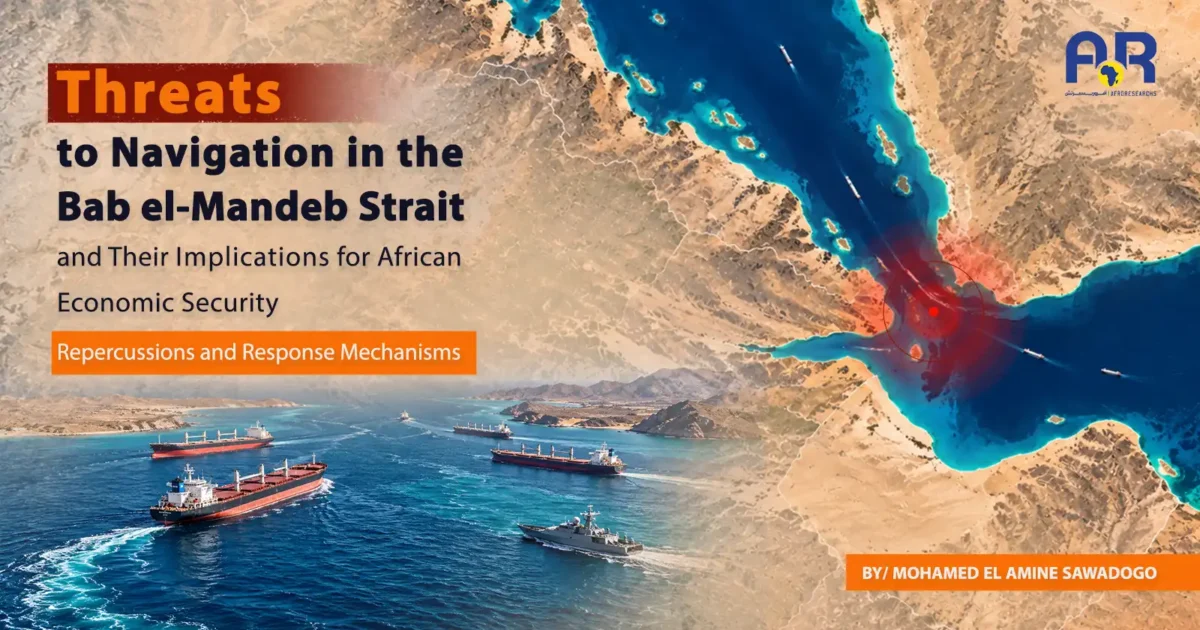
The Bab el-Mandeb Strait is no longer merely a narrow maritime passage separating the Arabian Peninsula from the Horn of Africa. It has become one of the most important strategic points at which the interests of global trade, energy and food security, and regional and international competition intersect. Its importance to Africa stems from its geographical position linking the Red Sea to the Gulf of Aden and the Indian Ocean, making it a major maritime gateway for trade moving from Asia to Europe through the Suez Canal, in addition to its pivotal role in connecting East African markets to global shipping routes.
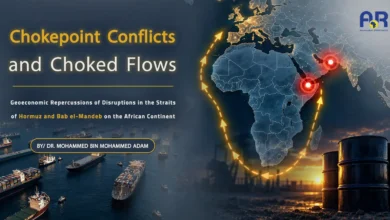
The strait has gained increasing security and economic significance since late 2023, when the Houthis in Yemen began attacking commercial vessels in the Red Sea and the Gulf of Aden, declaring that their actions were linked to the war in Gaza. These attacks, the international military operations that followed, and the precautionary measures taken by shipping companies disrupted maritime shipping and prompted several carriers to divert their vessels away from the Red Sea and the Suez Canal and around the Cape of Good Hope at the southern tip of Africa.
Africa’s geographical position, which offers the continent an opportunity to become a global hub for trade and logistics, can simultaneously become a source of economic vulnerability when its surrounding sea routes face military threats. Moreover, despite differences in their locations and degrees of integration into global trade, African countries cannot insulate their economies from disruptions along this passage, as their effects are transmitted through fuel, food and fertilizer prices, marine insurance, and import and export costs.
Discussing the repercussions of Houthi activity does not mean that the Houthis exercise complete maritime control over Bab el-Mandeb. Rather, their ability to target vessels or heighten security risks may be sufficient to cause widespread economic disruption, even without formally or continuously closing the strait.
This article seeks to analyze the geopolitical and economic importance of the Bab el-Mandeb Strait, explain the crisis’s repercussions for African economic security, and review its direct and indirect implications and its effects on ports and trade in East Africa. It also discusses the strategic implications for Africa’s economic decision-making autonomy and proposes ways to confront and address them.
I. The Geopolitical and Economic Importance of the Bab el-Mandeb Strait
The Bab el-Mandeb Strait lies between Yemen’s western coast on one side and the coasts of Djibouti and Eritrea on the other. It links the Red Sea to the Gulf of Aden and, beyond it, to the Indian Ocean. It is the southern gateway to the Red Sea, which ends in the north at the Suez Canal in Egypt.
The strait’s strategic importance derives from three main considerations:
1. Its Position in the Global Trade Network
The maritime passage extending from Bab el-Mandeb to the Suez Canal carries vessels connecting Asian factories and markets to European consumers. Important trade flows between the Middle East, Africa and Europe also depend on it. On 7 March 2024, the International Monetary Fund noted that the Suez Canal accounted for approximately 15% of global maritime trade volume, according to the estimates used at the time.
2. Its Importance for Energy Security
Navigation through the strait is not limited to containers and consumer goods; it also includes crude oil and petroleum products. According to the U.S. Energy Information Administration, oil flows through Bab el-Mandeb averaged approximately 9.3 million barrels per day in 2023, before declining to approximately 4.1 million barrels per day in 2024. This represents a decrease of around 56%, revealing the scale of the change in oil movements through this passage during the crisis.
3. Its Direct Connection to African Countries’ Interests
The strait is situated at the entrance to the Horn of Africa, near important ports and commercial centers, including the Port of Djibouti, Eritrean ports and the Port of Berbera in Somaliland. Egypt lies at the northern end of this passage, where Suez Canal revenues depend heavily on transiting vessels.
This geography makes navigational security a distinctly African concern, rather than simply a matter affecting Yemen or the Middle East. Any prolonged disruption can alter trade costs and directions and affect port revenues, countries’ capacity to meet their needs, and the continent’s position in the global economy.
II. The Crisis’s Repercussions for African Economic Security
The effects of the crisis differ according to each African country’s location and relationship with maritime routes. Djibouti, Eritrea and Somalia lie near the strait, while Egypt is directly affected through the Suez Canal. Kenya, Tanzania and other countries are also affected through trade routes, transport prices and imports.
Some ports in West African countries, including Senegal, Côte d’Ivoire, Ghana and Nigeria, may benefit from changing port-call patterns or logistics services. At the same time, however, these countries may face higher costs for importing goods from Asia or exporting products to European and Asian markets. It is therefore impossible to assume that all African countries suffer equally, or to regard increased traffic around the Cape of Good Hope as an automatic economic gain for African ports. The more a country depends on imports of food, fuel, medicines and industrial equipment, the more sensitive it becomes to rising transport costs and delayed vessel arrivals.
In April 2024, UNCTAD warned that East African countries were particularly exposed to disruptions in the grain trade because several depended on wheat imports from Europe and the Black Sea region. In countries already experiencing weak purchasing power or high inflation, rising freight costs can become an additional burden on households, businesses and public budgets.
The crisis’s effects are not confined to the cost of a shipment; they extend to the amount of foreign currency countries need to purchase imports and pay for their transport and insurance. If the fuel and food import bill rises while exports remain unchanged or decline, pressure on foreign exchange reserves increases, current account imbalances widen, and financing essential imports becomes more difficult.
The risk is more severe in economies experiencing high debt, weak currencies, chronic trade deficits or limited reserves. The same shock may therefore be manageable in a country with strong reserves but develop into a crisis affecting livelihoods and public finances in another.
III. Direct and Indirect Implications for African Economic Security
Rising transport costs are among the most rapidly transmitted effects of disruptions at Bab el-Mandeb on African markets. When vessels switch from the Suez Canal to the Cape of Good Hope route, they travel longer distances, consume more fuel and require additional days at sea. Carriers may also have to adjust sailing schedules and redeploy vessels and containers.
On 22 February 2024, UNCTAD reported that, compared with early December 2023, average spot container freight rates from Shanghai had increased by 122% overall, by 256% on routes to Europe and by 162% to the U.S. West Coast. These figures refer to specific international freight indices, rather than uniform rates applicable to all African routes.
This increase affects African importers through higher costs of delivering goods to ports, part of which is subsequently passed on to wholesalers, retailers and consumers. The situation becomes more complicated when vessel and cargo insurance costs rise, as risks may prompt some carriers to impose surcharges on shipments, refuse certain voyages or require more expensive security arrangements. Shipping companies therefore do not bear the cost of the threat alone; they share the burden with importers, exporters and consumers. Governments may also bear part of it if they are compelled to subsidize essential commodity prices.
Several African countries depend on imports of wheat, grains, vegetable oils and fertilizers. When vessels are delayed or shipping becomes more expensive, the cost of supplying these goods also rises, particularly in countries lacking adequate strategic stocks or depending on a limited number of suppliers.
In April 2024, UNCTAD noted that East African countries were particularly sensitive to disruptions in the wheat trade, given their dependence on imports from Europe and the Black Sea region.
The risks emerge at four levels:
- Higher costs of importing grains, oils and processed foods.
- Higher costs of imported fertilizers and agricultural inputs, increasing domestic production costs.
- Declining purchasing power among poor households, which spend a large share of their income on food.
- Greater financial burdens on governments if they are compelled to increase subsidies or finance food relief programs.
Disruptions to navigation at Bab el-Mandeb change shipping routes for oil and petroleum products, even when there is no actual shortfall in global production.
According to the U.S. Energy Information Administration, based on tanker-tracking data, enormous quantities of oil, estimated at millions of barrels per day, pass through the Bab el-Mandeb Strait. Average flows fell from approximately 9.3 million barrels per day in 2023 to approximately 4.1 million barrels per day in 2024, a decrease of around 56%. This decline does not, however, mean that an equivalent quantity disappeared from the global market: some shipments followed alternative routes, while trade patterns between producing and consuming regions also changed.
For Africa, the outcomes vary according to the nature of the economy:
- Fuel-importing countries: They may face higher transport and insurance costs, increasing the cost of supplying gasoline, diesel and fuel used to generate electricity.
- Oil-producing and exporting countries: The costs of delivering their exports to Asian markets may change, and some of their exports may benefit from shifts in demand, but this does not constitute a guaranteed gain.
- Countries dependent on road transport: Higher diesel prices may feed through to domestic transport and the distribution of food and goods, even in countries far from the Red Sea.
IV. Disruptions to Ports and Trade in East Africa
Ports in the Horn of Africa and the eastern part of the continent are affected to varying degrees by disruptions to navigation in the Red Sea. UNCTAD has documented the effects of this crisis on African trade flows and trade facilitation. Its preparatory materials published in 2024 also highlighted differences in African countries’ exposure to vital maritime routes. UNCTAD’s document on the effects of shipping disruptions on African trade presented notable figures and indications reflecting the scale of the potential impacts on the continent’s economies.
The economic significance of these countries is evident as follows:
- Djibouti: Its logistical role depends heavily on its strategic position at the entrance to the Red Sea and on the port, transport and storage services it provides. Its shipping traffic may be affected by declining or reorganized maritime activity, although limited opportunities to benefit from certain alternative services may emerge.
- Sudan: The effects of disruptions to maritime trade overlap with the repercussions of internal conflict and the humanitarian crisis, making it harder to distinguish the effects of rising freight costs from other factors disrupting supplies and markets.
- Kenya: Trade through its ports, foremost among them Mombasa, is affected by rising international transport costs. Shipping disruptions may also affect imports of food, energy and industrial inputs.
- Tanzania: Its maritime trade, including traffic through the Port of Dar es Salaam, is affected by changes in freight rates and import prices, although the degree of impact varies according to the origins and destinations of goods.
These cases demonstrate that the threat is not confined to coastal states. Its effects can spread to landlocked countries through road and rail networks and the ports on which they depend to import supplies and export products.
Rising transport costs also interact with commodity prices and exchange rate fluctuations to generate inflationary pressures that may persist even after the maritime threat subsides. When the cost of importing goods increases, traders are often forced to raise prices. If this coincides with a depreciation of the local currency, the import bill increases even when global prices do not rise to the same extent. In economies characterized by narrow markets and limited competition, these increases may be passed on rapidly to consumers, while local businesses struggle to absorb them by improving productivity or diversifying suppliers.
In March 2024, the International Monetary Fund cautioned that a decline in the number of vessels arriving at ports in sub-Saharan Africa could reflect delayed shipments or their diversion to other routes. Such changes could affect the accuracy of trade statistics and customs revenues, as well as intensify inflationary pressures if they persisted for long periods.
Accordingly, measuring the crisis’s effects through freight prices alone is insufficient. Food price indices, fuel costs, exchange rates, import arrival schedules and customs revenue levels should also be monitored.
V. Strategic Implications for Africa’s Economic Decision-Making Autonomy
The Bab el-Mandeb crisis should not be reduced to rising freight prices or declining Suez Canal revenues. The deeper issue concerns African countries’ ability to protect their economic interests in an international environment of worsening geopolitical risks.
Four main strategic challenges emerge in this context:
- Continued dependence on external routes: Many African economies still rely on long maritime routes to import essential goods and export raw materials, leaving them exposed to costs and repercussions over which they have no direct control.
- Weak African economic integration: If an African country depends on a distant supplier, a port offering limited options and a weak domestic transport network, a single maritime disruption can affect the entire supply chain. African trade integration can reduce these risks by diversifying suppliers and markets and strengthening intra-African trade.
- Militarization of maritime routes: Continued attacks and military counteroperations may intensify international competition over maritime locations and military bases around the Red Sea and the Gulf of Aden. African countries therefore need to ensure the security of their coasts and ports without allowing their territories or territorial waters to become arenas of conflict between international powers.
- Unequal capacity to respond to crises: Countries with strong financial reserves, multiple ports and strategic stocks are better able to absorb shocks than those facing fiscal deficits and weak infrastructure. The crisis thus reveals clear disparities in levels of economic protection within the African continent itself.
VI. Means of Response and Remediation
Addressing the repercussions of maritime threats requires more than calls to protect international navigation. It demands an integrated economic and security policy combining regional cooperation, port development, stronger food and energy security, and diversification of trade routes.
- Strengthening African maritime cooperation: Countries bordering the Red Sea and the Gulf of Aden and those in the Horn of Africa should develop joint mechanisms for exchanging information on maritime risks and strengthen early warning systems, search and rescue, and the protection of vessels and ports. The African Union, in coordination with the International Maritime Organization and the United Nations, can also support this cooperation within the framework of international law, while avoiding a slide into open military conflicts.
- Developing ports and alternative transport networks: This requires modernizing African ports, improving railways, roads, warehouses and customs clearance centers, and developing refueling and maintenance services. Ports such as Mombasa, Dar es Salaam and Durban can strengthen their position within regional trade networks, but this requires substantial investment and effective management, rather than merely assuming that vessel diversions will automatically generate gains.
- Building strategic food and fuel stocks: Governments can reduce their exposure to shocks by establishing carefully planned reserves of grains, essential foodstuffs and fuel, and developing effective systems for managing and rotating stocks and prioritizing their distribution. These policies should be based on accurate data on consumption, storage capacity and financial costs, so that stocks do not become a burden on public budgets or a source of waste.
- Increasing domestic production and diversifying import sources: Expanding domestic agricultural production, improving irrigation and storage systems, and developing food processing and fertilizer industries can reduce excessive dependence on distant supply chains. This does not mean dispensing with global trade, but rather limiting the risks associated with reliance on a single supplier or maritime route.
- Operationalizing the African Continental Free Trade Area: The African Continental Free Trade Area can help diversify markets and sources of goods and industrial inputs and improve trade flows within the continent. Achieving these gains, however, requires removing tariff and non-tariff barriers, improving road and rail networks, and developing payment and trade insurance systems, so that intra-African trade becomes a practical and effective alternative in several sectors.
- Establishing an African system for monitoring maritime trade risks: The African Union and regional economic institutions can establish a specialized mechanism to monitor freight and insurance prices, vessel movements, arrival schedules for essential goods, and conditions in food and energy markets. These data can help identify the countries most exposed to risks and direct support and financing to them before transport disruptions turn into widespread livelihood crises.
I therefore pose a fundamental question: Can the crisis become an economic opportunity for Africa?
My answer is that, despite the scale of the risks, some African countries may benefit from shifts in global shipping routes, particularly those with strategic ports on the Indian or Atlantic Ocean or near the Cape of Good Hope.
For example, increased vessel traffic around southern Africa may raise demand for refueling, maintenance, storage and various maritime services. Other ports may also benefit from changing port-call patterns or the redistribution of logistics services.
However, realizing these benefits remains contingent on several basic conditions:
- Ports’ capacity to accommodate large vessels and provide services efficiently and quickly.
- The availability of developed infrastructure connecting ports to industrial areas and domestic markets.
- Stable legal and tax frameworks and port charges.
- The availability of skilled labor and the necessary financial and insurance services.
- Plans to ensure that a temporary increase in vessel traffic does not lead to unviable investments once shipping returns to its normal routes.
More importantly, a larger number of vessels passing near African coasts does not necessarily mean higher national income. The actual economic value depends on the quality of services provided by local ports, the amount of added value retained by the country, and its ability to turn maritime transit into investment, jobs and industries associated with maritime activity.
The navigation crisis in the Bab el-Mandeb Strait reveals a strategic reality that African countries must fully recognize: economic security is inseparable from the security of maritime routes, and building a resilient economy remains difficult when essential needs remain dependent on international routes vulnerable to disruption, without effective trade, production and logistics alternatives.
The developments that began in late 2023 have shown that merely threatening maritime navigation can produce widespread economic effects even without completely closing the strait. Trade through the Suez Canal declined, freight rates rose on several international routes, oil flows through Bab el-Mandeb fell, and Egypt’s Suez Canal revenues suffered substantial losses during 2024.
Africa’s real challenge, however, lies not only in the maritime crisis itself but also in how prepared African economies are to confront its repercussions. Countries that depend on a limited number of ports and suppliers and face weak domestic production and high debt levels will be more vulnerable to disruptions than countries that have successfully diversified their markets, developed their infrastructure and maintained adequate strategic stocks.
What is required, therefore, goes beyond waiting for stability to return to the Red Sea. It involves building a long-term African strategy based on protecting navigation under international law, strengthening cooperation among coastal states, developing ports and transport networks, expanding domestic production and activating intra-African trade.
Africa will not achieve economic security simply by possessing natural resources, but by having the capacity to transport, secure, process and trade those resources, as well as limiting the exposure of its peoples’ needs to external shocks. In this context, the Bab el-Mandeb crisis should be transformed from a passing threat into a strategic impetus to rethink the structure of the African economy, the conditions for its independence, and its resilience in the face of international crises.