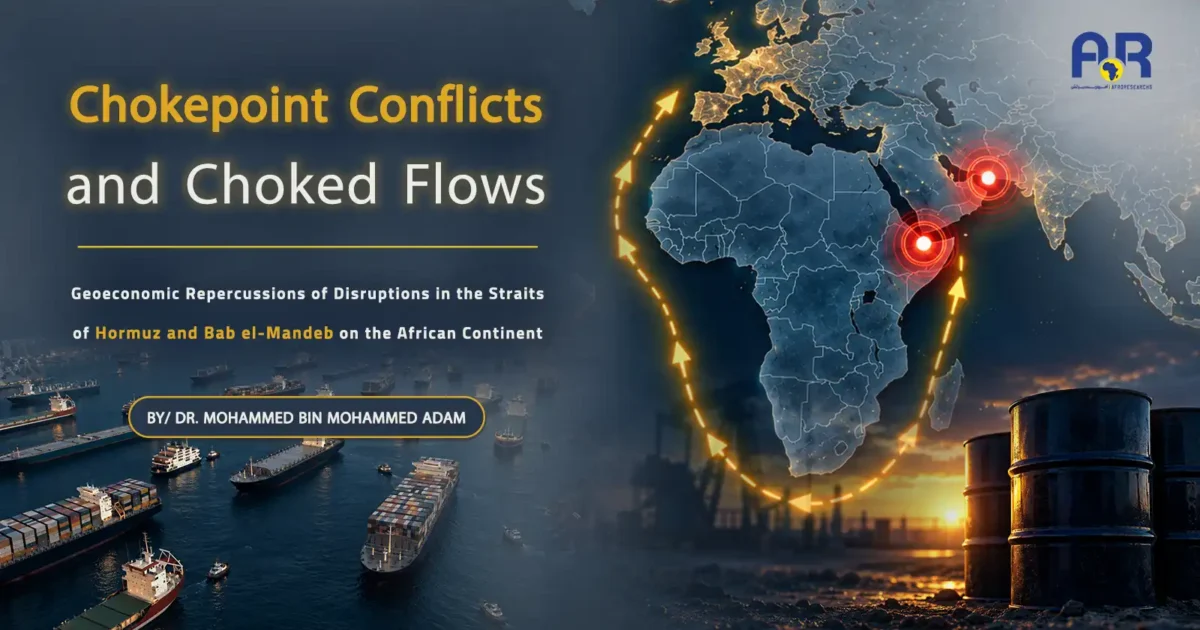
Chokepoint Conflicts and Choked Flows: Geoeconomic Repercussions of Disruptions in the Straits of Hormuz and Bab el-Mandeb on the African Continent
Executive Summary
The regional and international security architecture is undergoing a structural paradigm shift, as geopolitical confrontation pivots from localized land conflicts toward systemic attrition targeting maritime chokepoints, critical energy infrastructure, and global supply networks across the arc connecting the Persian Gulf, the Gulf of Oman, Bab el-Mandeb, and the Southern Red Sea. The acute threat no longer resides exclusively in a total military blockade, but rather in a calibrated strategy of operational disruption, elevating sovereign and maritime risk premiums to thresholds that compel major shipping alliances and container liners to systematically divert transit routes away from historical arteries.
The compounding strategic dilemma lies in the non-fungibility and interdependency of Hormuz and Bab el-Mandeb: they do not operate as isolated maritime corridors, but as an integrated global flow mechanism. Concurrent destabilization nullifies regional overland bypass mechanisms and strikes raw material, energy, and manufactured trade across Asia, the Middle East, Africa, and Europe simultaneously. Africa finds itself severely exposed—not as a bystander, but as a structurally vulnerable importer of refined fuels, synthetic fertilizers, and grain staples. Landlocked economies and transit ports face compounding inflationary pressures, currency depreciation, and fiscal crowding-out, transforming a maritime security crisis into an acute threat to continental national security and social stability.
I. Hormuz and Bab el-Mandeb: Dual-Chokepoint Dilemma and Overland Constraints
1. Hormuz as the Epicenter of Global Energy Shock
The Strait of Hormuz remains the undisputed jugular vein of international oil markets, funneling approximately 20 to 21 million barrels per day (mb/d) of crude, refined petroleum, and condensate—representing roughly 20% of global petroleum liquids consumption—alongside more than 20% of global liquefied natural gas (LNG) commerce. Escalating hostilities immediately trigger surges in Brent crude futures, dirty tanker freight benchmarks, and War Risk insurance premiums, delivering an immediate price shock to non-oil-producing developing economies, most notably in Africa.
2. The Limits of Overland Bypass Pipelines
Regional pipeline infrastructure cannot substitute for maritime flows through Hormuz. The aggregate nameplate capacity of operational bypass routes—principally Saudi Arabia’s 5 mb/d East-West Crude Pipeline (Petroline) to Yanbu on the Red Sea and the UAE’s 1.5–1.8 mb/d Abu Dhabi Crude Oil Pipeline (ADCOP) to Fujairah—leaves a baseline deficit of over 12 to 13 mb/d that cannot bypass the strait under any operating scenario. Furthermore, terminal infrastructure and pipeline pumping stations themselves sit within the operational envelope of ballistic missiles and long-range unmanned aerial systems (UAS), undermining assumptions of overland resilience.
3. Bab el-Mandeb: Direct Geographical Contiguity with Africa
Bab el-Mandeb interfaces directly with the Horn of Africa, Djibouti, Eritrea, and the Western littoral of the Red Sea. Asymmetric warfare waged by non-state actors—principally the Houthi movement utilizing anti-ship cruise missiles, loitering munitions, and uncrewed surface vessels (USVs)—has created an environment of permanent operational interdiction. Commercial vessels face direct kinetic exposure, invalidating standard risk-mitigation frameworks and severing the maritime bridge connecting the Indian Ocean to the Suez Canal.
4. Compound Shocks and Failure of Route Decoupling
Attempts to circumvent Hormuz by discharging crude into Red Sea export terminals converge directly into the contested maritime zone of Bab el-Mandeb. Conversely, avoiding Bab el-Mandeb cuts off direct transit of Gulf-refined products into East and North African consumption hubs. The crisis thereby demonstrates that maritime bottlenecks cannot be decoupled, compounding supply disruptions across multiple supply vectors.
II. Re-Engineering Global Trade: The Cape of Good Hope Diversion
Confronted with war-risk insurance premiums surging beyond 0.7%–1.0% of vessel hull and machinery value, global carrier alliances (including MSC, Maersk, CMA CGM, and Hapag-Lloyd) have redirected vessel traffic around the southern tip of Africa via the Cape of Good Hope, triggering wide-ranging economic distortions:
- Transit Distance and Fuel Surcharges: The Cape rerouting adds 3,000 to 4,000 nautical miles per voyage between East Asian manufacturing hubs and European/Mediterranean discharge ports, expanding transit times by 10 to 15 days and escalating bunker fuel consumption by over 30%.
- Absorption of Global Fleet Capacity: The elongated transit cycles absorb a massive share of the global container and tanker fleet, effectively reducing net capacity. This shortage drives up container freight rates (TEU spot prices) globally, including on intra-African lanes and routes entirely outside the combat perimeter.
- African Port Congestion: While bunkering and logistics hubs in Southern and Eastern Africa (e.g., Durban, Maputo, Port Louis, Walvis Bay) observed transient surges in service demand, deep-seated infrastructure deficits, berth delays, and shallow draft restrictions caused severe port congestion, stalling local cargo handling and escalating domestic import costs.
III. Transmission Channels to African Economies
The transmission of chokepoint interdiction into African real economies operates through a rigid seven-tier cascade:
Chokepoint ➔ Maritime Fleet ➔ Freight & Insurance Premiums ➔ Discharge Port ➔ Overland Freight Corridor ➔ Local Wholesale/Retail ➔ End Consumer
1. Refined Petroleum Vulnerability
Despite significant continental crude reserves, Africa suffers from structural domestic refinery deficits, forcing countries to import 60% to 80% of their refined fuels (gasoline, diesel, jet A-1) from Middle Eastern, Indian, and European refineries. Consequently:
- Skyrocketing international crack spreads and maritime tanker freight directly inflate pump prices.
- Diesel-fueled off-grid generation, which powers critical manufacturing, telecommunications towers, and hospital infrastructure across sub-Saharan Africa to compensate for grid deficits, faces prohibitive operating expenditures.
- Secondary freight charges for heavy transport trucks surge, driving wide-scale domestic cost-push inflation.
2. Agricultural Inputs and Food Insecurity
The agricultural shock constitutes the most socially volatile vulnerability. Because natural gas constitutes 70%–80% of ammonia production costs for nitrogenous fertilizers, energy price shocks immediately transmit to agrochemicals. Coupled with soaring dry-bulk shipping rates:
- Smallholder farmers and agricultural cooperatives face prohibitive fertilizer input costs at the critical onset of planting seasons.
- Acreage under cultivation contracts and application rates decline, depressing crop yields for subsequent harvest cycles and triggering structural domestic food deficits alongside inflated import bills.
- Acute nutritional stress and food security emergencies escalate across drought-prone and conflict-affected zones.
IV. Comparative Regional and Sectoral Matrix
| Regional Sub-System | Structural Vulnerability | Direct Macroeconomic / Operational Impacts
|
| Landlocked Sahel States (Chad, Niger, Mali, Burkina Faso) | Absence of sovereign maritime access; reliance on coastal transit ports and 1,000–1,500 km truck corridors. | Compounded freight costs (maritime surcharges + long-haul diesel transport). Hyperinflation in basic grains, flour, and medicine; elevated threat of socio-political unrest. |
| Arab Republic of Egypt (Suez Canal Axis) | Direct fiscal reliance on Suez Canal transit tolls as a premier sovereign source of hard currency. | Contraction of Suez Canal transit revenues by 50%–60%, widening current account deficits and aggravating foreign currency liquidity shortages. |
| Horn & East Africa (Djibouti, Ethiopia, Kenya, Tanzania) | Direct geographic and littoral exposure to the Bab el-Mandeb / Southern Red Sea operational zone. | Disruption of trade corridors for landlocked Ethiopia via Djibouti; severe import inflation; pressure on external sovereign reserves; freight rerouting bottlenecks. |
| African Hydrocarbon Producers (Nigeria, Angola, Algeria, Libya) | Crude export windfalls decoupled from domestic refinery self-sufficiency; constrained spare capacity. | Nominal fiscal revenue increases offset by catastrophic subsidy outlays for imported refined fuels, currency volatility, and domestic inflationary pressures. |
V. Macroeconomic Transmission: Exchange Rates, Inflation, and Sovereign Debt
1. Reserve Depletion and Foreign Exchange Depreciation
Surging import invoices for essential commodities compel central banks to allocate disproportionate foreign exchange reserves to cover letters of credit. As reserve buffers degrade, sovereign currencies experience accelerated depreciation against the US dollar, cementing persistent imported inflation.
2. Sovereign Debt Sustainability Stress
Amid global monetary tightening, currency depreciation sharply elevates external debt service ratios on US dollar- and euro-denominated Eurobonds and bilateral obligations. Fiscal space for capital expenditure, infrastructure development, and social safety nets is systematically crowded out by escalating debt servicing commitments.
3. The Subsidy Dilemma
Sovereign leadership is caught in a policy impasse: maintaining fuel and food subsidies preserves social stability at the cost of catastrophic budget deficits and fiscal insolvency; conversely, abolishing subsidies abruptly triggers violent urban discontent and political destabilization.
VI. Strategic Scenario Matrix
Scenario 1: Managed De-escalation (Probability: Low)
Triggers: Diplomatic breakthroughs capping naval and asymmetric attacks; stabilization of the Red Sea littoral; gradual return of maritime traffic to the Suez route.
African Impact: Gradual deflation of maritime freight indices; stabilizing current accounts; persistent domestic price stickiness lasting 6–12 months due to downstream market frictions.
Scenario 2: Prolonged Attrition and Structural Disruption (Probability: High)
Triggers: Continued low-frequency, high-consequence drone/missile strikes; perpetual war-risk insurance premiums; structural permanence of the Cape route.
African Impact: The most corrosive trajectory: chronic fiscal bleeding, sustained elevated food and fuel benchmarks, structural erosion of sovereign credit ratings, and systemic economic exhaustion.
Scenario 3: Dual-Chokepoint Kinetic Escalation (Probability: Moderate)
Triggers: Broadening of hostilities to include sustained attacks on energy infrastructure, total interdiction in Hormuz, and complete closure of Bab el-Mandeb.
African Impact: Brent crude surging above $130–$140/bbl; absolute shortages of fertilizers and refined fuels; balance of payments collapse across vulnerable frontier economies; high risk of sovereign defaults and localized state fragility.
Scenario 4: Kinetic Targeting of Overland Bypass Corridors (Probability: Low/Contingent)
Triggers: Precision strikes incapacitating Saudi Petroline, ADCOP pipelines, or Arabian Sea terminals, neutralizing overland rerouting assumptions.
African Impact: Total disarticulation of hydrocarbon supply lines; catastrophic disruption of industrial inputs; acute stagflation requiring multilateral emergency macroeconomic support.
VII. Strategic Takeaways and Policy Implications
- Re-conceptualizing Continental National Security: Chokepoint security must not be dismissed as a distant Persian Gulf or Red Sea littoral dilemma. For Africa, maritime chokepoints are primary determinants of domestic food security, macroeconomic stability, and sovereign debt viability.
- Sovereign Energy and Agricultural Autonomy: The crisis underscores the imperative of accelerating regional refining complexes (e.g., Dangote refinery) and expanding continental fertilizer production (e.g., Morocco’s OCP) to break dependency on volatile external maritime corridors.
- Infrastructure Integration: African policymakers and regional economic communities (ECOWAS, EAC, IGAD) must prioritize multimodal transport corridors connecting landlocked states to multiple oceanic outlets, hedging against single-corridor vulnerabilities and insulating the African Continental Free Trade Area (AfCFTA) from external maritime shocks.