Western Defenses in a Pre-War Posture Where Does Africa Stand Amid the Risks of a Comprehensive World War, and What Is Its Readiness to Face Strategic, Military, and Economic Repercussions?
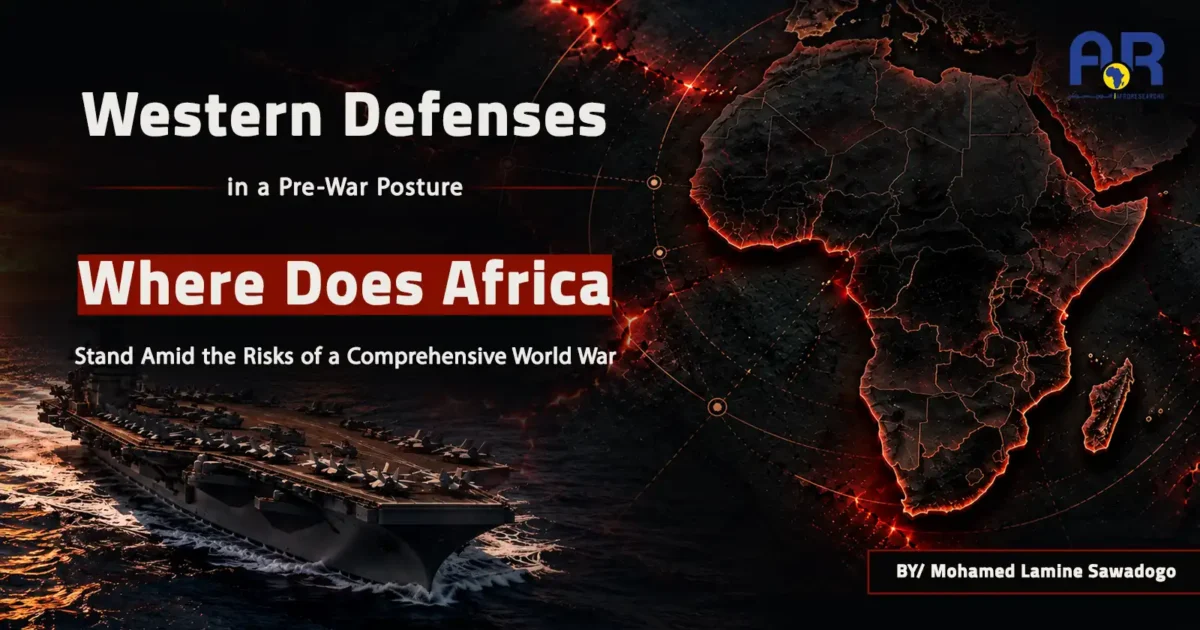
The significance of this topic lies in the current period, as African countries host foreign European, American, Russian, and Chinese military bases that could transform into open battlegrounds among these competing major powers. This is driven by Africa’s growing importance, its geographical location, the Red Sea and Gulf of Aden corridors, its natural resources, and its ports.
International powers preparing for a comprehensive world war are competing for military, security, and logistical influence within the continent. Africans may pay a heavy price for the upcoming war due to armed conflicts that could erupt between foreign military bases in Africa—between Russia, China, and the US on one hand, and Russia, its allies, and Europeans on the other. Africans will pay a steep price in a war in which they have no stake.
Addressing this serious dilemma, I will discuss the topic across four main axes:
Axis I: The West Enters the Pre-Comprehensive World War Phase Prior to 2030
The Western world is preparing for a devastating, comprehensive war with the Russia-China axis and their allies in the coming years and prior to 2030, according to various Western statements. They are planning for it, expanding their military and defense spending, and preparing European populations for grueling and potentially nuclear wars.
British General Sir Roly Walker, Chief of the General Staff of the British Army, warned on October 16, 2026, stating that international conditions are extremely hazardous and that politicians will soon need to have a frank dialogue with citizens regarding war preparedness and the sacrifices required to strengthen national defense. Addressing roughly 700 troops at the Catterick Garrison in northern England, he remarked verbatim: (You do not know it, but our nation will need you; there are extremely grave risks in the world at the present time).
According to media reports published on October 18, 2026, Britain, France, Germany, and Poland are preparing to conduct joint military exercises next month, involving at least 1,500 military personnel. These exercises are reportedly intended to practice the scenario of deploying a multinational force in Ukraine following a potential ceasefire, though some experts view them as preparation for fighting a war in Ukraine against Russia, while Russia is currently rolling out various weapons to counter Ukraine.
This recalls the appeal made by General Fabien Mandon, Chief of the French Defence Staff, on October 22, 2025, before the Defense Committee of the French National Assembly, where he stated: (We must prepare for a shock within three or four years in confronting Russia). He called for preparing the French military and society for the possibility of a widespread war in Europe. He reiterated this call in an interview with the newspaper Ouest-France on November 11, 2025, emphasizing the necessity of preparing for a potential confrontation with Russia before 2030. He reaffirmed this on November 18, 2025, before the conference of French mayors, urging French society to prepare for potential human sacrifices in a future war. During a Senate session on April 27, 2026, when asked whether his assessment regarding the potential shock within three or four years had changed, he replied that he had no reason to believe this timeline had receded.
France has been speaking of a (war economy) since 2022, gradually transitioning to increased defense spending, accelerated production of weapons and munitions, and preparation for a potential large-scale military confrontation in Europe, a path followed by most Eastern and Western European nations.
In November 2024, Swedish authorities distributed a booklet titled (If Crisis or War Comes) (Om krisen eller kriget kommer) to more than five million households as part of strengthening civil preparedness. The booklet remains the official approved version according to the competent government agency, which confirmed this in its update published in 2026.
German Defense Minister Boris Pistorius issued a grave warning on June 5, 2024, before the German parliament: “Wir müssen bis 2029 kriegstüchtig sein” (Translation: We must be capable of waging war by 2029). Germany aims to reach defense spending equivalent to 3.5\% of its Gross Domestic Product by 2029, according to the German government, alongside developing its armed forces.
Władysław Kosiniak-Kamysz, Deputy Prime Minister and Minister of Defense of Poland, called on October 13, 2026, for shifting the European defense industry sector into what he described as (War Mode) to accelerate the production of weapons and munitions and match the pace of Russian military production.
On October 2, 2026, Polish Radio revealed that the Ministry of Defense had prepared a draft bill colloquially dubbed the «Pre-war law», aimed at facilitating preparations for a state of war.
Donald Tusk had previously stated on July 31, 2025, that Europe is living through a pre-war phase and that a global conflict is taking shape before our eyes. He linked his warning to security estimates at the time indicating the possibility that Russia might prepare to attack NATO by 2027.
Axis II: Where Does Africa Stand Amid the Risks of a Comprehensive World War, Given the Presence of Foreign Military Bases on Its Soil That Could Become Devastating War Zones?
Does Africa possess the capability to protect its land, airspace, territorial waters, and secure food, energy, and trade routes if international escalation transforms into a widespread military confrontation?
Anyone monitoring defense policies in African countries generally realizes that some recognize the risks of ongoing global events, while certain African governments live in a state of near-total detachment from the repercussions of upcoming wars. As of the writing of this article, there is insufficient public evidence to state that African countries are preparing, within a unified continental plan, for an upcoming world war leading up to 2030. However, there are clear indicators of enhanced military capabilities in certain African nations, expanded defense cooperation, and readiness for escalating security threats.
According to the Stockholm International Peace Research Institute (SIPRI), African military expenditure reached approximately \$58.2 billion in 2025, marking an 8.5\% increase over 2024. Spending in North Africa reached \$35 billion, while sub-Saharan Africa accounted for \$23.3 billion. In my view, much of this spending has been allocated to combatting armed terrorist groups rather than preparing for an upcoming world war prior to 2030, as projected by European leaders.
Various military exercises are taking place in certain regions of Africa, including Tunisia, Morocco, Ghana, and Senegal hosting the (African Lion 2026) exercises, with the participation of over 40 nations and approximately 5,600 military personnel, aimed at improving coordination and operational readiness. However, these exercises do not prove that participants are preparing for a world war; they are part of military cooperation and joint training, and may be directed toward combatting armed terrorist groups actively operating across various parts of Africa.
Algeria is among the most prominent African countries in terms of defense spending, with its military expenditure reaching approximately \$25.4 billion in 2025 according to SIPRI. This is primarily linked to regional balances and security considerations, and is not in itself evidence of preparation for a world war.
Egypt ranks second, focusing on border protection, securing the Suez Canal, the Red Sea, and the Eastern Mediterranean, alongside developing its air force, navy, and air defense capabilities.
Morocco ranks third, having developed military cooperation with the United States and other partners, and participates in multinational exercises encompassing joint operations training and countering modern threats.
South Africa ranks fourth, possessing an industrial and defense base alongside experience in regional military cooperation, though its military expenditure stood at approximately \$3.2 billion in 2025, amid ongoing financial pressures on the defense sector.
Nigeria ranks fifth, having increased its military spending in 2025 by approximately 55\% to reach nearly \$2.1 billion, against the backdrop of escalating security challenges and armed insurgency within the country.
These examples illustrate varying trends rather than a ranking of the strongest militaries or evidence of a joint plan for global war preparation.
Axis III: The Danger of Foreign Military Bases in Africa and Their Weaponization in an Upcoming World War Between the Western Axis, Russia, China, and Their Allies Prior to 2030
Any upcoming world war could result in immense devastation in Africa because the continent hosts military bases belonging to these competing powers—a risk that must be mitigated. According to the 2023 Mo Ibrahim Foundation report, 23 out of 54 African countries hosted a military presence from outside the continent, documenting 14 foreign nations with military footprints in Africa.
Furthermore, the (No Bases in Africa) campaign by the organization World BEYOND War noted the existence of approximately 49 US military sites in Africa; however, this figure relies on a broad definition of sites and does not imply the existence of 49 independent, permanent US bases.
The United States operates over 20 military sites in Africa, in addition to the main Camp Lemonnier facility in Djibouti. US officials stated in June 2025 that the facility accommodates approximately 3,300 military personnel and civilian employees. US forces, in cooperation with Kenyan forces, also utilize the Manda Bay facility in Kenya, particularly to support security operations and combat armed groups in East Africa. US and Kenyan forces conducted joint exercises to defend the facility in September 2026.
France maintains military bases in Africa, including its permanent base in Djibouti, following the reorganization of the French military presence completed in the summer of 2025. It also retains liaison and military cooperation detachments in Côte d’Ivoire and Gabon, which are not counted as independent permanent French bases.
Russia relies heavily on forces from the Africa Corps, subordinate to the Russian Ministry of Defense, as well as security and logistical arrangements with local governments. According to an updated US Congressional Research Service report dated April 8, 2026, and a Swedish Defence Research Agency analysis published in October 2026, Russia has intensified its presence in Libya, the Central African Republic, Mali, Burkina Faso, Niger, Equatorial Guinea, Sudan, and Togo.
It should be noted here that estimates regarding the numbers of foreign military bases in Africa are not entirely precise; consequently, figures vary from one research center to another because some of these facilities are classified and undisclosed, while others are integrated within United Nations facilities or bases.
As previously mentioned, these foreign bases pose a threat to the future of security and stability in Africa, potentially turning the continent into an open battlefield in any upcoming comprehensive world war. Consequently, many argue for the necessity of reassessing the continuation of this foreign military presence before conflicts erupt that could force African populations to pay a heavy price.
Axis IV: What Is Africa’s Readiness to Face the Strategic, Military, and Economic Repercussions of the Upcoming World War?
It can be stated without doubt or hesitation that Africa does not appear sufficiently prepared—strategically, militarily, or economically—to face the repercussions of a widespread world war. The continent still relies to varying degrees on Western or Eastern weaponry and depends heavily on military technology imported from outside the continent, leaving its strategic autonomy margin limited. Therefore, it would have been more prudent to limit the granting of foreign military bases to competing powers in Africa, ensuring that African populations do not pay the price for upcoming wars from which they have nothing to gain.
Today, Ukraine and Russia are engaging in forms of indirect competition inside Africa. This rivalry has extended to the African arena, particularly in Mali, the Sahel region, and Libya. Statements by Andriy Yusov, spokesperson for Ukrainian military intelligence, sparked widespread controversy following the battle that erupted near the town of Kidal (Tinzaouaten) in northern Mali between July 25 and 26, 2024, along the Algerian border. The battle took place between Tuareg separatist forces, the Malian army, and Russian mercenaries from the Wagner Group prior to its renaming as the Africa Corps. The battle resulted in the deaths of dozens of Wagner operatives and Malian soldiers, according to Malian and Russian sources.
Andriy stated that the rebels obtained information from Ukraine that assisted them in executing the operation, but this statement was not independently verified in all details of the alleged Ukrainian support, and a rebel representative denied receiving any external assistance during the battle.
According to an Agence France-Presse report published on October 9, 2026, alongside other reports concerning the expansion of the Ukrainian role in northern Mali, some sources reported the presence of approximately 15 Ukrainian drone specialists assisting the Azwad Liberation Front (FLA), which fights the Malian army and its Russian allies. These reports point to roles in training, operational planning, and assisting in drone operation, although I believe attributing this scale of involvement to Ukraine may be an attempt to mask the true actors on the ground.
In April 2026, Radio France Internationale published an investigation—subsequently reported by Euronews—indicating the presence of over 200 Ukrainian military personnel and specialists in western Libya, along with sites used to operate aerial and maritime drones. The investigation also linked the Ukrainian presence to the attack targeting the Russian gas carrier (Arctic Metagaz) in March 2026. Similarly, the Associated Press cited accounts from Libyan officials regarding a potential Ukrainian role in that attack.
Press reports have also noted the presence of Ukrainian specialists in Sudan within the context of competition with Russia, though available information regarding their numbers remains extremely limited. The objective of Ukraine—and behind it France and NATO, according to this perspective—is to distract Russia outside the European theater, target Russian influence networks, expand drone warfare capabilities, and demonstrate Kyiv’s capacity to confront Russian interests beyond Europe’s borders, avenging the Russians outside their immediate perimeter.
Mali, Niger, and Burkina Faso have adopted a clear stance toward Ukraine. In August 2024, Mali announced the severance of diplomatic relations with Ukraine, followed by a similar step by Niger. In December 2024, Burkina Faso announced the severance of its diplomatic relations with Ukraine amid accusations concerning support for armed terrorist groups in Mali and elsewhere.
All these geopolitical developments confirm that Africa may pay a heavy price in any upcoming world war due to the presence of foreign military bases belonging to global powers competing for influence and resources. Furthermore, many African leaders, according to this perspective, have yet to realize the gravity of these policies and their potential consequences in turning Africa into an arena for armed international conflicts, compounded by the fragility of economic, security, and political infrastructure in a number of continental states.
The outbreak of a widespread world war will not merely constitute a military confrontation among competing major powers; rather, it could transform into a cross-border economic shock extending beyond battlefields to encompass energy, food, trade, debt, currencies, and social stability. Africa will face a critically dangerous strategic test, as the survival capability of its nations will depend heavily on their level of import dependency, the size of their financial reserves, the diversification of their production, and their capacity to secure food, energy, and transport means.
If oil or gas supplies are disrupted, or navigation through the Strait of Hormuz, the Bab el-Mandeb, and other vital maritime corridors is impaired—a plausible scenario in any upcoming world war—fuel, transport, and electricity prices in Africa could surge dramatically. Fuel-importing countries will be directly harmed, and a comprehensive world war will disrupt grain exports, drive up fertilizer and fuel prices, and increase shipping and insurance costs. The impacts will be most severe for nations dependent on wheat and rice imports or agricultural production inputs. Pressures will mount on African countries importing food, fuel, fertilizers, and other goods; public budget deficits may widen, prices will rise, and food stockpiles and foreign exchange availability will become decisive factors in confronting potential crises.
Conversely, African countries that invest in domestic agriculture, energy, manufacturing, intra-African trade, and strategic reserves can mitigate their reliance on distant markets, even if they cannot entirely isolate themselves from the repercussions of any widespread global crisis.