Ethiopia on the Brink of Partition The Crisis of Political Federalism, Negative Inter-Nationalities Competition, and Regional and International Interventions
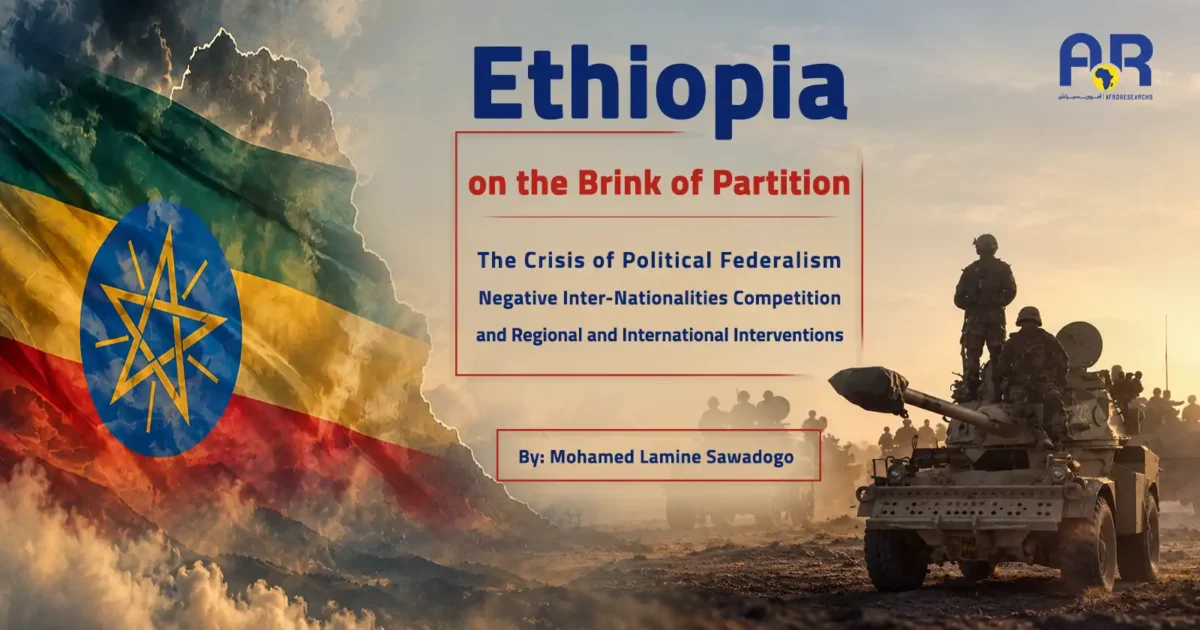
To understand the conflict in Ethiopia—represented by the war witnessed and still being witnessed in the northern Tigray region, where military movements remain active—it is not sufficient to view it merely as a military confrontation between the federal government and the armed Tigray People’s Liberation Front (TPLF). Its roots run much deeper, linked to the nature of the Ethiopian state’s geographic and national composition, the history of power distribution among nationalities and ethnicities, competition over resources and territories, as well as the regional and international interests intersecting within and around Ethiopia.
I will address this topic through three interconnected pillars: the crisis of political federalism driven by the struggle for power, the negative competition among nationalities and centers of influence, and the regional and international interventions that have contributed to complicating, internationalizing, and expanding the crisis.
Pillar One: The Crisis of Political Federalism in Ethiopia
The roots of recent wars trace back to a deep political crisis arising from the power struggle between the Tigray People’s Liberation Front and the Ethiopian federal government led by Abiy Ahmed following his assumption of the premiership in 2018. Since 1991, the TPLF had been the preeminent force within Ethiopia’s ruling coalition, wielding sweeping influence across state institutions, the military, and security apparatuses, despite Tigrayans comprising a minority of the total population. This influence persisted until the outbreak of protests that weakened the former regime and paved the way for Abiy Ahmed’s ascent to power.
With the rise of Abiy Ahmed, a new phase of reorganizing state institutions and political alliances began across Ethiopia. These transformations led to a decline in Tigray’s influence at the federal level, intensifying disputes between the two sides over the future of the political system, the nature of Ethiopian federalism, and the distribution of powers between the central government and the regions.
The conflict between Abiy Ahmed’s bloc and the Front peaked in 2020, when Tigrayan authorities held regional elections in September of that year, despite the federal government’s decision to postpone general elections due to the COVID-19 pandemic. The government refused to recognize the legitimacy of these elections, while Tigray’s leadership rejected federal decrees, considering them an encroachment on regional jurisdiction.
On November 4, 2020, open war erupted following Abiy Ahmed’s announcement of a military operation against Tigrayan forces after accusing the Front of attacking federal army bases. Since then, the political crisis transformed into a widespread war lasting roughly two years, prior to the signing of the Pretoria Peace Agreement in November 2022, wherein both parties agreed to a permanent cessation of hostilities.
However, the peace agreement failed to resolve fundamental disputes between the Front and the state, nor did it establish a stable political settlement. Issues concerning disarmament, the future of regional administration, the return of displaced persons, and territorial disputes remained contested. Due to multiple skirmishes and recurring violations, fighting resumed in 2026, affirming that the crisis was not merely a transient military clash, but a struggle over the nature of the Federal Democratic Republic of Ethiopia, extending further to the contest over Ethiopia’s territorial integrity and secessionist calls.
Pillar Two: Negative Competition Among Nationalities Over Centers of Influence in Ethiopia
The reality of the Tigray war cannot be understood in isolation from the nature of Ethiopia’s federal system, which is based on regions defined by national and ethnic identities, and the resulting competition for power, land, resources, and political representation. Ethiopia is not an ethnically or linguistically homogeneous state; rather, it comprises major nationalities—foremost among them the Oromo, Amhara, and Tigrayans—alongside other peoples and nationalities, making the distribution of power one of the most sensitive issues in the country.
The nature of this conflict in its national dimension can be understood through the following aspects:
1. Negative Competition Between Tigrayan and Amhara Nationalities:
The dispute over agricultural lands, particularly in western Tigray, represents one of the most prominent facets of the conflict between forces associated with Tigray and Amhara nationalist forces allied with the Abiy-backed administration between 2020 and 2022. Amhara forces claimed territories they argued were annexed to Tigray by regional authorities during the federal reorganization of the 1990s, while Tigrayan authorities regard them as part of their regional territory.
During the war, Amhara forces and allied groups, backed by the federal authority, seized disputed areas, rendering the return of displaced persons and the settlement of land status among the most complex dossiers following the peace agreement.
The alliance between Abiy Ahmed and Amhara forces was short-lived; clashes broke out between the government and the Fano—a vital component of Amhara forces—in 2023 following government efforts to dissolve regional special forces and strip them of their military independence, alongside territorial and security disputes. By September 2026, Fano entered into a military alliance incorporating the Tigray People’s Liberation Front and other opposition groups, declaring the objective of overthrowing Abiy Ahmed’s government and forming a transitional administration.
2. The Conflict Between the Federal Government and Other Ethiopian Nationalist Forces:
Opposition to the government was not restricted to the Tigray Front; Abiy Ahmed’s government also faced unrest and insurgencies in other regions, particularly in Oromia, where armed opposition groups became active, alongside tensions in Amhara regions and elsewhere. This implies that the Tigray crisis is part of a broader crisis concerning the future of Ethiopian federalism, the limits of central authority, and the government’s capacity to manage national pluralism without resorting to force.
Furthermore, the joining of anti-government coalitions by Ethiopian opposition groups during 2026 expanded the dimensions of the crisis, meaning confrontation is no longer confined solely to the Tigray region.
Nationalist rivalry has imbued the war with greater complexity; controlling land is no longer merely a federal administrative matter, but is tied to local communities’ anxieties regarding their identity, rights, and security. Historical grievances and nationalist and ethnic rhetoric were deployed to mobilize fighters and muster political support, while civilians in multiple regions suffered killings, displacement, violence, and abuses.
The competition among nationalities and centers of influence in Ethiopia has made the war broader than a simple bilateral dispute; it has become part of a structural crisis within the Ethiopian system, where identity intersects with conflict over land, power, and resources, threatening the stability of federalism. Nonetheless, it is inaccurate to interpret all developments as purely ethnic conflict; political and military elites occasionally utilize national and ethnic identities to fortify their positions in a struggle that also revolves around power, resources, and the state’s future.
Pillar Three: Regional and International Interventions in Ethiopia
The Tigray war gains regional significance due to Ethiopia’s strategic location in the Horn of Africa, its borders with Eritrea, Sudan, Somalia, Djibouti, and Kenya, as well as its ties to Red Sea and Nile issues and international competition over ports and maritime corridors. However, a distinction must be made between proven military intervention, alleged support denied by involved parties, and geopolitical rivalry that may influence the war without entailing direct participation.
This aspect can be understood through the following points:
1. Direct Eritrean Military Intervention in Ethiopia:
Eritrea is the regional party most closely connected to the war militarily and maintains a direct relationship with it. Throughout its history, the Tigray People’s Liberation Front experienced fluctuating conflicts and relations with Eritrean forces, after which animosity between the two sides evolved into a major factor fueling the war.
Following the outbreak of fighting in 2020, Eritrean troops intervened alongside Ethiopian government forces against the Tigray Front. Human rights reports documented the presence of Eritrean forces and their involvement in abuses against civilians, and in March 2021, Abiy Ahmed acknowledged the entry of Eritrean troops into Tigray.
However, the Pretoria agreement, as previously noted, did not extinguish all causes of animosity nor guarantee a permanent settlement of relations between Asmara and Addis Ababa. With escalating tensions surrounding Ethiopia’s pursuit of access to the Red Sea and the port of Assab, and accusations leveled against it regarding support for certain groups opposed to the Eritrean regime, bilateral relations returned to a highly sensitive phase.
In September and October 2026, the Ethiopian government accused Eritrea of supporting the TPLF and other armed groups, and even deploying troops across the border; Eritrea denied these allegations, triggering further friction between the two countries.
2. Strategic Egyptian Intervention in Ethiopia:
Egypt enters within the broader context of strategic rivalry with Ethiopia, centered fundamentally around the Grand Ethiopian Renaissance Dam (GERD), Nile water-sharing, and the balance of power in the Horn of Africa and the Red Sea. Egypt views the GERD as an existential threat concerning its water security, while Ethiopia regards it as a sovereign and essential developmental project. This dispute has led to recurring political and diplomatic tensions between the two nations.
In September 2026, Ethiopian military officials accused Egypt and Sudan of supporting an alliance of armed groups seeking to overthrow Abiy Ahmed’s government; however, Egypt denied these allegations, and Sudan dismissed the Ethiopian accusations as lacking evidence. The Egyptian-Ethiopian dispute forms an important strategic backdrop to the crisis and may increase regional polarization, yet one should not assert definitively that Egypt manages the Tigray war or arms the Front absent independent and reliable evidence.
3. Sudanese Logistical Intervention in Ethiopia:
Ethiopia and Sudan share long borders and disputed areas, most notably the Al-Fashqa region, alongside the impact of the internal Sudanese war on regional security calculations. The internal Ethiopian conflict coincided with strained bilateral relations and mutual accusations regarding support for the Tigray Front. In September 2026, as noted earlier, Ethiopia accused the Sudanese regime of supporting the Front, but Sudan denied these charges.
4. Israeli Security and Intelligence Intervention in Ethiopia:
There is scarcely an armed conflict in the Horn of Africa, North Africa, and the Middle East where Israel’s hand is absent. Israel intervenes in Ethiopia within the broader context of its interest in the Horn of Africa and the Red Sea, given the strategic importance of this region for navigation security, commerce, and ports, alongside its ties to competition with other regional and international powers.
Today, Israel supports Ethiopia—its longtime ally—against Tigray, which is backed by Eritrean President Isaias Afwerki (its former ally), who is likewise supported by Egypt, a country maintaining good ties with Israel. This picture appears entirely paradoxical: Israel supports Ethiopia against the Tigray Front while simultaneously supporting the Tigray Front’s allies against Ethiopia.
5. Gulf States’ Intervention in Ethiopia:
Ethiopia cannot be isolated from the broader competition over ports, maritime corridors, and political and security influence in asylum within the Horn of Africa. The UAE, Turkey, Saudi Arabia, and other regional powers possess varying interests concerning Red Sea security, relations with African governments, trade, investment, and security cooperation. These nations exert varying influence over events in Ethiopia. Should the war expand between Ethiopia and Tigray on one hand, or between Ethiopia and Eritrea on the other, diplomatic pressures and indirect interventions could intensify, with some states seeking to safeguard allies or protect strategic interests.
Conclusion
It is evident from this article that the Ethiopian conflict cannot be explained by a single factor or a single pillar; rather, it stems from the interaction of three fundamental pillars:
- The Internal Political Level: The struggle between the federal government and the Tigray Front over power, governance legitimacy, and the future of the federal system.
- The National and Regional Level: Competition among nationalities and centers of influence, alongside disputes over land, resources, and political representation.
- The Regional and International Level: Eritrea’s intervention in the war, escalating tensions with Egypt and Sudan, and broader competition over the Red Sea, the Nile, ports, and strategic influence.
The danger of the situation lies in how these levels feed into one another: the more internal settlement falters, the greater the opportunities to exploit the crisis in regional rivalries; and the more external competition escalates, the harder achieving internal settlement becomes.
Therefore, I believe that bringing a sustainable end to the war requires more than a military victory or a reshuffle of regional administration; it necessitates an inclusive political settlement within Ethiopia, addressing the roots of national and regional conflicts, ensuring the return of displaced persons, holding violators accountable, alongside preventing the Horn of Africa from transforming into an open arena of confrontation among regional and international powers.
Praise and peace be upon Muhammad, his family, and his companions.