Introduction: The Geographical Characteristics and Strategic Location of the Sahel Region
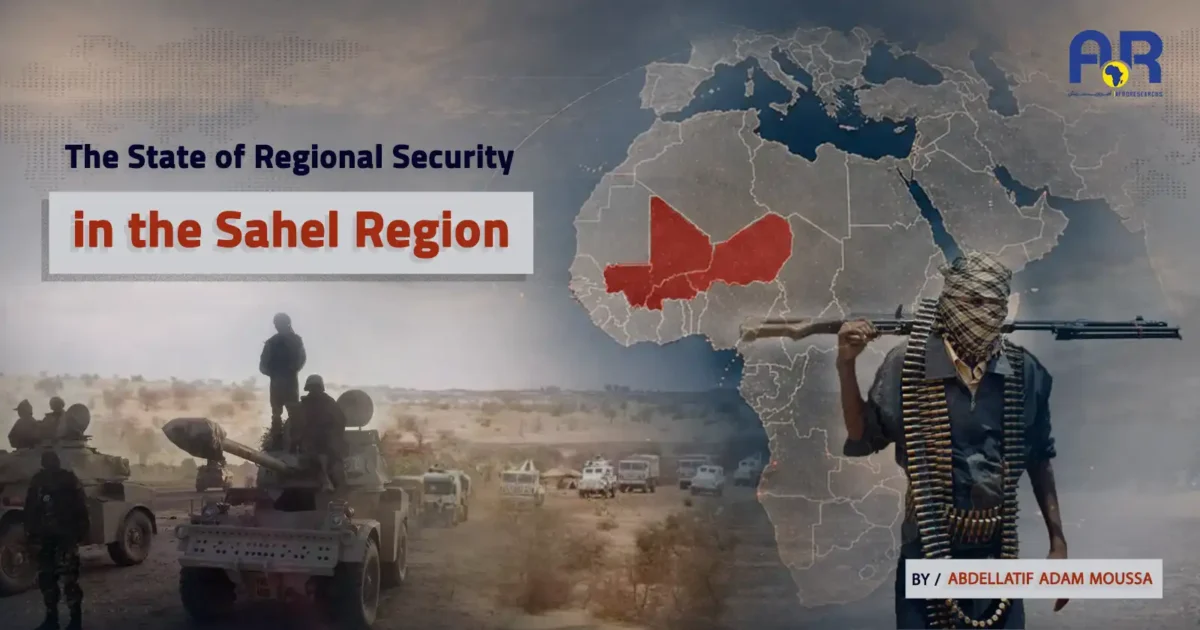
The African Sahel represents an extended geographical strip separating the Great Sahara Desert in North Africa from the tropical regions in the south, and its climate is considered semi-arid. This geographical situation grants these countries vital and strategically important positions on the continent, owing to a climate that represents the natural transition between the desert and the tropical zone and is characterized by rainfall and forests.
This vast and sprawling geographical region faces grave security challenges, owing to the existing security vacuum and the weakness of coordination among the Sahel states. This has made the region a fertile environment and a safe haven for the influence and movements of armed groups and extremist organizations that exploit this shortfall and the weakness of security coordination. These organizations strive with every effort to expand the scope of their operations by establishing isolated gathering and training areas deep in the desert, and from their positions they dispatch advance scouts to monitor any hostile movements against them.
These groups have grown and evolved, and their activity has increased noticeably in recent months after they developed their organizational and combat capabilities. Among the most prominent of these groups during those months is the terrorist “Group for the Support of Islam and Muslims” (JNIM), which is considered the primary arm of al-Qaeda in the Sahel region.
First: The Causes and Drivers of the Growing Security Breakdown and the Evolution of Armed Groups
The causes behind the growth of this situation — which undermines the security, social, political, and economic conditions in the region and is linked to the emergence and evolution of these groups — are numerous, but they can be summarized in a few important points:
◆ Economic and climatic factors: Poverty, rising unemployment, and the scarcity of resources due to climate change stand out as fundamental factors that have contributed to attracting numbers of young people and drawing them toward voluntary and forced recruitment into the ranks of these groups.
◆ Lack of awareness and weak religious grounding: The absence of sufficient awareness has led many young people to drift into the ranks of terrorism and extremism, owing to ignorance of religion and a weak grounding in Islamic jurisprudence.
◆ The intertwining of the criminal environment with terrorist activity: The presence of an organized criminal environment specializing in the trade and smuggling of weapons and drugs, as well as the seizure of gold-mining sites and the smuggling of gold along with fuel, in addition to crimes of highway robbery and cattle theft.
All of this has turned the Sahel region into a fully integrated criminal environment, to the point that it has become a hotbed for such activity and a fertile ground that has contributed to shifting the geography of terrorism from the Middle East into the depths of the African continent. This has undermined the security situation and become a threat to the Sahel states — clearly evident through armed operations, their expansion, and the growth of activity linked to the developing organizational capabilities of these groups and their recent coordinated movements, through which they targeted the countries of the “coup triangle” (Mali, Niger, and Burkina Faso), in addition to Nigeria, extending even to Benin.
Second: Field Developments and the Theaters of Military Operations
In recent months, the African Sahel region has witnessed a succession of events on the ground and an escalation through organized attacks targeting Burkina Faso, Mali, and Niger, launched from the volatile border juncture by these armed groups — foremost among them the “Azawad Liberation Front” and the “Group for the Support of Islam and Muslims” (JNIM):
- The Theater of Operations in Mali
The groups have expanded their operations in the northern and southern regions. This group and its allies carried out simultaneous, well-organized operations targeting the political, economic, and security centers of gravity in several important cities, as well as the headquarters and bases of the regular armies and certain strategic sites and security positions. These groups organized their approach in full coordination, enabling them to enter some sites and besiege several cities, areas, and other strategic locations. As a result of these attacks, the Malian defense minister was targeted and killed, and these allied armed groups worked to cut off the logistical supply of the Malian army in a number of cities. They recently recorded their most violent attack to date, targeting the cities of (Kidal, Mopti, Anéfis, Gao, Sévaré, Kéniéroba, Ségou, and Bamako), in which the Malian army lost a considerable number of soldiers, and the terrorist groups captured around 152 soldiers as a result of these attacks.
- The Theater of Confrontations in Burkina Faso
In the recent period, the country has been subjected to organized, well-planned attacks by the Islamic State organization, which operates from and is centered in the Sahel region and the Northern province. Consequently, confrontations between the Burkinabè government army and the armed groups have been concentrated in the northern and northeastern regions along the borders with Mali and Niger. In recent months, the government army was subjected to a violent attack launched by fighters of the Group for the Support of Islam and Muslims (JNIM) (the arm of al-Qaeda), targeting the towns of (Djibo, Soum, and Nansmigia) in the north of the country along the border with Mali. A number of residents of these areas and villages were displaced, and the groups also targeted army positions and security stationing points, resulting in the death of more than 160 military personnel and civilians.
- Security Tensions in Niger
During this period, Niger has also witnessed notable security tension and instability as a result of the escalation of military activity by the terrorist groups, among which the Islamic State organization has emerged as the principal security threat to its southern regions — particularly the (Tillabéri) region at the volatile border juncture with Mali and Burkina Faso. Through repeated attacks, the Nigerien government army lost a considerable number of soldiers, in addition to the targeting of Niger’s international airport and several vital sites.
- The Reality of the Threat in Nigeria and the Infighting Among the Organizations
Nigeria is considered the most affected by terrorist acts and the repeated armed attacks of the “Islamic State in West Africa” (ISWAP), the most active organization, associated with committing a number of crimes such as killing, crucifixion, looting, mass kidnapping, and deliberate acts of sabotage, in addition to the escalating conflict between it and the “Boko Haram” group in the northeastern areas of (Borno) State. Boko Haram is thus considered the most threatening in Nigeria through its targeting of civilians and its numerous attacks on the areas of (Daski, Karamti, Kwada, and Malam), which fall administratively under Borno State — the state most affected by repeated terrorist and hostile acts.
Third: Political Approaches and Official Decisions to Confront Extremism
Among the important aspects in the development of events in the Sahel region — which have pushed some military leaders in those countries to take certain decisions viewed as potentially contributing to remedying the phenomenon of extremism and conflict — are the following:
- The Decisions of the Transitional Authority in Burkina Faso Regarding Religious Institutions and Figures
The transitional military ruler of Burkina Faso, Captain Ibrahim Traoré, took decisive measures on this matter aimed at curbing terrorism and drying up its sources. The well-known Burkinabè preacher (Mohamed Ishaq Kindo), who enjoys a large following among Burkinabè youth, was arrested — despite his full support for President Traoré at the start of his rule, which he expressed on many platforms and media outlets by standing by him on the grounds that he is a Muslim ruler. Another decision concerned the return of around 800 Burkinabè students studying at Islamic universities in the Kingdom of Saudi Arabia, requiring them to leave their studies and return to the country.
Taking such bold steps may be ill-advised or not well studied in all their dimensions. This also amounts to a clear accusation against those Islamic universities, or the attribution to some of them of responsibility for fostering terrorism in the Sahel region — even though this matter, first and foremost, requires evidence, scientific proof, and substantiation.
It is well established that many of these universities are among the academic institutions that have contributed most to combating terrorist ideology and extremism. There are thousands of African graduates who studied and specialized in the Islamic sciences, Sharia, law, the principles of jurisprudence, the Arabic language, and other fields, and who deepened their studies further until some of them became professors, doctors, and directors across the continent. Not one of them has been proven to become, or has turned into, a terrorist, a leader of extremist groups, or an advocate of that ideology — because the maxim “knowledge is light” is a firm principle: light and insight for the mind, for discernment, and for the soundness of thought and understanding.
It is also established that none of the leaders and chiefs of the terrorist groups in the Sahel region are graduates of those Arab Islamic universities; rather, most of them received limited, brief, and incomplete local education, and studied under individuals and informal, non-academic circles. This led to their insufficient knowledge of the fundamentals of religion, the sciences, jurisprudence, and a correct understanding of Islam. This deficiency drove them to adopt extremist ideas outside the official academic frameworks. Indeed, we have observed that much extremist terrorist thought excommunicates students of the Islamic sciences and accuses the universities and institutes from which they graduate of being deviant institutions that imitate the West — an example being the group (Boko Haram), whose name signifies that “the books you study are forbidden (haram).”
- The Measures Directed at Social Components in Niger
In Niger, the government likewise took other decisive measures aimed at revoking all identity documents from the Arab components — the (Mahamid) Arabs — and expelling them beyond the country’s borders, on the grounds that they are citizens more closely connected to Chad. This step, which targeted specific ethnic components, may be ill-advised or not fully considered in all its dimensions, ramifications, and effects — both in the near term and for the future prospects of a community that has lived much of its social history in, and whose fate has been bound to, that region.
Fourth: Geopolitical Shifts, Foreign Interventions, and the Prospects for Regional Security
- The Repercussions of Ending the Foreign Presence and Withdrawing from ECOWAS
This is embodied in the decisions taken by the transitional military governments of the three countries to reject the foreign military presence (French and American) in the region. These forces, which had been present since 2013, had their presence terminated, in addition to the withdrawal of those military governments from the Economic Community of West African States (ECOWAS). This latter decision had a direct impact on the ground, reducing integrated security, intelligence, and logistical coordination among all these states, and weakening everyone’s efforts to resolve the phenomenon. Many rebel and extremist groups in the region benefited from these bold steps, which prompted many of them to organize and arrange their affairs, thereby unleashing massive waves of violently organized terrorist activity that reached many of the region’s countries (Chad, Niger, Mali, Burkina Faso, and Mauritania). This has turned the entire Sahel region into a center of gravity for terrorist activity worldwide.
- Assessing the Russian Role and the Risks of External Infiltration
Despite the Russian presence embodied in the “Africa Corps” and deployed across Mali, Niger, and Burkina Faso, this presence has achieved no kind of success or victory in bringing the security situation under control. This is because the armed groups and extremist organizations took advantage of the situation of those states and the security, social, and economic vacuum in the border areas, and worked to develop their organizational capabilities. They have become more capable than before of spreading and escalating well-planned, coordinated, cross-border attacks; the challenge therefore remains great and persistent throughout the entire region. In addition, external interventions have recently brought about a qualitative infiltration within some terrorist and opposition groups, which have become more closely tied to a project of partitioning countries and to conflicts over identity and power.
Conclusion: Reading the Reality and Diagnosing the Requirements for Resolution
The extremist terrorist groups, in all their various and allied names, will remain a source of danger and a security threat to the Sahel states and the West Africa region in general, for many of them have changed and developed their organizational capabilities. The most prominent of these groups is the “Group for the Support of Islam and Muslims” (JNIM), the arm of al-Qaeda in the region. It is no longer easy at present to eliminate these groups by traditional means, because they have shifted to a more organized and structured posture than before. This became clearly evident through the recent attacks that occurred in Mali, which revealed to us another important dimension concerning the shortcomings of the Malian armed forces in certain important areas related to confronting these extremist groups and how to eliminate them — especially those affiliated with al-Qaeda and ISIS. These groups have become the greatest danger in the Sahel region in general.
Given that the vast Sahel region now faces a significant security vacuum and unprecedented challenges due to the presence of these growing extremist groups, all of this places a heavy burden on the armies of the targeted countries, which also suffer from a lack of sufficient security and intelligence coordination and integrated logistical support. Cross-border terrorism is considered a major security threat and a fundamental driver of instability in the region, because it obstructs development, reconstruction, and progress programs in those states.
It has frequently emerged of late that these states have achieved some tactical victories; however, the growing capabilities of the organized threats posed by the extremist groups, and the external targeting by Western circles, have become evident and have been reflected at the level of internal confrontations. It has become plainly clear that these states’ military capacities face difficulty in adequately containing the situation and resolving the matter by re-imposing their military control and putting in place a comprehensive strategy to combat terrorism and eradicate it from the region. The proof of this is the rise in the rate of attacks and operations against these states over the past months, and the positioning and entrenchment of the groups in the tri-border area between Mali, Niger, and Burkina Faso — which poses an even greater danger to the region’s society.
This last aspect is very important and requires us to read the reality of terrorism and its true nature in the region and to diagnose it in a precise, scientific manner so that it may be confronted in a systematic way. For an error in diagnosing the ailment may cause harm through an error in prescribing the remedy, and would help perpetuate the situation and the crisis rather than treating it at its roots. Herein lie the reasons for the sound foundations needed to resolve the phenomenon and eradicate it in the Sahel region in general.