Chad: When Torrential Rains Devastate Food Security Food and Humanitarian Security Facing Compounding Floods and Climate Shifts (2024–2026)

Executive Summary
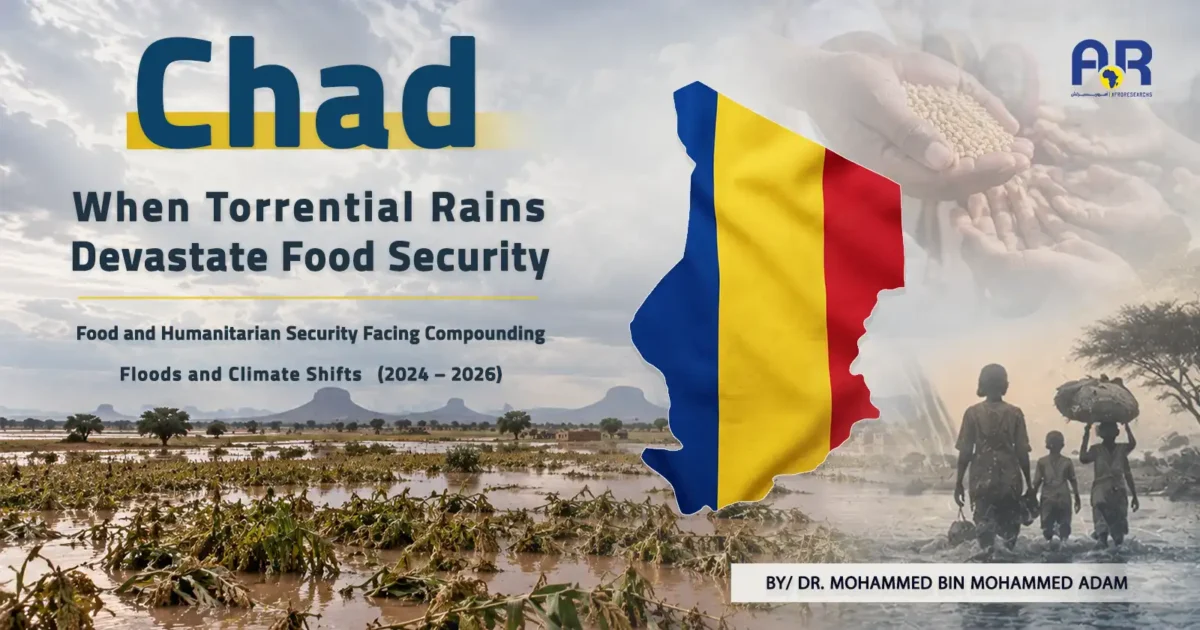
Since the 2024 rainy season, the Republic of Chad has stood at the crossroads of two overlapping crises: an unprecedented country-wide flood surge and a progressive collapse in food security metrics that has pushed acute food insecurity to historic highs. According to UN reports, the 2024 floods impacted approximately 2 million people across all 23 provinces, resulting in 576 fatalities and submerging over 432,000 hectares of arable land. The year 2025 offered no reprieve, affecting more than 407,000 additional people and inundating around 91,000 hectares of cereal crops, causing cereal production to drop to 2.67 million metric tons and generating a cereal deficit exceeding 614,000 metric tons.
Over 3.3 million people face acute food insecurity (IPC/CH Phase 3 and above). Joint national analytical frameworks via the Cadre Harmonisé projected needs to peak between June and August 2026 at approximately 2.98 million people, including 264,000 in Emergency (Phase 4). Concurrently, Chad hosts one of the largest refugee populations in Africa (1.5 million refugees, over 940,000 of whom fled Sudan), putting immense strain on local resources, markets, and basic services in eastern provinces, while funding for the food security and nutrition response plan reached merely 11.5%.
Assessment Conclusion: Absent regional military escalation, the number of acutely food-insecure individuals in Chad is projected to surpass 3 million during the fourth quarter of 2026, accompanied by a sharp rise in child wasting. This necessitates a strategic paradigm shift from reactive emergency relief to anticipatory action and climate resilience before humanitarian costs become existential.
Introduction
Floods in Chad are no longer seasonal weather incidents relegated to passing bulletins; over three consecutive years, they have become a decisive strategic variable shaping food security and social stability in a country that occupies a critical geopolitical axis between the Sahel and Central Africa. This paper synthesizes field assessments and analytical reporting from major international bodies (UN OCHA, Global Humanitarian Overview 2026, FAO, WFP, FEWS NET, IPC, IFRC, and the World Bank) to evaluate Chad’s vulnerability between climate volatility and livelihood fragility, projecting crisis trajectories for 2026–2027.
I. General Context: Absorbing Regional Crises Amid Internal Fragility
Geopolitically located at the intersection of the Sahel and Central Africa, Chad has historically served as a relative hub of stability in a volatile region. However, this regional role carries an immense burden: the country hosts roughly 1.5 million refugees, including more than 940,600 who fled the conflict in Sudan since April 2023, along with nearly 344,000 returning Chadians. According to FAO, this inflow places intense pressure on basic services, local markets, and livelihoods, particularly in the eastern provinces of Ouaddaï, Wadi Fira, Sila, and Ennedi Est.
Simultaneously, the Lac Province remains deeply fragile, where recurring non-state armed group violence—displacing approximately 226,000 people as of May 2025—intersects with chronic ecological degradation and recurrent climate shocks. In this compounded environment, floods act as a force multiplier, amplifying existing stresses and eroding state and community resilience.
II. Floods: From Seasonal Anomaly to Climate Pattern
1. Establishing a New Normal
The 2022 floods marked a critical turning point: affecting 19 out of 23 provinces, impacting 1.4 million people, and destroying 465,030 hectares of cropland, 80,000 homes, and 20,000 livestock. Yet, 2024 shattered all prior records: water levels across the Chari-Logone river basin matched or surpassed the 2022 peak, submerging virtually every province. By October 1, 2024, the toll stood at 1.95 million people affected, 576 deaths, 432,203 hectares of destroyed crops, 72,170 livestock lost, and 217,779 destroyed homes, displacing 342,471 households.
In 2025, climate pressures persisted, affecting an additional 407,759 people across 16 provinces and flooding over 91,000 hectares of cultivated land. The impact hit the agricultural breadbasket in the southwest (Lac, Mandoul, Moyen-Chari, Tandjilé, Mayo-Kebbi Est, Batha) particularly hard. This successive cascade (2022–2024–2025) makes relying on normal rainfall patterns a failing proposition. With climate indicators projecting prolonged impacts of ocean-atmospheric fluctuations (such as La Niña/El Niño cycles) through 2027, WFP initiated anticipatory action protocols in Chad as early as May 2026.
Table 1: Major Flood Toll in Chad (2022–2025) Based on International Sources
| Season | Affected Population | Damaged Cropland | Destroyed Dwellings | Livestock Lost
|
| 2022 | ≈ 1.4 million (19 provinces) | 465,030 ha | 80,000 homes | 20,000 heads |
| 2024 | ≈ 1.95 million (all provinces) | 432,238 ha completely destroyed | 217,779 homes | 72,170 heads |
| 2025 | 407,759 additional (16 provinces) | > 91,000 ha inundated | — | — |
2. Transmission Channels: How Flooding Triggers Hunger
- Direct Agricultural Asset Losses: Immediate destruction of standing crops and livestock mortality.
- Livelihood Erosion: Depletion of productive assets as families sell equipment and livestock to survive.
- Displacement and Supply Chain Severance: Washed-out roads and collapsed bridges elevate transport tariffs and starve local markets of supplies.
- Waterborne Epidemics: Outbreaks of cholera in the east reached 2,928 reported cases and 164 deaths by November 10, 2025.
- Education Disruption: Schools converted into emergency shelters, compromising long-term human capital.
III. Food Security and Nutrition: Metrics on the Edge of Emergency
1. Deteriorating Indicators
According to FAO (GIEWS), an estimated 1.93 million people experienced acute food insecurity between October and December 2025 (including 96,000 in Emergency, Phase 4). Projections indicated this figure would reach 2.98 million during the June–August 2026 lean season, with 264,000 in Phase 4. WFP estimates that roughly 3.2 million people (~15% of the population) require assistance over the same period, while FEWS NET projected food assistance needs between 2.5 and 2.99 million people, peaking from July to September 2026.
These differing baselines all point to compounding drivers: the structural cereal gap (>614,000 metric tons) fuels price hikes, while broken transport infrastructure isolates vulnerable populations from markets. In provinces like Kanem and Bahr el Gazel, where dependence on markets is high and Phase 3 is anticipated during the lean season, cereal prices have become the principal determinant of household nutrition.
Table 2: Key Food Security Metrics for Chad (2025–2026)
| Metric | Value | Period | Source / Framework
|
| Acute Food Insecurity (CH Phase 3+) | ≈ 1.93 million (96,000 in Phase 4) | Oct – Dec 2025 | GIEWS / FAO – Cadre Harmonisé |
| Seasonal Lean Projection (CH Phase 3+) | ≈ 2.98 million (264,000 in Phase 4) | Jun – Aug 2026 | GIEWS / FAO – Cadre Harmonisé |
| Acute Food Insecurity | ≈ 3.2 million (15% of population) | Jun – Aug 2026 | WFP |
| Population in Need of Food Assistance | 2.5 – 2.99 million (Peak: Jul–Sep 2026) | 2026 | FEWS NET |
| Agricultural Output & Cereal Deficit | 2.67M tons / Deficit of 614,000 tons | 2025 Season | Global Humanitarian Overview 2026 |
| Children at Risk of Acute Malnutrition | ≈ 2 million children (6–59 months) | Oct 2025 – Sep 2026 | IPC Acute Malnutrition Analysis |
2. The Nutritional Toll on Early Childhood
The January 2026 IPC Acute Malnutrition Snapshot warns that approximately 2 million children under the age of five are at risk of acute malnutrition between October 2025 and September 2026, exacerbated by poor WASH conditions and flood damage. Furthermore, GHO 2026 revealed that 240,000 children missed planned nutritional interventions in 2025 solely due to funding shortages.
IV. Humanitarian Dimensions: Displacement, Public Health, and Blocked Access
Flooding remains a major driver of displacement: 342,471 households were displaced in 2024, leaving 56,000 vulnerable families without emergency shelter heading into 2026.
Public health challenges continue to mount: beyond cholera outbreaks in the east, malaria remains hyper-endemic, causing 493,249 reported cases and 472 deaths during epidemiological week 24 alone (June 2025), alongside a spike in measles cases from 41 in May to 248 in June. Humanitarian operations also face severe friction: 116 access constraints were documented in the first half of the year (including 71 movement restrictions, 13 physical security incidents, and 39 UNHAS flight cancellations), disrupting or denying aid to over 400,000 people across border belts such as Lac, Adré, Ouaddaï, Sila, and Wadi Fira.
V. International Response: Declarative Ambition vs. Chronic Underfunding
The humanitarian architecture in Chad, led by OCHA across sectoral clusters, involves WFP, UNHCR, UNICEF, WHO, FAO, and local civil society alongside the Red Cross of Chad. While the initial operational rollout of food, shelter, and WASH supplies was relatively swift, structural financing remains critically deficient.
Following the 2024 floods, an emergency appeal for $64 million was launched, but only around 10% was initially funded. In 2025, the Food Security and Nutrition cluster secured only 11.5% of required funding, while the UN 2026 Humanitarian Response Plan requires $986 million. This systemic shortfall has left 240,000 children without therapeutic nutrition, 56,000 households without shelter, and halted 45 critical WASH and health projects.
Analytical Takeaway: While early warning and anticipatory frameworks have demonstrated technical efficacy, they remain constrained by fragmented, stopgap financing mechanisms. Meanwhile, state bodies such as the National Food Security Office (ONASA) maintain technical capacity but face persistent fiscal constraints, confining their mandate to crisis relief rather than structural mitigation.
VI. Future Scenarios (2026–2027)
- Scenario 1 (Most Likely) – Managed Deterioration: Acute food insecurity surpasses 3 million individuals in late 2026 due to the cereal deficit and logistical bottlenecks. Hunger remains concentrated in eastern host communities and southern flood zones. Aid pipelines deliver partial relief, preventing widespread famine thresholds without reversing nutritional decline.
- Scenario 2 (Pessimistic) – Compounded Shock: Severe climatic variations coupled with regional security escalation in 2027 replicate 2024-scale flooding in the absence of riverbank reinforcements and drainage infrastructure. The population in need surpasses 3.5 million, public health outbreaks expand, and northern Sahelian zones (Kanem, Bahr el Gazel) fall into Emergency status (Phase 4).
- Scenario 3 (Optimistic) – Resilience Transformation: Timely upstream funding preceding the rainy season scales up anticipatory cash transfers, flood-resilient crop varieties, and strategic reserves, stabilizing baseline metrics across two agricultural cycles.
Early Warning Dashboard Indicators: Chari-Logone river water levels (June–September); 2026 HRP funding flows; eastern cholera clusters; sorghum and millet market prices in N’Djamena; and refugee arrival numbers via the Adré crossing.
VII. Strategic Recommendations
- To Donors and International Partners:
- Close the financing gap by moving the $986 million 2026 HRP from bare survival relief to resilience building.
- Invest in climate adaptation infrastructure (drainage, secondary road networks, bridges).
- Scale up anticipatory cash transfers and early-maturing seed distribution based on FEWS NET risk mapping.
- To the Government of Chad:
- Transition ONASA from an emergency distribution body into a strategic reserve authority managing grain stocks equivalent to the previous annual deficit (614,000 metric tons).
- Enforce land-use zoning and resilient urban-rural master plans prohibiting settlements along vulnerable river corridors and natural floodways.
- To Civil Society and Research Institutions:
- Channel flexible, direct funding to localized humanitarian actors capable of maintaining access in hard-to-reach areas.
- Deploy integrated monitoring dashboards tracking environmental markers, displacement, and food commodity prices to inform timely policymaking.
Conclusion
International reporting on Chad outlines an era of “climate hunger” in Central Africa: a nation highly vulnerable to climate shifts bearing immense regional stabilization burdens. The divide between catastrophe and resilience hinges on rapid financing and governance choices: every hectare safeguarded, every grain reserve pre-positioned, and every cash transfer delivered before disaster strikes is far less costly than emergency response measured in human lives.