Dakar’s Political Earthquake: How the Faye–Sonko Rupture Threatens Senegal’s Democratic Exception
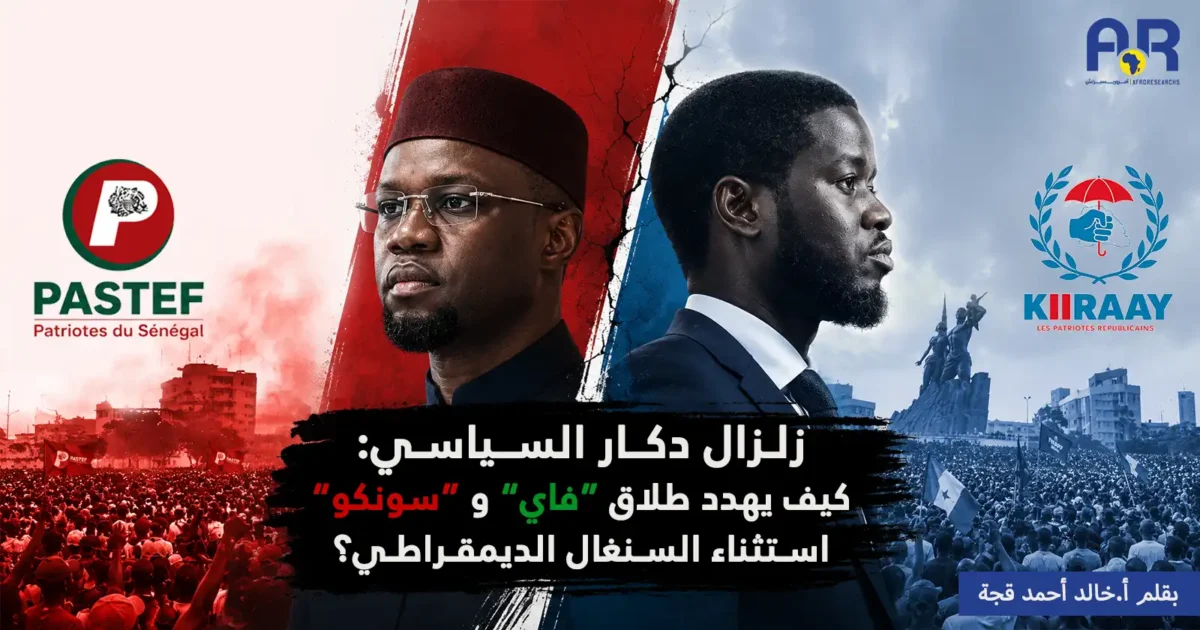
In the heart of West Africa — a region where civilian governments have fallen like autumn leaves under the weight of successive military coups — Senegal has for decades stood as an impregnable fortress of democracy and a model of the peaceful transfer of power. Today, however, the capital Dakar is living through an unprecedented “political earthquake” whose aftershocks threaten to redraw the country’s party and constitutional map from the roots up. On 25 July 2026, Senegalese President Bassirou Diomaye Faye appeared before the public to formally announce the founding of his new political party, “Kiiraay” (The Republican Patriots) — a move that amounts to an irrevocable divorce and a final, definitive break with his former ally and political mentor, his dismissed prime minister, Ousmane Sonko.
This dramatic development is no mere passing party defection in the back rooms of politics; it is an open declaration of the collapse of the “dual leadership” model — the “two-headed majority” — that had carried the two men’s alliance into the presidential palace in March 2024 under the celebrated popular slogan “Diomaye is Sonko, and Sonko is Diomaye.” The corridors and offices of power have proven too narrow to accommodate both the radical, populist “legitimacy of the street” that Sonko embodies and the “legitimacy of institutions” and pragmatism imposed by the presidency that Faye holds.
In this in-depth analysis, we plunge into the inner workings of this violent collision, unpack its economic and institutional roots, summon the ghosts of Senegalese history, and look ahead to the reverberations of this crisis for the future of democracy in a country poised on the brink of a major economic and geopolitical transformation.
The Deep Roots of the Rupture: The Curse of Debt and the Mirage of Revolution
To grasp the nature of this fracture, one must return to the beginnings that once bound together the shared struggles of two former tax inspectors, Faye and Sonko. The two men jointly founded the “PASTEF” party in 2014, channelling the anger of an urban youth aggrieved by corruption and unemployment into an electoral flood that swept away the regime of former President Macky Sall. When Sonko was barred from running for the presidency by politically motivated court rulings, Faye became the “Plan B” who carried the presidential election in the first round with a crushing 54.28%.
But the euphoria of revolutionary victory soon collided with a catastrophic financial reality. Immediately upon taking the reins of power, the new administration uncovered hidden sovereign debts left behind by the previous regime worth some 13 billion dollars, driving the public-debt ratio to a perilous 132% of GDP. Here the first cracks in the alliance appeared: President Faye chose the path of “reason of state” and pragmatism, entering into gruelling negotiations with the International Monetary Fund to rescue the economy and stave off default on international bonds falling due one after another. This came at the price of harsh conditions — raising tax revenues by 40%, scrapping subsidies, and reviewing opaque loans such as the “Total Return Swap” (TRS) arrangements concluded with major financial institutions.
In sharp counterpoint, Sonko rose up in defiance, clinging to his populist, sovereigntist rhetoric and casting any submission to IMF dictates or accession to restructuring programmes as a “disgrace” and a surrender of African sovereignty. Sonko demanded radical alternatives: allocating two billion dollars to fuel subsidies and ratcheting up pressure on foreign mining and energy companies — threatening to revoke 71 mining licences, freezing the accounts of major firms such as the Industries Chimiques du Sénégal to reclaim vast tax arrears, and taking aim at oil and gas majors such as “Woodside” and “BP.” This stark divergence stalled development plans and led to Senegal’s credit rating being downgraded twice in succession in under a year, leaving the country liable for repayment burdens approaching 10 billion dollars.
“Kiiraay”: The President’s Shield and the War to Dismantle Alliances
As Sonko’s language of defiance escalated — seizing on Faye’s absence during an official visit to Washington to complain of being sidelined, then later declaring at a public rally that “Diomaye is not Sonko,” thereby disowning the campaign slogan — President Faye realised that his political survival and the protection of his programme demanded complete independence from the PASTEF party machine that Sonko controlled. The response came decisively on 22 May 2026, when Faye issued a shock decree dismissing Sonko from the premiership and appointing the technocrat Amadou Lamine Lô in his place, in a government wholly stripped of any representation for the ministers of the old party.
This trajectory was crowned on 25 July 2026 with Faye’s announcement in Dakar of the founding of his new party, “Kiiraay — The Republican Patriots,” a word that means “the shield” in the local Wolof language. The party adopted the slogan “The Nation First” and took as its visual emblem an umbrella unfurled over a map of Senegal — an implicit message that the age of loyalty to individuals is over and that the state alone is the shield. In his founding address, Faye spoke as a man of state and institutions, asserting emphatically that what safeguards the country’s stability, in calm and in storm alike, is not revolutionary slogans or crowds, but “institutions” alone.
The founding was no creature of the moment; it was deftly engineered by former Prime Minister Aminata Touré and saw the fusion and merger of 437 entities, parties and political movements. The strategy of Faye and his fledgling party rests on drawing in young defector leaders from PASTEF, along with more than 400 mayors from former President Sall’s “Alliance for the Republic” (APR) — the aim being to seize control of 80% of the municipalities in the local elections slated for 2027 and to clear the path toward the presidential election of 2029.
The Senegalese press greeted the event with visible division. While the daily “Sud Quotidien” read the move as a legitimate defence of the Republic’s institutions and its ethics, “Le Quotidien” underscored Faye’s success in penetrating the electoral strongholds of rivals and allies alike. The newspaper “Walfadjri,” for its part, delivered a scathing critique under the headline “Deferred Priorities,” holding that this cockfight at the summit of power amounts to a deliberate distraction that turns a blind eye to the plight of the ordinary citizen whose bones are ground down day after day by soaring prices and unemployment.
A Clash of Institutions: From the Parliamentary Chamber to the Threat of the “Nuclear Option”
Ousmane Sonko did not bow to the presidential blow; instead he carried the battle to another arena where he holds the upper hand. He leveraged his party’s crushing parliamentary majority — it had won 130 of 165 seats in the early legislative elections held on 17 November 2024, after Faye dissolved the previous parliament — to ascend to the presidency of the National Assembly on 26 May 2026. The vote unfolded in a stormy session boycotted by the opposition, which branded it a “constitutional coup” on the grounds that Sonko had never been an elected deputy in the first place.
Senegal thereupon turned into a theatre of tense “cohabitation” between two heads. On 27 April 2026, President Faye sought to push through constitutional reforms designed to rebalance the executive branch and to create a nine-member Constitutional Court with sweeping powers to supplant the Constitutional Council — a manoeuvre to clip parliament’s wings. In riposte, the National Assembly under Sonko’s leadership attempted in late June 2026 to pass a legislative amendment barring the President of the Republic from leading a political party, in an unmistakable pre-emptive bid to strangle the “Kiiraay” party at birth. The Constitutional Council, however, intervened forcefully on 9 July 2026 through its decision no. (6/C/2026), striking down the amendment for breaching the constitution’s financial and legislative procedures.
The strategic peril lies in the fact that, under Article 87, President Faye is constitutionally barred from dissolving the National Assembly again before two years have elapsed since the last election — that is, until November 2026. With Sonko repeatedly threatening to table a motion of no confidence against the government of Amadou Lamine Lô, constitutional-law scholars believe Faye may be driven — should the legislative horizon seal shut and the budget seize up — to invoke “Article 52” of the constitution. This exceptional provision grants the President the power to govern by decree and direct order, bypassing parliament — an option akin to a “nuclear option” that could set the Senegalese street ablaze and pitch the country into a spiral of violence with dire consequences.
The Ghost of 1962: Will History Repeat Itself, or Will the Scales Tip?
Today’s fraught Senegalese scene cannot be read without recalling a political memory weighed down by the trauma of the December 1962 crisis. In that founding period, the country’s first president, Léopold Sédar Senghor — who then embodied the legitimacy of institutions, pragmatism and financial openness toward France — collided with his comrade-in-arms and prime minister Mamadou Dia, who espoused a radical socialist vision calling for an immediate break with Paris and with the traditional economy of the marabouts. That crisis ended with Dia accused of orchestrating a coup, which led to his imprisonment and the entrenchment of absolute presidential power in Senghor’s hands.
Today, Diomaye Faye assumes the role of a latter-day Senghor with his pragmatism and his alignment with international institutions and the IMF to rescue the state treasury, while Sonko embodies, par excellence, the figure of Mamadou Dia with his radical revolutionary rhetoric spurning dependency, French influence and the CFA franc. Yet the essential, historic difference is that Sonko today commands what Dia never possessed: an absolute parliamentary majority and a formidable capacity — honed by a ferocious activist record — to mobilise the street through social media and an urban youth that sees in him a symbol of deliverance. This makes resolving the crisis with a presidential “knockout blow,” as happened in the 1960s, a scenario laden with the risk of igniting civil war or wholesale civil disobedience.
The Mantle of the “Marabouts”: A Safety Valve in the Face of the Storm
In Senegal, politics cannot be prised apart from the immense weight of the Sufi brotherhoods (such as the Mouride and the Tijaniyya), whose economic and social sway has historically cast them as a “safety valve” in moments of grave crisis. President Faye is keenly aware of this reality — which explains his pilgrimage to the holy city on the eve of the grand “Grand Magal” of Touba celebrations in the summer of 2026. There, before the religious leadership, Faye pledged to inject massive investments worth 32 billion CFA francs into infrastructure projects and the building of private hospitals to shield the city from flooding, in an open bid to secure a conservative spiritual and communal cover for his new party and his technocratic government.
Ousmane Sonko, by contrast, has long grappled with the wariness of certain religious leaders toward his radical, revolutionary rhetoric, which his opponents painted as carrying “Salafist” or “anti-confraternity” leanings. Despite his shrewd attempts to make amends by founding supportive youth movements from within religious circles, such as the “Patriots of the Sons of the Quranic Schools” movement (MODDAP), the open clash with the presidency may nudge the traditional religious establishment — which by temperament inclines toward stability — to fall in behind President Faye’s legitimacy in order to avert strife.
An Economy on the Edge of the Abyss and the “Senegal 2050” Ambitions Left to the Winds
This grinding political crisis strikes the Senegalese economy at its very core, and at a pivotal, historic juncture. The country recently unveiled its strategic development plan, “Senegal 2050,” which aims to bring about a sweeping structural transformation — raising per-capita income by 50% within five years, training 700,000 young people for integration into the labour market, and curbing an excessive reliance on external debt.
This ambition coincides with Senegal’s formal entry into the club of oil- and gas-producing nations. In June 2024, production came on stream at the “Sangomar” oil field, recording some 17 million barrels in its first year, with plans to reach 100,000 barrels per day. In parallel, the “Grand Tortue Ahmeyim” (GTA) liquefied-natural-gas project, shared with Mauritania, entered its first phases with a production capacity of 2.5 million tonnes per year destined for Europe.
Yet the absence of legislative consensus and the institutional paralysis threaten to derail the fiscal and tax reforms the donors demand. Without parliament’s endorsement — parliament being under Sonko’s control — of the austerity and restructuring plans, Senegal confronts the catastrophic risk of an outright default on the Eurobonds maturing in the summer of 2026, which would spell the collapse of international confidence, capital flight, and the metamorphosis of the dream of oil wealth into an economic nightmare.
Aftershocks of the Storm: A Crisis-Ridden ECOWAS Presidency
The tremor of this earthquake does not halt at Senegal’s national borders; it reaches out to convulse a turbulent regional landscape. Senegal was recently chosen to take up the presidency of the Commission of the Economic Community of West African States (ECOWAS – CEDEAO) for the 2026–2030 period, represented by General Birame Diop, with President Faye assuming the chairmanship of the Conference of Heads of State.
Faye — with his pragmatism and his measured discourse — was expected to play the historic role of mediator, salvaging the organisation and coaxing back the withdrawn military states (Mali, Burkina Faso, Niger — the Alliance of Sahel States, AES). His profound internal crisis, however, hollows out that diplomacy. For while Faye represents ECOWAS’s conservative institutional line, Sonko’s sovereigntist, anti-French-colonial discourse clearly overlaps with the populist ideology of the rebel military regimes of the Sahel. This internal rift poses a fundamental question to regional partners: how can Dakar export a model of stability and mediation to its neighbours while its own legislative and executive institutions teeter on the edge of collapse and open confrontation?
Conclusion
President Bassirou Diomaye Faye’s decision to found the “Kiiraay” party represents a strategic choice to side with the logic of the state, its institutions and its pressing economic constraints, against the popular revolutionary tide and the radical rhetoric that carried him to the presidency. But this choice subjects the resilience of the Senegalese “democratic exception” to its severest historic test. Between a president entrenched behind the palace and his technocratic government, and a populist leader who dominates parliament and holds the pulse of the street, the Senegalese people’s yearning to escape poverty — and the future of stability across the whole of West Africa — remain hostage to a brutal war of attrition, one from which no one may emerge victorious should the country slide toward the edge of the constitutional and societal abyss.