Determinants of Economic Growth and Digital Transformation in Africa
A Critical Analytical Study in Light of the United Nations Economic Report on Africa 2026

Abstract
The United Nations Economic Report on Africa 2026 presents a complex picture of the African economy, combining an improvement in aggregate indicators with the persistence of structural imbalances that limit the achievement of sustainable and inclusive economic development. The report affirms that the continent is on a path of gradual economic recovery, supported by rising public investment, improving domestic demand, and falling inflation rates in a number of countries, alongside expanding investment in infrastructure and digital transformation. This improvement, however, is not distributed evenly across countries and regions, as growth rates continue to reflect a clear disparity in economic structures, institutional efficiency, and levels of political stability.
East Africa stands out as the fastest-growing region on the continent, with its growth rate projected to rise from 5.4% in 2025 to 5.8% in 2026, benefiting from strong domestic demand, infrastructure investment, and the diversity of productive activities. It is followed by West Africa at close to 4.5%, driven by economic reforms and the expansion of the energy and services sectors, while North Africa maintains a growth rate of around 4.4% thanks to the diversity of its economic activity across energy, agriculture, tourism, and services. By contrast, the performance of Central Africa and Southern Africa remains more modest, owing to persistent structural constraints, weak productivity, and the impact of political and environmental crises.
The report also illustrates the effect of energy-market volatility in shaping the contours of economic growth: oil-importing countries benefited from the decline in crude prices from USD 79 per barrel in January 2025 to around USD 64 in November of the same year, while oil-exporting countries faced fiscal pressures because some of them depend on oil for more than 80% of their total exports — a fact that reflects the continued fragility of rentier economies in the face of external shocks.
In another context, the report affirms that digital transformation has become one of the principal drivers of economic growth in Africa, with the services sector contributing 48.8% of GDP, against 26.2% for industry and 17.9% for agriculture. The report holds that integrating advanced technologies — such as artificial intelligence, financial technology, cloud computing, and big-data analytics — can raise productivity, enhance financial inclusion, and increase the competitiveness of African economies.
National experiences support this vision. In Mauritius the business-process-outsourcing sector now contributes about 5.8% of GDP, while the technology sector’s contribution in South Africa is projected to rise to between 15% and 20% of GDP. In Ghana the contribution of the information and communications technology sector rose from GHS 4.4 billion in 2016 to GHS 21 billion in 2022, while digital financial services raised GDP by between 8% and 10% and lifted average per-capita income by about USD 530.
Despite these positive indicators, the report reveals persistent structural challenges that limit technology’s capacity to bring about comprehensive economic transformation — most notably weak digital infrastructure, a skills shortage, a widening digital divide between countries and regions, limited financing, and the need to develop digital governance and legislative frameworks. It is also noted that higher growth rates are not always reflected in improved human-development indicators, as is evident in the persistently high poverty rate in Guinea — around 52% — despite its high growth rates.
From a critical analytical perspective, the report shows that the future of the African economy is not tied to higher growth rates alone, but to the ability of states to convert this growth into structural development founded on economic diversification, strengthened innovation, investment in human capital, and institutional development — thereby reducing dependence on primary-commodity exports and increasing African economies’ capacity to withstand external shocks. Digital transformation therefore represents a strategic opportunity to rebuild the African economy, though its success remains contingent on integrating institutional reform, investing in knowledge, and achieving fairness in the distribution of the fruits of growth, so as to move the continent from a natural-resource-based economy to one founded on innovation, productivity, and sustainable development.
General Introduction
Economic growth is one of the fundamental indicators for measuring the capacity of national economies to achieve development and improve levels of welfare. Yet contemporary economies are no longer measured by aggregate growth rates alone, but by the extent to which they can bring about structural transformation that enhances productivity, raises the efficiency of resource allocation, and lays the foundation for an economy better able to withstand crises and international volatility.
Over the past two decades the African continent has become an increasingly important focus of international economic debate — not only for the vast natural resources and growing consumer markets it possesses, but also for the structural changes it is undergoing in patterns of production, investment, and economic integration. African economies have gradually shifted from a focus on exploiting primary resources toward adopting broader development visions aimed at diversifying the productive base, strengthening industrialization, developing infrastructure, and leveraging technological progress to rebuild the various economic sectors. Even so, these economies still face a complex set of challenges linked to weak productivity, high rates of poverty and unemployment, and developmental disparities between regions, in addition to the effects of global economic volatility, climate change, and geopolitical tensions — all of which make the study of the determinants of economic growth in Africa a matter of growing scholarly and practical importance.
In this context, the United Nations Economic Report on Africa 2026 (Economic Report on Africa 2026) acquires particular significance: it does not merely present aggregate growth indicators but offers an analytical vision linking economic performance, institutional reforms, infrastructure investment, digital transformation, and advanced technologies as intertwined factors that help shape the future of the African economy. The report also presents a precise comparison between the continent’s subregions, illustrating the disparity in growth rates, the difference in their drivers, and the factors that enhance some countries’ capacity to achieve high growth rates relative to others.
The report reveals that economic growth in Africa is no longer tied to natural resources alone, but increasingly depends on institutional efficiency, the quality of economic policies, investment in human capital, and the adoption of technology and innovation. Advanced technologies — artificial intelligence, big-data analytics, cloud computing, and financial technology (FinTech) — have become key tools reshaping the services, industry, and agriculture sectors, contributing to higher productivity, greater financial inclusion, the attraction of foreign direct investment, and improved efficiency of public services. Technology, therefore, is no longer merely a factor that supports growth; it has become a structural component of the process of economic transformation.
Nevertheless, this transformation is not without complications and challenges. The digital divide between countries, weak technological infrastructure, a shortage of digital skills, limited financing, and the continued dependence on exporting raw materials all constitute obstacles that limit African economies’ ability to fully harness the digital revolution. Moreover, higher economic growth rates do not necessarily mean the achievement of inclusive development, since positive economic indicators may coexist with persistent poverty, high unemployment, and widening social and regional disparities — which makes it necessary to distinguish between economic growth (an increase in output) and economic development (a structural process aimed at improving quality of life and raising the level of social welfare).
On this basis, this study adopts a critical analytical reading of the first chapter of the United Nations Economic Report on Africa 2026, aiming to move beyond a descriptive presentation of economic indicators toward an analysis of the determinants behind the continent’s economic performance, to clarify the nature of the relationship between digital transformation and economic growth, and to assess the extent to which advanced technologies can bring about structural transformation in African economies. The study also seeks to explain the disparities between subregions and to analyse the national experiences highlighted by the report — particularly in the fields of digital government, financial technology, and the digital transformation of services — while identifying the institutional, legislative, and financing challenges that still limit the use of technology as a tool for achieving sustainable development.
The importance of this study stems from the fact that it does not treat the report merely as a source of data and indicators, but as an analytical document reflecting the United Nations’ orientations in understanding the paths of economic development in Africa at the present stage. The study therefore seeks to offer a critical reading grounded in the analysis of quantitative indicators, linking them to institutional, technological, and developmental dimensions, so as to provide a deeper understanding of the factors that determine the future of the African economy and its potential to move from an economic model that relies primarily on natural resources to a productive model founded on knowledge, innovation, and the digital economy — one capable of achieving growth that is more sustainable, inclusive, and resilient to global economic shifts.
An in-depth analytical reading of the first part of the United Nations Economic Report on Africa 2026 reveals that the African economy continues to display a degree of resilience in the face of global economic pressures, benefiting from improved macroeconomic stability, increased public investment, and the expansion of infrastructure projects, alongside the growing role of technology and innovation in reshaping the continent’s economic structure. At the same time, the report shows that the growth path is still marked by clear regional and structural disparities, resulting from differing levels of development, varying institutional capacities, and the continued impact of geopolitical and climatic factors on the economic performance of African states.
Structure of the Study
1) Recent Economic Performance in Sub-Saharan Africa
2) Digital Transformation and Technology as Drivers of African Economic Growth
3) Advanced Technology and its Role in Developing Africa’s Productive Sectors: Toward a More Productive and Competitive Economy
4) Challenges of Digital Transformation and Prospects for Sustainable Economic Development in Africa
5) Conclusion
6) Recommendations
7) Key Indicators of the Impact of Digital Transformation on African Economies
1) Recent Economic Performance in Sub-Saharan Africa
First: Improved Growth Performance in 2026–2027, Supported by Public Investment
Africa’s real GDP growth rate recovered to around 4.0% in 2025 and is expected to hold at the same level in 2026 before rising to 4.1% in 2027. This rate is higher than the growth projected for Latin America and the Caribbean (2.3%), yet it remains below the rates recorded in East and South Asia (4.6%) and West Asia (4.1%).
The report attributes this improvement to better macroeconomic stability — particularly in the larger African economies — alongside increased public investment and a recovery in consumer spending. Even so, African economies continue to face external and internal challenges, chief among them geopolitical tensions and the political unrest that followed elections in some countries.
The report notes that some African governments have moved to implement policies to consolidate public finances, by rationalizing spending and prioritizing long-term capital investments in order to promote sustainable economic growth. It cites a number of strategic projects that have helped support economic activity — such as the high-speed rail project in Egypt, the Konza Technopolis in Kenya, and the Lagos Free Trade Zone in Nigeria — noting that the effects of these projects were not confined to improving economic connectivity but also helped attract foreign direct investment and bolster investor confidence.
These indicators reveal that the report adopts a perspective linking economic growth with infrastructure investment as a principal driver of higher productivity and improved competitiveness. It also highlights that public investment plays not merely a fiscal role, but helps create an economic environment attractive to private capital, whether domestic or foreign. The projected growth, therefore, is not explained by higher aggregate demand alone, but reflects an orientation toward investment in productive assets capable of generating long-term economic returns.
The regional comparison also shows that Africa has begun to narrow the gap with some developing regions, yet it still underperforms the economies of East and South Asia — pointing to a continued need to strengthen innovation, improve productivity, and develop industrial and technological capacities.
Although the report offers an optimistic view of improving economic growth, it focuses heavily on aggregate indicators without adequately discussing the extent to which this growth is reflected in improved living standards or in the reduction of poverty and inequality within African states. Relying on public investment alone may also be insufficient to achieve sustainable economic transformation if it is not accompanied by institutional reforms, an improved business environment, and greater efficiency of public administration.
It is also noticeable that the report presents successful models of infrastructure projects but does not address in detail the potential risks associated with financing them — such as rising indebtedness, disparate economic returns across countries, or African economies’ capacity to maintain and sustain these projects. Likewise, the continued impact of geopolitical tensions and political unrest may limit some countries’ ability to fully benefit from the anticipated investment momentum.
It can be concluded that the growth projected for Africa in 2026–2027 reflects a relative improvement in the economic environment, supported by public investment and macroeconomic stability. Yet the sustainability of this growth remains contingent on African states’ ability to convert capital investment into real productivity gains, strengthen economic diversification, raise institutional efficiency, and expand investment in technology, innovation, and human capital. Achieving comprehensive economic transformation, therefore, does not depend on higher growth rates alone but requires building a development model capable of withstanding external shocks and delivering more inclusive and sustainable development.
Second: Divergent Performance of Africa’s Oil-Importing and Oil-Exporting Countries
Despite the recovery of Africa’s GDP growth in 2025, the performance of oil-importing and oil-exporting countries followed two different paths. Oil-importing economies benefited from the marked decline in crude prices, as the price per barrel fell from USD 79 in January 2025 to around USD 64 in November of the same year. This decline is attributable to a set of factors, most notably the uncertainty surrounding US trade policy and weaker-than-expected global demand, particularly in major economies such as Brazil, China, and India.
By contrast, the report expects that falling oil prices will produce negative outcomes for Africa’s largest oil-exporting countries — especially Algeria, Angola, and Nigeria — given their economies’ heavy dependence on oil revenues. In most of these countries, oil exports account for more than 80% of total exports, making them more exposed to fluctuations in global markets.
The report also notes that expectations of higher global oil demand, coupled with the anticipated increase in production by the OPEC+ alliance, may keep downward pressure on prices as a result of increased global supply — which in turn helps improve the prospects for containing inflation, especially in oil-importing countries.
In light of these developments, the report expects the growth rate of oil-exporting countries to decline from around 4.0% in 2025 to 3.7% in 2026, owing to continued low oil prices and the possibility of a surplus in global markets. It adds that the fragile political situations in Libya, South Sudan, and Sudan represent an additional factor that heightens uncertainty and adversely affects these countries’ economic performance.
This part of the report reflects the dual nature of the continent’s economies, in that global economic variables do not produce identical outcomes across all countries; rather, their effects differ according to economic structure and sources of national income. The fall in oil prices — good news for energy-importing countries — simultaneously becomes a source of fiscal and economic pressure for countries whose public budgets depend mainly on oil revenues.
These findings indicate that the dependence of a number of African economies on exporting a single primary commodity makes them more vulnerable to external shocks — underscoring the persistence of what the economic literature terms the fragility of the rentier economy, in which growth rates, public-spending levels, and fiscal balances are tied to commodity-price fluctuations more than to real production or economic diversity.
The report also highlights the importance of energy prices as a variable affecting inflation. Oil-importing countries benefit from lower import costs, which eases inflationary pressures, reduces transport and production costs, and gives governments greater fiscal space to channel resources toward investment in infrastructure or social services. For oil-exporting countries, by contrast, declining revenues may push them to cut public spending or increase borrowing, with negative effects on growth and investment.
The report further shows that geopolitical factors have become an integral part of explaining economic performance in Africa. Internal political tensions in some oil-producing countries, together with disruptions in global markets, confirm that economic growth is no longer solely a product of economic variables but has become linked to the degree of political stability, institutional efficiency, and governments’ ability to manage crises.
The reference to OPEC+ policies reveals the extent to which African economies are integrated into the global energy market, where oil prices are no longer set solely by domestic supply and demand but are now shaped by international production decisions, geopolitical competition, investor expectations, and global economic trends.
Although the report offers a logical explanation for the divergent performance of oil-importing and oil-exporting countries, it focuses primarily on the effect of oil prices without giving sufficient attention to the internal structural factors that determine countries’ capacity to absorb economic shocks. Some oil-producing countries have succeeded in limiting the impact of price volatility through diversifying income sources and establishing sovereign wealth funds and productive investments, while others have remained hostage to cyclical fluctuations because of weak economic diversification.
The report also implicitly assumes that lower oil prices automatically improve the situation of importing countries; yet this effect remains conditional on governments’ ability to invest the fiscal savings in productive sectors rather than directing them to short-term consumption spending. Lower prices thus represent a potential development opportunity, but they do not guarantee development unless accompanied by economic and institutional reform.
From another angle, the report does not discuss in depth the impact of the global shift toward clean energy on the future of oil-dependent African economies. Continued reliance on oil revenues amid the international drive to reduce carbon emissions may impose long-term structural challenges that go beyond mere cyclical price fluctuations and require a reformulation of the economic strategies of energy-producing countries.
This part of the report confirms that global oil-market volatility does not affect all African economies to the same degree; rather, its effects are determined by the nature of the productive structure and the extent of income-source diversity. It also highlights that excessive dependence on oil exports increases economies’ fragility in the face of external shocks, whereas economic diversification and investment in productive and technological sectors provide greater capacity for stability and sustainability. Moving toward a more diversified economy — founded on innovation, industry, and high-value-added services — thus represents one of the essential conditions for strengthening African economies’ resilience and reducing their sensitivity to global energy-market fluctuations.
Third: East Africa Leads Economic Growth at the Subregional Level
Economic growth rates varied across Africa’s subregions in 2025, with East Africa retaining its position as the fastest-growing region: its real GDP growth is estimated at around 5.4% in 2025 and is projected to rise to 5.8% in 2026. This performance is attributed to strong growth in Djibouti, Ethiopia, Rwanda, Tanzania, and Uganda, underpinned by continued strong domestic demand, increased investment in infrastructure projects, and robust performance in the agriculture and mining sectors. Nonetheless, conflicts in eastern Democratic Republic of the Congo, Madagascar, and South Sudan remain among the most significant challenges facing the region and limit the sustainability of its growth.
This paragraph reveals that economic growth within Africa is not homogeneous but is unevenly distributed across regions — reflecting differences in economic structures, levels of political stability, and the effectiveness of development policies. The report highlights East Africa as the continent’s new economic center of gravity, owing to a number of its states’ reliance on infrastructure investment, diversification of economic activities, and stronger domestic demand, rather than excessive dependence on exporting raw materials.
The report also shows that growth in East Africa rests on a multi-sector productive base spanning agriculture, mining, and services — which affords the region’s economies greater resilience in the face of external economic shocks compared with economies that depend on a single sector or a single primary commodity.
From another angle, the report highlights the close relationship between infrastructure investment and economic growth, as developing transport, energy, and communications networks improves the business environment, lowers production costs, increases competitiveness, and attracts more domestic and foreign investment.
The findings indicate that East Africa’s distinctive economic performance is not tied to a single factor but reflects the interaction of a set of economic and institutional factors. Strong domestic demand provides an internal market supportive of production, while government investment in infrastructure helps remove the constraints that impede economic activity. At the same time, the diversity of productive sectors distributes income sources and reduces reliance on any single sector, thereby increasing the economy’s capacity to absorb external shocks.
By contrast, the reference to armed conflicts confirms that economic growth cannot be separated from the political and security environment, as conflicts disrupt supply chains, weaken investor confidence, and drain public resources — limiting the prospects for sustainable growth even in economies that possess strong productive foundations.
Although the report presents East Africa as a successful model of economic growth, it focuses primarily on aggregate indicators without sufficiently discussing the extent to which this growth is reflected in improved living standards or the reduction of poverty and inequality. A higher growth rate does not necessarily mean inclusive development if the economic returns remain concentrated in particular sectors or areas to the exclusion of others.
Nor does the report provide sufficient analysis of the differences among the region’s own countries, since the economic and institutional capacities of Ethiopia, Rwanda, Tanzania, and Djibouti differ markedly — making the interpretation of growth at the regional level less precise if these differences are not taken into account. It is also noticeable that the report links growth to increased infrastructure investment but does not discuss at length the sustainability of financing these projects, nor the impact of rising public debt in some countries on the continuation of this growth over the long term.
It can be concluded that East Africa currently represents the principal engine of economic growth on the continent, thanks to its relative success in combining infrastructure investment, diversification of productive activities, and stronger domestic demand. Yet the continuation of this performance remains contingent on the region’s states’ ability to contain armed conflicts, strengthen institutional stability, and convert economic growth into inclusive development reflected in improved incomes, employment, and quality of life — so as to ensure the sustainability of economic gains and prevent them from being confined to aggregate indicators alone.
Fourth: West Africa — Growth Driven by Reforms and Investment in Productive Sectors
The report expects West Africa to achieve an average growth rate of 4.5% over the period 2025–2026, with Senegal topping the region at an average growth rate of 7.5%, followed by Niger at 7.1% and then Guinea at 6.6%. Senegal’s distinctive economic performance is attributed to continued growth in the hydrocarbons sector, alongside a favorable economic environment — including low inflation — as well as the government’s implementation of a program of economic reform and transformation. This program is built on encouraging foreign direct investment, supporting digital transformation, improving the efficiency of government administration and public services, narrowing the digital divide, and fostering innovation and entrepreneurship.
Growth in Guinea rests on increased activity in the mining and agriculture sectors, yet the report notes that this growth has not been inclusive, as the national poverty rate still stands at 52% of the population. The report also expects Nigeria’s economy — the largest in the region — to record a growth rate of 3.8% in 2026, driven by increased oil production and a strong services sector, in addition to gains from internal economic reforms. Despite the recalculation of GDP using 2019 as a base year, the services sector remains the largest and most significant contributor to the Nigerian economy.
These indicators reveal that West Africa represents a diverse economic model combining natural-resource-dependent economies with those that have begun to move toward the digital economy and institutional reform. It is noticeable that the report does not link growth to a single factor but to a set of economic determinants that differ from one country to another.
The report also highlights the growing role of the services sector in Nigeria, which reflects a gradual shift toward a more diversified economy in which financial, digital, and communications services have become an important source of GDP alongside the oil sector. The continued dominance of the services sector reflects an evolution in the economic structure, but it does not eliminate the ongoing dependence on oil as a principal source of revenue — which leaves the economy exposed to global-market fluctuations.
The report presents West Africa’s experience as an example of the diversity of growth paths, but it does not sufficiently discuss the challenges associated with the sustainability of this growth. Reliance on the hydrocarbons sector in Senegal or on oil in Niger and Nigeria remains tied to global price fluctuations and shifts in the energy market, which may limit the stability of economic performance over the long term.
The report also notes the success of digital-transformation and administrative-reform programs in Senegal, but it does not assess the extent to which these reforms have improved productivity, created jobs, or reduced social inequality. The focus appears to have fallen on growth rates more than on the quality of that growth and its developmental effects.
The case of Guinea stands out as evidence that higher GDP does not necessarily mean improved social welfare, as the persistently high poverty rate of 52% reveals the limited transmission of the fruits of growth to the various segments of society — underscoring the need to adopt more equitable policies for the distribution of economic returns.
It can be inferred that West Africa’s economies are following divergent development paths, combining reliance on natural resources, institutional reforms, digital transformation, and the development of the services sector. Yet the sustainability of these paths remains contingent on states’ ability to diversify their productive bases, reduce dependence on raw-material exports, and link economic growth to improved human-development indicators and social justice. The region’s experience also confirms that real growth is not measured by higher GDP alone, but by its capacity to create jobs, reduce poverty, and strengthen the economy’s competitiveness in the face of global volatility.
Fifth: Real GDP Growth Rate in Africa by Subregion (2024–2026)
The real GDP growth rate is one of the most important economic indicators used to assess economic performance, as it reflects the actual increase in the value of goods and services produced after excluding the effect of inflation, thereby providing a more accurate picture of the level of real economic activity. Studying this indicator in the African continent acquires particular importance given the clear disparity between subregions in terms of natural resources, economic structure, levels of development, political stability, and the capacity to attract investment, in addition to differences in the economic policies and structural reforms pursued by the countries of each region.
Over the period 2024–2026, estimates point to a continued recovery of African economies, supported by improving domestic and external demand, increasing investment in infrastructure, the expansion of the digital economy, and improved performance in the agriculture, industry, and services sectors in a number of countries. At the same time, growth rates continue to be affected by a set of challenges — most notably high levels of public debt, commodity-price volatility, climate change, and continued inflationary pressures, alongside geopolitical tensions that affect supply chains and the movement of trade and investment.
The comparison between subregions also shows that growth rates are not distributed evenly across the continent but differ according to economic structures, the degree of productive diversity, and the level of regional integration. Some regions achieve high growth rates as a result of expansion in the services, technology, energy, and public-investment sectors, while others face a relative slowdown owing to heavy dependence on primary-commodity exports or their exposure to conflicts and security and environmental challenges. This confirms that achieving sustainable economic growth is not tied solely to the abundance of natural resources but also depends on the quality of economic policies, institutional efficiency, human-capital development, the strengthening of digital transformation, and infrastructure development — all of which support African economies’ capacity to achieve more sustainable and inclusive growth rates in the years ahead.
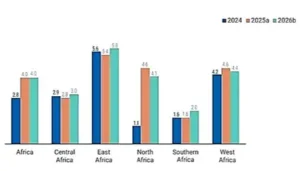
Figure (1): Comparison of real GDP growth rates
across African subregions, 2024, 2025, and 2026.
The data show that East Africa retains its position as the fastest-growing region, with its growth rate rising from around 5.3% in 2024 to 5.4% in 2025 and then to 5.8% in 2026 — the highest growth rate among all African regions. West Africa comes second, with its growth rate rising gradually from around 4.1% to 4.5% and then 4.6%, reflecting improved economic activity in a number of the region’s countries. North Africa, meanwhile, maintains a relatively strong economic performance, recording a growth rate of nearly 3.8% in 2024 before rising to 4.4% in both 2025 and 2026.
By contrast, Central Africa records more moderate growth, rising from around 3.4% to 3.5% and then 3.7%, while Southern Africa remains the lowest-growing region, improving from about 2.2% in 2024 to 2.5% in 2025 and then to around 2.8% in 2026. The comparison reveals that all African regions are trending toward higher growth rates in 2026, though the pace of this improvement differs markedly from one region to another.
The figure reflects that economic growth in Africa does not proceed at a single pace but is marked by clear regional disparity that mirrors differences in economic structures, investment levels, political stability, institutional efficiency, and the degree of economic openness.
East Africa stands out as the most dynamic model on the continent, thanks to the success of a number of its countries in channeling investment toward infrastructure, improving the business environment, strengthening domestic demand, and diversifying productive sectors. The continued rise in growth rates over the three years confirms that the region’s economies possess a relative capacity to maintain growth momentum despite global challenges.
West Africa’s growth path, for its part, reflects a number of its economies’ benefit from economic reforms, improved energy production, and expanding service activity — though some countries’ continued dependence on oil and primary-commodity exports leaves this growth more closely tied to global-market fluctuations. In North Africa, the data reveal a more stable performance, supported by the diversity of economic activity across energy, industry, agriculture, tourism, and services — which affords the region’s economies a greater capacity for balance compared with single-sector economies.
In Central Africa and Southern Africa, the limited growth rates point to persistent structural challenges — such as weak industrialization, low productivity, limited investment, and continued dependence on raw-material exports — in addition to the impact of political crises in some countries.
These indicators suggest that economic performance in Africa is largely tied to each region’s ability to diversify its productive base and improve the efficiency of its economic institutions. Regions that have invested in infrastructure, digital transformation, and human-capital development have achieved higher and more sustainable growth rates, while less diversified economies have remained more exposed to external shocks.
The data also confirm that economic growth depends not only on the abundance of natural resources but is also linked to the quality of public policies, the efficiency of resource management, and the existence of a stable investment environment — which explains why some countries not rich in natural resources outperform countries that possess large reserves of oil or minerals.
Despite the figure’s importance in highlighting regional differences, it presents economic growth as the principal indicator of economic performance without clarifying the extent to which this growth is reflected in human-development indicators, job creation, or improved income distribution. A higher growth rate does not necessarily mean improved welfare for citizens if it is not accompanied by expanded employment, higher productivity, and improved basic services.
The figure also focuses on regional averages, which may conceal the large disparities between countries within a single region. A limited number of countries may achieve high growth rates that raise the regional average, while others continue to face deep economic and structural crises. It is also noticeable that the report does not discuss in detail the risks that could affect these projections — such as escalating geopolitical tensions, commodity-price volatility, or the effects of climate change — factors that could alter growth forecasts within a short period.
The figure confirms that Africa is trending toward a gradual improvement in economic performance, though this improvement is not distributed evenly across subregions. East Africa stands out as the continent’s principal growth engine, while some other regions continue to face structural challenges that limit their capacity to achieve high growth rates. Narrowing the development gap between African regions therefore requires policies focused on economic diversification, strengthening innovation, developing infrastructure, and improving governance — so as to move economic growth beyond a mere improvement in aggregate indicators toward more inclusive and sustainable economic and social development.
Sixth: The Performance of Central Africa and Southern Africa
The recovery of oil production and infrastructure investment in Libya is expected to bolster the economic performance of the North Africa region, despite the continued civil war in Sudan, which remains a factor weighing on the region’s growth prospects. In Central Africa, the economic growth rate is expected to rise from around 2.8% in 2025 to 3.0% in 2026, driven by increased investment in infrastructure — particularly in transport and digital transformation — alongside improved governance and institutions, enhanced macroeconomic stability through fiscal and monetary policies, the leveraging of natural resources (especially in the agriculture and energy sectors), and an accelerating pace of urbanization led by Cameroon, the Central African Republic, and Chad. Even so, Central Africa remains among the lowest-performing regions on the continent, ahead only of Southern Africa.
Southern Africa, for its part, is expected to achieve a growth rate of around 1.9% over the period 2025–2027, after recording stable growth of 1.6% since 2024. In South Africa, the region’s largest economy, growth remained limited at around 1.0% in 2025, with an expected rise to 1.4% in 2026 and 1.7% in 2027. The report attributes this limited performance to continued disruptions in energy supply, water shortages, and increasingly extreme climatic phenomena. By contrast, Zambia and Zimbabwe are expected to lead economic growth within the region in 2026, supported by improved performance in the mining sector, strong agricultural activity, and higher commodity prices.
Here the clear disparity in growth dynamics between the African regions is revealed, in which the economic factor intersects with political, institutional, and environmental dimensions. While some economies rely on the recovery of oil production or the exploitation of natural resources, others rely on improving the quality of institutions and investing in infrastructure and digital transformation.
The report illustrates the importance of investment in digital and transport infrastructure as a driver of growth in Central Africa, reflecting a gradual shift in the development vision — from confining activity to the exploitation of natural resources toward enhancing the economy’s efficiency and raising its productivity through improved basic infrastructure. By contrast, the report shows that Southern Africa’s limited performance is not due to a lack of economic resources but to the presence of structural constraints — such as energy crises, water scarcity, and climate change — factors that now directly affect productive capacity and investment attractiveness.
The data also confirm that environmental factors have become an influential element in explaining economic performance, reflecting the expanding relationship between the economy and sustainable development, whereby growth no longer depends solely on capital and labor but has become linked to states’ ability to manage natural resources and adapt to climate risks.
These findings indicate that achieving economic growth in Africa now requires a combination of institutional reforms, productive investment, and environmental policies. Countries that have managed to improve governance and develop infrastructure have achieved higher growth rates, even where their natural resources are limited.
The report also highlights that reliance on the mining or oil sector alone is not sufficient to achieve development, as the impact of these resources depends on the efficiency of their management and governments’ ability to deploy their revenues in support of economic and social development. From another angle, the reference to the energy and water crises in South Africa confirms that climate change has become a real economic constraint that affects industrial and agricultural production and limits the competitiveness of national economies.
Although the report links growth to improved governance and infrastructure investment, it does not provide a detailed analysis of the mechanisms for improving institutions, or of how to address the challenges associated with corruption and weak public administration — factors that represent among the most significant obstacles to development in a number of Central African countries.
The report also treats the impact of climate change as an external factor that limits growth, without discussing in depth climate-adaptation policies or the shift toward the green economy, which have become an essential element of modern development strategies. It is also noticeable that the continued reliance on mining and natural resources in some countries may limit the prospects for long-term structural transformation if it is not accompanied by an expansion of industrialization and the digital economy.
It can be concluded that the future of growth in Central Africa and Southern Africa depends on states’ ability to combine institutional reform, infrastructure investment, economic diversification, and adaptation to environmental challenges. The experiences presented in the report also confirm that the abundance of natural resources is not sufficient to achieve development unless it is managed within sound economic policies aimed at raising productivity, strengthening competitiveness, and achieving sustainable development.
2) Digital Transformation and Technology as Drivers of African Economic Growth
First: The Continued Dominance of the Services Sector in GDP, with a Growing Role for Technology and Innovation
Taking as a starting point the statement: “Advanced technologies and innovation hold great potential to accelerate the transformation of the services sector in Africa and to increase its contribution to GDP.”
This statement reflects the central idea on which the report rests: technology is no longer an independent economic sector but has become a driving force reshaping all economic sectors — especially the services sector, which is the largest contributor to GDP in most African economies. The report notes that applications of artificial intelligence, big-data analytics, cloud computing, and financial technology are capable of raising productivity, improving service quality, reducing transaction costs, and enhancing financial inclusion, thereby increasing the value added of the services sector.
From a critical perspective, this vision appears logical but may involve a degree of optimism, since achieving these outcomes is conditional on the availability of advanced digital infrastructure, effective legislation, and continued investment in education and digital skills, as well as on narrowing the digital divide between and within countries. Technology, therefore, does not bring about economic transformation automatically; its effectiveness depends on the institutional environment and the public policies that govern its use. It follows that the future of the African economy will be determined not by possessing advanced technologies in themselves, but by states’ ability to integrate them into development strategies and convert them into tools for raising productivity, strengthening competitiveness, and achieving more inclusive and sustainable economic growth.
The services sector continues to hold first place in terms of its contribution to Africa’s economic output, accounting for around 48.8% of GDP in 2024, followed by the industry sector at 26.2% — including manufacturing, which represents 11.3% — and then the agriculture sector at 17.9%.
The report holds that advanced technologies and innovation possess great potential to accelerate the transformation of the services sector as well as the industrial sector, and to increase their contribution to GDP — especially since the services sector in most African countries still relies heavily on traditional activities. At the same time, the report shows that most African economies still depend on agriculture, which calls for adopting policies and investments that harness advanced technologies and innovation — while taking climate change into account — in order to raise agricultural productivity.
Here an important shift in the structure of the African economy is revealed, in which the services sector has become the principal engine of economic activity, surpassing the industrial and agricultural sectors. This reflects a gradual evolution in the structure of African economies, though the report draws attention to the fact that this dominance does not necessarily mean qualitative advancement, because a large share of services is still traditional and low-productivity.
The report notes that integrating artificial intelligence, big-data analytics, cloud computing, and financial technology into the services sector can raise productivity, improve service quality, enhance financial inclusion, and increase value added — thereby helping to raise the sector’s contribution to GDP. In the agricultural sector, the report affirms that technology represents a means of improving productivity, rationalizing water use, and strengthening food security, especially amid the increasing effects of climate change on African economies.
The report adopts an optimistic view of technology’s role, but it implicitly assumes that digital transformation will automatically lead to higher productivity, whereas development experiences indicate that the success of this transformation requires strong digital infrastructure, effective legislation, investment in education and skills, and an institutional environment capable of absorbing innovation.
The report also does not sufficiently discuss the risks of digital transformation — such as the widening digital divide between and within countries, the potential loss of some traditional jobs as a result of automation, or issues of data protection and digital sovereignty — subjects that have become an essential part of the contemporary technology economy.
The report concludes that technology and innovation represent an essential pillar for restructuring the African economy, but that achieving this goal requires moving beyond the traditional use of technology toward building a knowledge economy founded on innovation, investment in human capital, and institutional development — so as to ensure that digital growth is converted into comprehensive and sustainable economic development whose effects are not confined to improving aggregate indicators but extend to raising productivity, creating jobs, and strengthening the competitiveness of African economies.
Second: Advanced Technologies and Innovation as a Driver of Economic Growth in Africa — Pioneering African Experiences
The report notes that the limited spread and level of adoption of advanced technologies in some economic sectors underscore the need to increase investment in technology. Strategic investments in digital infrastructure, together with comprehensive digital policies and institutional reforms, have contributed to tangible economic and social gains in many African countries in recent years.
Technological progress has also increasingly helped to drive economic growth by enhancing financial inclusion, developing education, supporting entrepreneurship, improving governance, and facilitating access to public services. These efforts have contributed to increasing the contribution of the information and communications technology (ICT) sector to GDP, enhancing financial inclusion, improving the efficiency of public services, and increasing flows of foreign direct investment in Ghana, Kenya, Mauritius, Morocco, and South Africa.
◆ The Mauritius Experience in E-Government and Business Process Outsourcing
In Mauritius, investment in digital infrastructure has been one of the most important factors contributing to the restructuring of the national economy and the enhancement of its competitiveness. The expansion of fiber-optic networks has provided high-speed internet connectivity throughout the country, improving data-transfer efficiency, reducing response times, and creating a digital environment capable of accommodating modern applications and services. This has helped attract foreign investment in the ICT sector and supported the shift toward the digital economy.
In parallel, the government has developed e-Government platforms by digitizing government services and making many transactions available online — such as company registration, tax services, licensing, and customs services — which has enhanced the efficiency of public administration, raised the level of transparency, reduced the time and costs associated with administrative procedures, facilitated the conduct of business, and improved the investment climate.
This digital development has been directly reflected in the growth of the business-process-outsourcing (BPO) sector, which relies on advanced digital infrastructure to provide its services to global companies — such as call centers, customer-support services, data processing, financial and accounting services, software development, and legal and administrative services. Mauritius has leveraged its geographic location, its workforce’s command of English and French, and its political stability to become a regional hub for providing these services to African, European, and Asian markets.
The business-process-outsourcing sector has become one of the vital sectors of the Mauritian economy, contributing around 5.8% of GDP, in addition to its role in providing thousands of jobs — particularly for young people and graduates in the fields of information technology, data analytics, business administration, and customer service. It has also helped diversify the economic structure, reduce dependence on traditional sectors such as agriculture and tourism, and enhance the country’s ability to integrate into the global digital economy — thereby supporting sustainable economic growth and raising Mauritius’s competitiveness internationally.
◆ The South Africa Experience in Developing the IT and Financial-Technology (FinTech) Sector
The development of digital infrastructure in South Africa has been an essential pillar for supporting the shift toward the digital economy and enhancing economic growth. The country has invested in expanding fiber-optic networks, improving communications services, and increasing the spread of high-speed internet, alongside developing data centers and cloud-computing services — helping to create a digital environment better able to accommodate innovation and technological investment.
This development has been directly reflected in the growth of the information and communications technology (ICT) and financial technology (FinTech) sectors, which have become among the most dynamic sectors in the South African economy. FinTech startups have helped expand the scope of digital payments, electronic banking, digital lending, digital insurance, and e-wallets — enhancing access to financial services for broad segments of the population, particularly individuals excluded from the traditional banking system, and helping to strengthen financial inclusion.
At the same time, the expansion of the digital economy has increased demand for specialized skills in the fields of software, cybersecurity, data analytics, artificial intelligence, and cloud computing — helping to create new jobs and develop digital skills. Digitization has also helped raise the productivity of institutions, reduce transaction costs, and improve the efficiency of service delivery in both the public and private sectors — thereby strengthening the competitiveness of the national economy.
In light of these developments, estimates indicate that the contribution of the ICT and FinTech sectors to South Africa’s GDP will rise to between 15% and 20% by 2025, compared with a range of 8% to 10% in 2020 — reflecting the growing role of the digital economy in supporting economic growth, expanding employment opportunities, enhancing financial inclusion, and raising levels of productivity and innovation.
◆ The Kenya Experience in Financial Innovation and the M-Pesa System
In Kenya, investments in digital infrastructure, together with the adoption of regulatory and legislative frameworks supportive of innovation, have consolidated the country’s standing as one of the most prominent centers of the digital economy and financial technology in Africa. The government has provided a favorable environment for the growth of startups and has encouraged investment in communications and internet services, digital applications, and electronic-payment solutions — strengthening the shift toward a more technology-dependent economy.
The M-Pesa system is one of the most prominent global models in the field of financial technology (FinTech), having brought about a radical transformation in financial services by enabling money transfers, payments, savings, and access to certain financial services via mobile phones, without the need to hold traditional bank accounts. This has helped expand access to financial services and increase rates of financial inclusion, particularly among rural populations and low-income groups, in addition to supporting economic activity and reducing the costs of financial transactions.
The advanced digital environment has also helped support small and medium-sized enterprises (SMEs) by facilitating access to digital financing and providing innovative business-management solutions — such as electronic accounting systems, inventory management, e-commerce, and digital payment and collection services — which has helped these enterprises improve their operational efficiency, expand the scope of their business, and strengthen their competitiveness in local and regional markets.
The spread of fast and secure digital payments has increased the efficiency of commercial activities, reduced reliance on cash, and raised the level of financial transparency — supporting economic growth and creating an environment more attractive to investment. These transformations have also strengthened the ability of individuals and companies to integrate into the digital economy and helped accelerate the pace of innovation and entrepreneurship.
In this context, reports have projected that the expansion of digital technologies in the agriculture, industry, transport, and trade sectors will yield significant economic gains by 2028 — through increasing GDP, creating hundreds of thousands of jobs, and generating substantial tax revenues as a result of the expansion of formal economic activity — reflecting the growing role of digital transformation in supporting sustainable economic and social development in Kenya.
◆ The Ghana Experience in the Growth of the Communications and Digital Financial-Services Sector
In Ghana, the information and communications technology (ICT) sector has become one of the principal drivers of economic growth, as a result of increasing investment in digital infrastructure, the expansion of communications and internet services, and the adoption of national policies aimed at supporting digital transformation. This has been reflected in the marked rise in the sector’s contribution to GDP, with its value rising from around GHS 4.4 billion in 2016 to nearly GHS 21 billion in 2022 — equivalent to around 4% of GDP — reflecting the sector’s growing economic role as one of the essential components of the national economy.
The effect of this growth has not been confined to the technology sector alone but has extended to various economic activities, as digitization has helped improve institutional efficiency, facilitate the conduct of business, expand the scope of e-commerce, raise company productivity, support innovation and entrepreneurship, and create an environment more attractive to domestic and foreign investment in digital fields.
At the same time, digital financial services — particularly mobile-money services — have emerged as one of the most important tools for enhancing financial inclusion in Ghana. These services have enabled millions of citizens, especially in rural and remote areas, to access financial services without the need for traditional bank accounts, through money transfers, payments, purchasing goods and services, saving, paying bills, and obtaining certain credit services via mobile phones.
This wide spread has helped integrate large segments of the population into the formal economy, increase the volume of digital financial transactions, improve market efficiency, and reduce the costs of financial transfers, in addition to supporting SMEs by facilitating payment and collection operations and access to financing. This has, in turn, strengthened local economic activity, raised rates of consumption and investment, and improved living standards.
Estimates indicate that the spread of digital financial services helped increase GDP by between 8% and 10% and raised average per-capita income by about USD 530 by the end of 2023 — reflecting the profound economic and social impact of digital transformation in improving income levels, reducing poverty, and enhancing economic stability.
The report concludes by affirming that achieving sustainable economic development in African countries does not depend on investment in technology alone, but requires adopting an integrated development approach founded on human-capital development — so as to ensure the preparation of cadres capable of dealing with modern digital technologies — alongside improving industrial activity by raising productive efficiency and strengthening knowledge-based manufacturing, and expanding access to finance so as to support the growth of SMEs and entrepreneurship.
The report also affirms the importance of effective institutions that are efficient, transparent, and capable of implementing economic policies, as well as the necessity of strengthening regional cooperation between African countries in the fields of digital trade, developing shared infrastructure, harmonizing legislation, and exchanging expertise and technology. The report holds that the integration of these factors represents the foundation for increasing productivity, accelerating digital transformation, strengthening the competitiveness of African economies, and achieving more inclusive and sustainable economic growth in the future.
This part reflects a fundamental shift in the philosophy of economic development adopted by the report, in that technology is no longer presented as a separate economic sector but as a horizontal productivity driver that affects all economic sectors. Digital technology has become a means of increasing market efficiency, improving resource allocation, reducing transaction costs, and raising the productivity of labor and capital — which ultimately is reflected in economic growth rates. The report also highlights that digital transformation is not confined to developing technical infrastructure but requires an integrated system encompassing legislation, digital governance, financial innovation, education, and skills development — so that technology becomes a pillar for restructuring the national economy.
The models presented in the report reveal the differing paths of digital transformation among African countries. In Mauritius, success was linked to developing digital business services; in Kenya, financial innovation led the process of financial inclusion; South Africa relied on developing the digital economy and the FinTech sector; while Ghana focused on maximizing the contribution of the communications and digital financial-services sector to economic activity.
It also confirms that technology has become a tool for enhancing economic inclusion, as digital financial services have provided access to groups previously excluded from the traditional financial system and have helped support SMEs, which represent the backbone of most African economies.
These findings indicate that the relationship between technology and economic growth is no longer indirect but has become a clear productive relationship that can be measured through the rising contribution of digital sectors to GDP, increased employment, improved efficiency of government services, and the expansion of financial inclusion.
The data also confirm that the success of digital transformation is not tied to the volume of spending on technology alone, but depends on the existence of an institutional environment capable of absorbing innovation and of providing the legal and regulatory frameworks that encourage investment, protect digital transactions, and support fair competition. The experiences presented in the report thus show that technology becomes more effective when integrated into a comprehensive development strategy linking the digital economy, institutional reform, human-capital development, and an improved business environment.
Although the report offers an optimistic view of technology’s impact on economic development, it focuses heavily on successful experiences without discussing to the same extent the challenges facing the generalization of these experiences to the rest of Africa’s countries. The report also does not adequately address the digital divide between countries, or between urban and rural areas — a divide that may limit the fairness of the distribution of the economic gains resulting from digital transformation. The report likewise lacks an analysis of the risks associated with increasing reliance on digital technologies, such as cybersecurity, data protection, digital monopoly, and the replacement of some traditional jobs by automation. It is also noticeable that the report links technology with economic growth but does not discuss in depth technology’s impact on addressing social disparities or reducing poverty — indicators no less important than increasing GDP.
This part of the report concludes that advanced technologies and innovation are no longer supporting tools for development but have become a principal driver for reshaping the African economy. The experiences presented confirm that investment in digital infrastructure, strengthening financial innovation, developing digital government services, and developing skills can lead to increased productivity, expanded financial inclusion, attracting investment, creating jobs, and raising the digital economy’s contribution to GDP. Achieving these outcomes sustainably, however, remains contingent on strengthening digital governance, narrowing the technological gap, developing legislative frameworks, and continued investment in human capital — so that digital transformation becomes a tool for achieving comprehensive and sustainable economic development, rather than merely a limited technical advance.
In 2026, African economies continued to expand along the path of digital transformation, with increasing investment in digital infrastructure, 5G networks, data centers, cloud computing, and artificial intelligence. These developments helped strengthen the digital economy’s contribution to economic growth, improve the efficiency of productive sectors, expand the scope of digital financial services, and support e-commerce and entrepreneurship.
The continent also witnessed an expansion in the adoption of artificial-intelligence applications in the fields of agriculture, healthcare, education, and government services, alongside growing attention to establishing legislative and regulatory frameworks for the governance of data and artificial intelligence — thereby fostering innovation while at the same time preserving privacy and cybersecurity. This orientation reflects a growing recognition that the digital economy is no longer an independent sector but has become a strategic pillar for achieving sustainable development, increasing productivity, and strengthening the competitiveness of African economies in the global economy.
3) Advanced Technology and its Role in Developing Africa’s Productive Sectors
The data presented in the United Nations Economic Report on Africa 2026 reveal that frontier technologies are no longer merely technical tools for improving operational performance, but have become one of the principal determinants for restructuring African economies and raising their productive efficiency. The report affirms that the limited spread of these technologies in some economic sectors calls for increased investment in digital infrastructure, the development of comprehensive digital policies, and the strengthening of institutional frameworks supportive of innovation — so as to allow technology to be converted into a principal driver of economic growth and sustainable development.
◆ First: Technology and Transformation in the Services Sector
The report notes that the services sector is the largest contributor to Africa’s GDP at 48.8%, yet a large part of this sector still relies on traditional, low-productivity activities. Integrating advanced technologies — such as artificial intelligence, cloud computing, big-data analytics, and financial technology (FinTech) — would therefore bring about a qualitative transformation in the nature of the services provided, raise their efficiency and quality, and increase their capacity to create value added.
The Kenyan experience, as presented by the report, confirms that the financial innovation embodied in the M-Pesa platform did not confine its effect to developing electronic-payment methods but extended to expanding the scope of financial inclusion, facilitating SMEs’ access to financing, and enhancing the speed and efficiency of financial transactions — which was directly reflected in economic activity and productivity.
◆ Second: Technology and the Development of the Industrial Sector
The report holds that the African industrial sector possesses significant opportunities to benefit from modern technologies, particularly in the fields of industrial automation, the Internet of Things, industrial robotics, and smart manufacturing. These applications would improve product quality, reduce production costs, raise the efficiency of resource use, and increase the competitiveness of African industries in global markets. The report also shows that digital transformation is not confined to modernizing production lines but also includes developing supply chains, improving inventory management, and deploying data in industrial decision-making — thereby strengthening African economies’ capacity to integrate into global value chains.
◆ Third: Technology and the Agricultural Sector
The report affirms that agriculture still represents one of the principal pillars of African economies, contributing 17.9% of GDP, and that a large part of the population depends on it for jobs and income. In this context, technology plays a role in improving agricultural production through the use of smart agriculture, remote sensing, geographic information systems, and climate-data analysis — helping to raise productivity, rationalize water use, and improve the management of agricultural resources. The report also stresses the need to direct investment toward agricultural innovation in order to confront the increasing effects of climate change, which have become one of the most significant challenges to food security on the continent.
◆ Fourth: Technology and the Enhancement of Financial Inclusion
The report highlights that digital transformation has directly contributed to expanding the base of beneficiaries of financial services, especially in countries that have adopted financial-technology solutions. Digital payments, mobile banking, and electronic platforms have helped integrate broad segments of the population into the formal financial system — improving financing opportunities, supporting entrepreneurship, and increasing economic activity.
The data presented in the report indicate that digital financial services in Ghana helped increase GDP by between 8% and 10% and raised average per-capita income by about USD 530 by the end of 2023 — reflecting the direct economic impact of digital transformation in enhancing financial inclusion.
◆ Fifth: Technology and the Attraction of Foreign Direct Investment
The report affirms that developing digital infrastructure and improving the digital business environment have become key factors in attracting foreign direct investment (FDI). The higher the efficiency of digital infrastructure, the more improved the electronic government services, and the stronger the institutional transparency, the greater the ability of African economies to attract high-value-added investment — particularly in technology sectors and knowledge industries.
The Mauritius experience stands out as a clear example of this, where the development of fiber-optic networks and e-Government platforms led to the growth of the business-process-outsourcing (BPO) sector, which now contributes 5.8% of GDP, in addition to creating new jobs.
The report’s content reveals that technology has become a structural element in the process of economic development and is no longer merely a tool for improving operational efficiency. Digital applications affect the various stages of the production process — from resource management, through production and distribution, to marketing and financial services. The relationship between technology and productivity has also become a direct one, as investment in digital infrastructure improves the efficiency of capital and labor use, reduces transaction costs, and raises the competitiveness of the national economy. The report also shows that the success of digital transformation depends on the integration of several elements — infrastructure, the legislative framework, effective institutions, and human-skills development — making technology part of an integrated development strategy rather than a separate technical project.
Despite the importance of the findings presented in the report, it tends to focus on the positive effects of technology without giving the same attention to the accompanying challenges. The expansion of digitization may widen the digital divide between countries and lead to disparities in the opportunities to benefit from technology between urban and rural areas. Increasing reliance on digital systems also raises issues related to cybersecurity, data protection, and digital sovereignty — subjects that have not received sufficient analysis in this part of the report. It is also noticeable that the report links technology with economic growth but does not discuss in detail the extent to which this growth is reflected in improved income distribution, reduced unemployment, or addressing social disparities — indicators that are essential when assessing the success of development policies.
It is clear that advanced technologies represent an essential pillar for reshaping Africa’s productive sectors, by raising the efficiency of services, developing industry, strengthening agricultural production, expanding financial inclusion, and attracting foreign direct investment. Yet realizing the full impact of these technologies requires building an integrated system that combines investment in digital infrastructure, institutional reform, human-capital development, and the establishment of effective regulatory frameworks — so as to ensure that technological progress is converted into comprehensive and sustainable economic development capable of strengthening productivity and competitiveness and improving the quality of life in African societies.
4) Challenges of Digital Transformation and Prospects for Sustainable Development in Africa
Although the United Nations Economic Report on Africa 2026 highlights the great potential that frontier technologies offer in supporting economic growth and enhancing productivity, it reveals at the same time that harnessing these technologies still faces a set of structural and institutional challenges that limit their capacity to bring about comprehensive economic transformation on the continent. Technology, however advanced, cannot achieve development automatically; rather, its impact depends on the economic and institutional environment and the public policies within which it is deployed.
◆ First: The Limited Spread of Advanced Technologies
The report notes that one of the most significant challenges lies in the low level of adoption of advanced technologies within a number of African economies, where many sectors still rely on traditional, low-efficiency production patterns — which reduces technology’s ability to raise productivity or improve competitiveness. This reflects a clear disparity in levels of digital transformation between countries: some economies, such as Kenya, Mauritius, and South Africa, have achieved tangible progress, while others are still in the early stages of building their digital infrastructure.
◆ Second: Deficiencies in Digital Infrastructure
The report affirms that the success of the digital economy is closely tied to the existence of strong digital infrastructure — encompassing communications networks, high-speed internet services, data centers, and electronic-payment systems. Yet many African countries still suffer from weak internet coverage, high connection costs, and insufficient investment in digital infrastructure — which limits the ability of individuals and institutions to fully benefit from modern technologies. This deficiency also widens the gap between urban and rural areas, as digital services are concentrated in major cities while rural areas remain less able to benefit from digital transformation.
◆ Third: Shortage of Skills and Human Capital
The report holds that technology cannot achieve its economic impact without human capital capable of developing, operating, and managing it. Limited digital skills, and weak technical education and training systems, therefore represent one of the most significant constraints on building a competitive digital economy in Africa. This requires directing investment toward developing education, cultivating digital skills, and supporting scientific research and innovation — so that African economies can move from consuming technology to producing and developing it.
◆ Fourth: The Digital Divide Between Countries and Regions
The data presented in the report reveal a clear disparity between African regions in levels of economic growth and digital transformation, which means that the fruits of technology are not distributed evenly across the continent. Countries with more efficient institutions, advanced infrastructure, and policies supportive of innovation achieve greater economic gains compared with countries suffering from weak institutional capacities or political unrest. Digital transformation may therefore, if not accompanied by corrective policies, widen the development gap between countries rather than narrow it.
◆ Fifth: Financing and Investment Challenges
The report notes that implementing digital-transformation projects requires enormous investments in infrastructure, innovation, and scientific research — which represents a challenge for a number of African economies suffering from high levels of public debt, limited fiscal space, and weak capacity to mobilize domestic resources. Attracting foreign direct investment in the digital sector also remains tied to improving the business environment, strengthening political stability, raising institutional efficiency, and developing the legislative frameworks that regulate the digital economy.
◆ Sixth: Digital Governance and the Legislative Framework
The report affirms, indirectly, that the success of digital transformation does not depend on technology alone but requires a digital-governance system capable of regulating data use, protecting privacy, ensuring cybersecurity, and strengthening trust in digital transactions. The importance of this dimension increases with the expansion of artificial intelligence and digital financial services, where the existence of clear legislation and effective oversight mechanisms becomes an essential condition for the sustainability of the digital economy.
These challenges reveal that digital transformation represents an integrated development project that goes beyond merely introducing technology into economic institutions. The relationship between technology and growth is not a mechanical one but is conditional on the state’s ability to build an economic and institutional system capable of absorbing innovation and converting it into value added.
The report also shows that the success of some African experiences was not the result of possessing technology alone, but of the integration of investment in infrastructure, institutional reform, financial innovation, and human-capital development. This means that countries that focus on purchasing technology without developing their institutional environment will not achieve the desired economic impact.
From another angle, the persistence of the digital divide between countries may lead to the reproduction of development gaps within the continent, whereby the more advanced economies benefit from the digital revolution at a faster pace while the less developed economies remain stuck in traditional production patterns — which threatens to deepen economic and regional imbalances.
Although the report presents the principal challenges facing digital transformation, it does not devote sufficient space to analyzing the social and ethical dimensions associated with this transformation — such as the impact of automation on labor markets, the risks of digital monopoly, digital sovereignty, and increasing dependence on global technology companies.
The report also focuses on increasing technology’s contribution to GDP without discussing in depth the extent to which this growth is reflected in social justice, poverty reduction, or improved income distribution. The success of digital transformation should be measured by its ability to improve quality of life and strengthen human development, not merely by higher aggregate economic indicators. It is also noticeable that the report addresses cybersecurity and data governance in general terms, whereas these issues have today become among the most important determinants of trust in the digital economy and require more detailed legal and institutional frameworks, especially with the increasing spread of artificial-intelligence applications and digital services.
It is clear that the future of the digital economy in Africa depends not so much on possessing technology as on states’ ability to build an integrated development system combining digital infrastructure, sound governance, investment in human capital, institutional reform, the mobilization of financing, and the establishment of modern legislation regulating the digital economy. The United Nations Economic Report on Africa 2026 affirms that technology represents a historic opportunity to restructure African economies, but that converting this opportunity into a sustainable development reality remains contingent on states’ ability to overcome structural challenges, narrow the digital divide, and build an economy founded on knowledge and innovation — one that achieves economic growth that is more inclusive, equitable, and sustainable.
5) Conclusion
An in-depth analytical reading of the first part of the United Nations Economic Report on Africa 2026 reveals that the African economy continues to display a degree of resilience in the face of global economic pressures, benefiting from improved macroeconomic stability, increased public investment, and the expansion of infrastructure projects, alongside the growing role of technology and innovation in reshaping the continent’s economic structure. At the same time, the report shows that the growth path is still marked by clear regional and structural disparities, resulting from differing levels of development, varying institutional capacities, and the continued impact of geopolitical and climatic factors on the economic performance of African states.
The study shows that East Africa continues to lead economic growth at the subregional level, supported by infrastructure investment and an improved business environment, while West Africa achieved a positive performance thanks to economic reforms and improved energy production. North Africa, for its part, benefited from the diversity of its growth sources across energy, agriculture, industry, and services, whereas Central Africa and Southern Africa continue to face structural challenges related to weak institutions, limited economic diversification, energy crises, and the effects of climate change.
The report also illustrates the gradual shift in the structure of the African economy, in which the services sector has become the largest contributor to GDP, with a growing role for advanced technologies and innovation in improving productivity, enhancing financial inclusion, raising the efficiency of public services, and attracting foreign direct investment. The national experiences of Kenya, Ghana, Mauritius, and South Africa have confirmed that investment in digital infrastructure, financial innovation, e-Government, and the development of the ICT sector has become one of the most important drivers of contemporary economic growth on the continent.
Nevertheless, the critical reading has shown that the report is dominated by a focus on aggregate growth indicators, without giving the same attention to issues of distributing the fruits of growth, reducing poverty, cutting unemployment, and regional and social disparities. The optimistic view of technology’s role is also not accompanied by sufficient analysis of the challenges associated with the digital divide, cybersecurity, data protection, and the shortage of digital skills — all of which are factors that may limit African economies’ ability to achieve comprehensive and sustainable digital transformation.
Key Findings
◆ The study showed that Africa’s economic growth rate is trending toward improvement, driven by public investment and improved macroeconomic stability.
◆ The findings revealed a clear disparity in growth rates between African regions, with East Africa continuing to lead as the fastest-growing region.
◆ The study demonstrated that more diversified economies were better able to withstand global economic volatility compared with economies dependent on a single primary commodity.
◆ The findings confirmed that continued heavy dependence on oil and raw-material exports increases the fragility of some economies in the face of international-market fluctuations.
◆ The study showed that the services sector has become the largest contributor to Africa’s GDP, ahead of industry and agriculture.
◆ The report established that advanced technologies, digital transformation, and financial innovation have become among the most important drivers of productivity and economic growth in Africa.
◆ The national experiences of Kenya, Ghana, Mauritius, and South Africa highlighted the positive impact of investment in digital infrastructure, e-Government, and digital financial services in enhancing financial inclusion, attracting investment, and creating jobs.
◆ The study revealed that the success of digital transformation does not depend on technology alone, but is tied to the existence of effective institutions, flexible regulatory frameworks, and sustained investment in education and skills development.
◆ The critical reading confirmed that achieving high economic growth does not necessarily mean achieving inclusive development, unless this growth is reflected in improved living standards, reduced poverty and unemployment, and strengthened social justice.
◆ The study concluded that the future of the African economy depends on states’ ability to deploy technology within an integrated development strategy founded on economic diversification, sound governance, and the strengthening of human capital — so as to ensure the transition of African economies to a more competitive and sustainable model.
6) Recommendations
In light of the United Nations Economic Report on Africa 2026, and the analysis, interpretation, and critical reading yielded by this study, the following recommendations may be offered:
◆ Strengthen investment in digital infrastructure — particularly high-speed communications networks, data centers, and cloud computing — so as to support digital transformation and raise the efficiency of the various economic sectors.
◆ Diversify the productive base of African economies and reduce excessive dependence on oil and raw-material exports, through supporting manufacturing industries and a knowledge- and innovation-based economy.
◆ Develop the legislative and regulatory frameworks that govern the digital economy — including data protection, cybersecurity, e-commerce, and artificial intelligence — so as to strengthen investor confidence and ensure the integrity of the digital environment.
◆ Increase spending on education and technical and digital training, and link educational outcomes to labor-market needs, so as to help prepare cadres capable of leading digital transformation and supporting the knowledge economy.
◆ Expand digital financial-inclusion programs and draw on successful African experiences — such as mobile financial services — so as to facilitate individuals’ and SMEs’ access to financing and banking services.
◆ Strengthen investment in scientific research, innovation, and entrepreneurship, and provide incentives for startups, so as to help produce technological solutions suited to the economic and social challenges facing the continent.
◆ Continue developing digital governance and e-administration, so as to raise the efficiency of public services, strengthen transparency and accountability, and reduce bureaucracy and administrative corruption.
◆ Strengthen regional economic integration by harmonizing digital policies, developing cross-border infrastructure, and facilitating the movement of data and digital services between African countries — so as to support the implementation of the African Continental Free Trade Area.
◆ Integrate advanced technologies into the productive sectors — particularly agriculture, industry, transport, and logistics — with the aim of raising productivity, improving the efficiency of resource use, and strengthening the competitiveness of African economies.
◆ Adopt development policies that take account of regional and social disparities, so that the effects of economic growth extend to all groups and areas, while prioritizing job creation, poverty reduction, and improved income distribution.
◆ Strengthen African economies’ capacity to withstand external shocks by building financial reserves, diversifying trading partners, and expanding sources of public revenue — so as to reduce the effects of commodity-price volatility and global economic crises.
◆ Integrate climate considerations into economic and investment policies, and support renewable-energy and climate-smart-agriculture projects, so as to limit the negative effects of climate change on growth, productivity, and food security.
◆ Strengthen cooperation between governments, the private sector, and international institutions in financing digital-transformation projects, technology transfer, and capacity building — so as to ensure the sustainability of digital development on the continent.
◆ Adopt a periodic system for monitoring and evaluating the impact of digital transformation on economic growth, productivity, employment, and financial inclusion — so as to allow public policies to be reviewed and developed on the basis of quantitative indicators and measurable results.
These recommendations affirm that achieving sustainable economic growth in Africa does not depend on improving aggregate indicators alone, but is tied to building a more diversified and innovative economy — one capable of deploying modern technology within an integrated institutional and legislative framework that ensures inclusive development, social justice, and the strengthening of the continent’s competitiveness in the global economy.
7) Key Indicators of the Impact of Digital Transformation on African Economies
The data presented in the report reveal a set of quantitative indicators reflecting the growing impact of digital transformation in supporting economic growth and enhancing productivity in African countries. These indicators highlight the scale of the digital sectors’ contribution to GDP, the extent of the development of digital infrastructure, and the expanding scope of financial inclusion, in addition to how this is reflected in job creation, improved income levels, and the strengthened competitiveness of African economies. The most prominent of these indicators are presented in the table below:
| Key Indicators Addressed by the Study |
| ◆ Africa’s growth of 4.0% in 2025. |
| ◆ Projected growth of 4.1% in 2027. |
| ◆ East Africa growth of 5.8%. |
| ◆ West Africa growth of 4.5–4.6%. |
| ◆ North Africa growth of 4.4%. |
| ◆ Central Africa growth of 3.0%. |
| ◆ Southern Africa growth of 1.9%. |
| ◆ Oil price decline from USD 79 to USD 64. |
| ◆ Some oil states depend on oil for more than 80% of exports. |
| ◆ Services sector contribution of 48.8% of GDP. |
| ◆ Industry sector contribution of 26.2%. |
| ◆ Manufacturing contribution of 11.3%. |
| ◆ Agriculture sector contribution of 17.9%. |
| ◆ The ICT sector’s contribution to Ghana’s economy rose from GHS 4.4 billion to GHS 21 billion. |
| ◆ The BPO sector’s contribution in Mauritius of 5.8% of GDP. |
| ◆ The technology sector’s contribution in South Africa rising to 15–20% of output. |
| ◆ An increase in Ghana’s GDP due to digital financial services of 8–10%. |
| ◆ An increase in average per-capita income of about USD 530. |
| ◆ A persistent poverty rate in Guinea of 52%. |
| ◆ 2028: the year in which the expansion of digital technologies in the agriculture, industry, transport, and trade sectors is expected to contribute to increasing GDP, creating hundreds of thousands of jobs, and generating substantial tax revenues. |
Source: UNECA, Economic Report on Africa 2026 — Growth through Innovation: Harnessing Data and Frontier Technologies for Africa’s Economic Transformation (Addis Ababa: UNECA, 2026). https://repository.uneca.org/handle/10855/50766