Algeria’s Rapprochement with the Confederation of Sahel States (AES) New Dynamics for Encircling Armed Groups Cutting Off Their Sources of Support and Strengthening Border Security

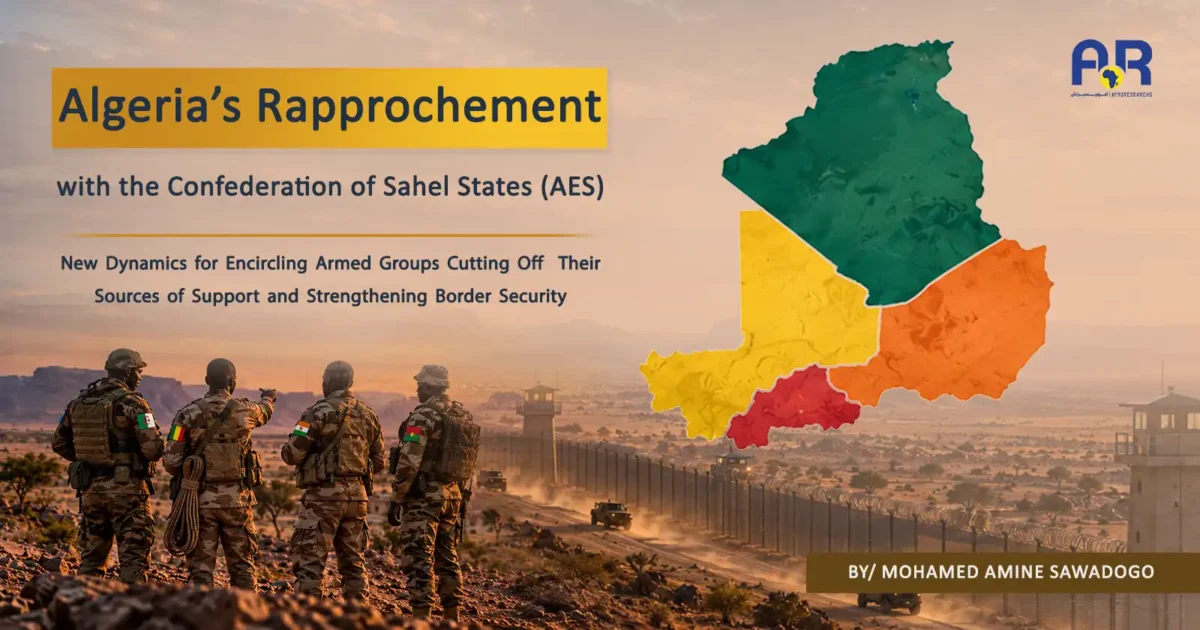
Algeria’s rapprochement with the Confederation of Sahel States (AES) is no longer merely a passing diplomatic initiative; it has become a strategic necessity dictated by geography and the interdependence of security and political interests between Algeria and the Confederation’s three member states: Burkina Faso, Mali and Niger.
In a region where terrorist threats intersect with organized crime, smuggling networks and border disputes, rebuilding trust and strengthening regional coordination emerge as two essential avenues for regaining the security initiative, narrowing the operational space available to armed groups and limiting their ability to exploit gaps in border security.
Algeria’s relations with the Sahel states experienced a sharp deterioration following the crisis of April 2025, before signs of a thaw began to emerge in early 2026, with the resumption of Algerian–Nigerien rapprochement and the expansion of areas of cooperation, followed by the restoration of diplomatic relations between Algeria and Mali in July 2026. These developments demonstrate that geopolitical and security interests continue to exert pressure towards overcoming disagreements, although political reconciliation does not necessarily mean that the causes of tension have disappeared or that their repercussions have ended.
This subject can be understood through the following premises:
First: Geography Necessitates Political and Security Rapprochement:
Algeria recognizes that the security of its south is inseparable from the stability of Mali, Niger and the wider Sahel region. The Confederation’s states likewise recognize that confronting armed groups cannot achieve sustained success as long as their shared borders remain open spaces for armed organizations of diverse nationalities, orientations and allegiances, as well as smuggling and supply networks.
Accordingly, rapprochement between the two sides should not be viewed solely through the lens of bilateral relations, but as an opportunity to reconnect the security space linking the northern and southern Sahel, and to close the gaps that armed groups exploit to move, regroup and strengthen their logistical capabilities.
Algeria shares extensive land borders with both Mali and Niger, exceeding 1,300 kilometres with the former and reaching approximately 1,000 kilometres with the latter. From a geopolitical perspective, this expanse of shared borders constitutes a contiguous vital space (Contiguous Security Space), meaning that any security vacuum on the Malian or Nigerien side can directly affect Algeria’s strategic depth and national security, and vice versa. This geographical interconnectedness has led both sides to recognize the difficulty of controlling borders unilaterally, necessitating technical and military rapprochement to establish what may be described as a shared “geographical shield”.
The physical geography of northern Mali and southern Niger is characterized by a vast and complex desert expanse, interspersed with rugged terrain and open spaces that are difficult to keep under continuous surveillance. For many years, this topography has provided a favorable environment for the movement of terrorist organizations, transnational organized crime networks, and networks trafficking in arms and people.
The current rapprochement therefore centers on closing the geopolitical vacuums that armed movements have exploited to maneuver across borders. Its primary objective is to strengthen operational and logistical coordination and transform geography from a “vulnerability” and potential corridor for armed groups into a shared “zone of control”, subject to coordinated intelligence, security and military surveillance.
Second: Shared Interests Necessitate Security and Intelligence Coordination between Algeria and the AES Union States:
The true strategic value of this rapprochement lies in translating political reconciliation into tangible operational cooperation, encompassing intelligence sharing, coordinated border surveillance, stronger communication channels between security and military leaderships, and the pursuit of terrorist financing, supply and smuggling networks.
During the Nigerien president’s visit to Algeria in February 2026, Algeria and Niger agreed to reactivate border monitoring mechanisms and coordinate counterterrorism strategies. The restoration of diplomatic relations between Algeria and Mali in July of the same year also opened a new window for rebuilding trust among the parties concerned.
1- Algerian–Nigerien Relations: Rapid Rapprochement and a Transition to Military Partnership:
Following a period of political estrangement and strained relations against the backdrop of withdrawals and the recall of ambassadors, Algerian–Nigerien relations witnessed a notable thaw, followed by an official return to diplomatic cooperation and coordination.
The president of Niger, General Abdourahamane Tiani, paid an official visit to Algeria that helped create conditions conducive to overcoming disagreements. This was followed by high-level visits aimed at exchanging support and expanding cooperation on development and energy issues.
As part of the development of military cooperation following President Tiani’s visit, the Republic of Niger’s Minister of National Defense, Army General Salifou Modi, undertook a series of successive, intensive official visits to the Algerian capital during October 2026. These focused on strengthening military and security cooperation and securing the shared borders. Reports indicated that he arrived on 13 October 2026, when he held meetings and discussions addressing security along the border and security developments in the Sahel. Further visits took place between 20 and 21 October 2026, approximately one week after the first visit.
The meetings between the Nigerien defense minister and Army General Saïd Chengriha, Chief of Staff of the Algerian Army, culminated in the signing of a new strategic agreement protocol on military and security cooperation, intended to secure the borders and counter terrorist threats.
2- Algerian–Malian Relations: From Diplomatic Crises to the Resumption of Dialogue and Coordination:
Relations between Bamako and Algiers experienced severe crises and diplomatic tensions, including the suspension of the peace agreement, border crises and the closure of airspace to aviation. Both sides nevertheless recognized that the requirements of security stability along their shared borders necessitated continued negotiation and communication, paving the way for the reopening of airspace, the resumption of diplomatic relations and the exchange of ambassadors.
In this context, Algerian–Malian relations witnessed high-level diplomatic engagement and an exchange of official visits between senior officials of the two countries, with the aim of turning the page on disagreements and entering a new phase of cooperation and coordination.
Intensive contacts between the leaderships resulted in high-level official visits, most notably that of the Prime Minister and Head of Government of the Republic of Mali, General Abdoulaye Maïga, to the Algerian capital on 24 August 2026, accompanied by the Minister of Foreign Affairs and Intelligence. He was received at Houari Boumediene International Airport by Algerian Prime Minister Sifi Ghrieb. The visit formed part of an official working mission, heading a government delegation that included senior Malian officials, to activate direct dialogue and seek common ground for resolving disagreements.
In return, Algerian Prime Minister Sifi Ghrieb paid an official visit to the Malian capital, Bamako, on 14 September 2026, accompanied by a high-level delegation that included the Secretary-General of the Ministry of Foreign Affairs, Lounès Magramane, and several security and military officials.
The visit focused on giving practical effect to the new dynamic in bilateral relations, deepening historical ties, examining security issues along the border, and strengthening security coordination to combat cross-border armed groups, alongside developing economic cooperation and supporting shared development between the two countries.
These relations developed in the aftermath of the Malian army’s recapture of the strategic city of Kidal in October 2026, after it had been controlled by several separatist forces. In early October 2026, the Malian army succeeded in entering Kidal and reasserting its control following the withdrawal of the Azawad movements and their retreat towards surrounding pastoral and mountainous areas.
The city had fallen to those movements in April 2026, when the “Azawad Liberation Front”, acting in coordination and in parallel with other armed groups, launched a large-scale offensive through which it regained control of Kidal and strategic positions in the north of the country.
If these steps are accompanied by practical coordination with the unified force of the Confederation of Sahel States, whose launch was announced in December 2025, the capacity of the region’s states to close gaps in border security and restrict armed groups’ freedom of movement may be strengthened.
Third: Tightening the Pressure on Armed Groups and Dismantling Them:
Armed groups benefit from weak coordination between states, the vastness of border areas, and their ability to move personnel, equipment and resources across areas that are difficult for any single state to monitor fully. Any serious security rapprochement between Algeria and the Confederation’s states would therefore narrow these spaces and limit the groups’ ability to maneuver, reposition and secure their supply lines.
A tightening of pressure on terrorist armed groups has been observed, particularly in the African Sahel, including Burkina Faso, Mali and Niger, where the region is undergoing dramatic security and military transformations. These countries are experiencing a dual war: one that depletes armed groups through infighting, and another waged by the regular armies of the Confederation of Sahel States to impose a blockade on them and constrain their operational and economic activities.
Conflict monitoring organizations, such as ACLED, have recorded more than 300 direct confrontations between the terrorist organizations ISIS and Jama’at Nusrat al-Islam wal-Muslimin along the border between Burkina Faso and Mali, and in regions and areas such as Ménaka, Séno and the outskirts of Koro. These confrontations have resulted in thousands of deaths and injuries on both sides, depleting the two organisations’ cadres and weakening their ability to carry out joint offensive operations.
Meanwhile, the armed forces of Burkina Faso, Mali and Niger, coordinating with one another and receiving operational and logistical support from their allies, are pursuing a multidimensional strategy intended to choke off these groups’ capabilities and curtail their influence. The authorities in the three countries have also launched extensive campaigns to tighten control over artisanal gold mining sites, bombarding some or subjecting them to regulatory and security restrictions, because some of these sites represent an important source of funding for armed organisations, which use the proceeds to purchase weapons and recruit young people.
Armed groups in the African Sahel are experiencing a state of dual exhaustion: on the one hand, they are being eroded internally by fierce and bloody wars between al-Qaeda and ISIS over influence and resources; on the other, they face encirclement and continuous pursuit under the coordinated security and military strategies implemented by the governments of Burkina Faso, Mali and Niger.
The leaders of the four countries—Burkina Faso, Mali, Niger and Algeria—alongside the other countries of the region, including Morocco, have recognised that strategic strangulation cannot be achieved through military operations alone. It also requires cutting off supply and financing networks, strengthening the state’s presence in remote areas, protecting civilians, developing intelligence cooperation, and addressing the local conditions that extremist groups exploit to expand their influence.
Fourth: Cracking Down on Unregulated Gold Prospecting in Southern Algeria:
The military operations conducted by the Algerian armed forces to address unregulated and illegal gold prospecting in Algeria’s far south and border areas form part of a comprehensive strategy in which security, economic and sovereignty dimensions intersect, similar to the military operations carried out by Mali, Burkina Faso and Niger.
The main objectives and principles governing these operations can be summarized as follows:
1- Protecting National Sovereignty and National Security:
The main prospecting areas lie in a vast desert and open border regions adjoining countries affected by security fragility, such as Mali and Niger. The Algerian army seeks to prevent cross-border infiltration and unlawful incursions into national territory.
Unregulated prospecting is frequently intertwined with smuggling networks, arms trafficking, irregular migration and armed groups active in the African Sahel, making efforts to address it part of a broader system for safeguarding national security.
2- Protecting National Wealth and Natural Resources:
The Algerian authorities consider the illegal extraction of gold and precious minerals to constitute a depletion of the country’s wealth and mineral resources outside official licensing and legal oversight. Military and security efforts also aim to shut down black-market outlets and confiscate equipment, heavy machinery and electricity generators that are brought into and used in the desert unlawfully.
3- Regulating the Sector and Integrating Young People into Economic Activity:
Alongside security measures, the Algerian government has launched programs to organize and regulate artisanal gold exploitation through the establishment of microenterprises (PME) and accredited local youth-led companies that undertake excavation and gold extraction under the supervision of the Ministry of Mines. Under this legal framework, prospecting activities conducted outside the approved official system are deemed unlawful and subject to legal action.
4- Protecting the Environment and Ecological Balance:
Unregulated prospecting operations destroy desert ecosystems and may involve the use of hazardous chemicals, such as mercury and cyanide, in gold extraction, threatening groundwater and the local environment and necessitating intervention by the authorities to limit these harms.
Official reports and the Algerian Ministry of Defence consistently emphasise that operations to pursue and confront prospecting groups in closed military and border areas are intended to enforce the law, combat transnational crime and ensure the security of national territory.
Fifth: Consensus on Rejecting Projects to Partition the Countries of the Region:
“National territorial unity and territorial integrity” constitute a fundamental pillar and a shared red line for Algeria, Mali and Niger, given that these countries share vast desert expanses, cross-border demographic and tribal structures, and intertwined historical and geopolitical challenges that expose them to the risks of partition and fragmentation.
The following offers an analytical reading of the dimensions of this shared concern and of how strategic necessity and converging interests have compelled cooperation among these countries in confronting separatist groups and threats to their territorial unity and stability.
1- The Spectre of Partition and Dismantlement: A Shared Existential Threat:
The security approaches of the three states converge on protecting the unity and continuity of the state against projects to redraw the map of the Sahel–Sahara region.
In Mali, recurrent separatist conflicts in the north, particularly in the territory that the Azawad movements call “Azawad”, with their stronghold centred on Kidal and its surroundings, represent one of the foremost challenges to the state’s unity and territorial integrity. According to this interpretation, these movements seek to undermine Bamako’s central authority, benefiting from regional and international support networks.
Algeria, for its part, bases its position on its historical memory and geopolitical calculations, adhering to a doctrine that regards “territorial unity as a red line”. Given its central position in the region, it recognises that any dismantlement of neighbouring states, particularly Mali and Niger, could trigger a direct security shock threatening its vast southern borders, alongside its historical rejection of projects aimed at establishing micro-entities on ethnic or tribal grounds in the region.
In Niger, the state faces challenges related to the fragility of certain northern and eastern border areas, alongside the risks posed by insurgent movements and the possibility that regional and international powers may exploit the issue of marginalised regions to weaken central authority.
2- Converging Interests: Why Has Cooperation Become an Unavoidable Necessity?
The leaders of the three countries have recognised that the risks of partition spare no capital, and that adopting a policy of “solidarity-based national security” constitutes one of the principal avenues for protecting states and strengthening their stability.
The visions of Algeria and the Confederation of Sahel States, comprising Mali, Burkina Faso and Niger, converge on the need to seek national solutions rooted in the region’s realities and the interests of its peoples, free from external dictates and international interventions that some parties accuse of overlooking separatist tendencies or using them to exert pressure on African states.
Moreover, any security vacuum in northern Mali or along Niger’s borders can be exploited by separatist and terrorist groups to move freely and expand their influence. Military cooperation and operational coordination, including successive visits by defence ministers and chiefs of staff, have therefore become essential instruments for closing avenues available to these movements and reducing their ability to exploit political disagreements among the region’s states.
3- Towards a New Regional Security Doctrine:
The region is witnessing a qualitative shift in its approach to partition and secession. Algeria, through its regional diplomacy, and Mali, Burkina Faso and Niger, whose governments have placed national sovereignty at the forefront of their priorities, are moving towards an integrated vision: the security of the region’s states is interconnected, and the security of Mali, Burkina Faso and Niger forms an indivisible whole.
Constraining separatist and armed groups and reasserting state sovereignty over the entirety of national territory are no longer merely political choices. They have become a strategic necessity imposed by security and geopolitical challenges, to protect these states’ stability and the future of their generations from the risks of fragmentation and partition.
Despite the importance of this rapprochement, the road ahead is not without challenges. Algeria and the Confederation’s states need to overcome the legacy of past disagreements, respect state sovereignty and territorial integrity, and establish clear understandings on border management and responses to shared threats.
The success of this process should also be understood as cooperation aimed at protecting regional security and preventing armed groups from exploiting political disagreements among the region’s states, rather than as an alignment against another regional state. The broader the channels of coordination and the stronger mutual trust become, the fewer opportunities there will be to exploit divisions in the service of armed agendas.
In concluding this article, I argue that Algeria’s rapprochement with the Confederation of Sahel States represents a strategic opportunity to rebuild the regional security system on the basis of shared interests, practical coordination and respect for national sovereignty. Its importance lies in its potential to connect Algerian efforts with the capacities of the Confederation’s states, restrict the routes available to armed groups and strengthen the security of shared borders.
Despite this aspiration, the true measure of the rapprochement’s success will not be the number of reciprocal visits or joint statements, but what it achieves on the ground in terms of effective security coordination, a reduction in armed groups’ capacity to move and resupply, and a tangible improvement in the security of populations and the stability of border regions. Geography and shared security interests necessitate cooperation, but political will and operational effectiveness are what transform it into sustainable strategic outcomes.
The recent rapprochement between Algeria and Bamako, Niamey and Ouagadougou is not merely a temporary diplomatic shift. It represents a response dictated by geographical imperatives and interlocking security and strategic interests. Geographical and border interconnectedness makes the stability of the three states an interdependent equation: either border security is managed collectively and in coordination, or the parties share the consequences of cross-border disorder.